
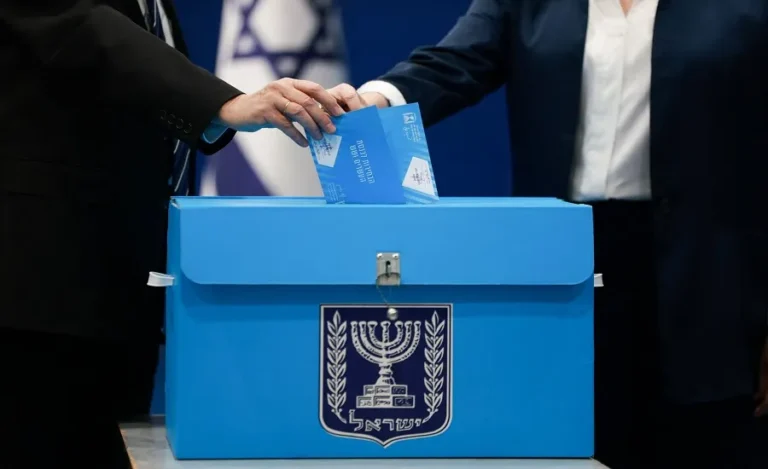
Israel’s election of 27 October 2026 resembles a setback for Netanyahu, and a challenge for democracy
THE just-concluded elections may have weakened Benjamin Netanyahu’s grip on power. Exit polls suggest that his bloc could fall short of a parliamentary majority, while the two Arab-led parties could win around 18 of the Knesset’s 120 seats. If confirmed, these results would give Arab representatives significant leverage in negotiations over Israel’s next government.
The contradiction is striking. Netanyahu warned supporters about high Arab voter turnout, yet that mobilisation may have strengthened the parliamentary position of the very citizens whose political influence he sought to portray as threatening.
The election therefore raises a question that extends beyond Netanyahu’s political survival: can a democracy recognise minority citizens as equal participants when their votes threaten the power of the governing majority?
It also exposes a wider problem in contemporary nationalism: the selective application of anti-racism, particularly when political alliances are built around defending one community while casting another as a threat.
Netanyahu’s limits and the limits of his defeat
Netanyahu has long presented himself as Israel’s indispensable leader, invoking national security and regional instability to justify his political dominance. His opponents have challenged that claim, pointing to the security failures preceding the Hamas-led attacks of 7 October 2023, the conduct of the subsequent wars, his dependence on far-right coalition partners and concerns about democratic accountability.
The election suggests that security rhetoric may no longer be sufficient to sustain his leadership. Voters can support a strong security policy while rejecting the politician, coalition or governing priorities associated with it.
But a Netanyahu setback should not be mistaken for a wholesale rejection of Israeli nationalism. Opposition parties include politicians who favour hard-line security policies and oppose Palestinian statehood. A change of government could therefore alter Israel’s leadership without fundamentally changing its approach to Palestinians or its conception of national security.
The immediate significance is narrower but still substantial: Netanyahu’s claim to political indispensability has been challenged. Whether that challenge becomes a change of government will depend on the final results and the coalition negotiations that follow.
The defeat of a leader, however, is not necessarily the defeat of the politics that sustained him.
Arab representation without equal political legitimacy
If the exit-poll projections are confirmed, the Arab-led parties would hold approximately 15 per cent of the Knesset’s seats. In a parliament where 61 seats constitute a majority, their support could become consequential.
Yet parliamentary representation does not automatically confer governing power. Jewish-led opposition parties may be unwilling to form a government dependent on Arab representatives, while disagreements over security and other policies could complicate cooperation.
Not every objection to a coalition with Arab parties is necessarily racist. Political differences are legitimate. The deeper problem arises when Arab representatives are treated as inherently unacceptable partners because of their ethnic or national identity rather than their policies.
Netanyahu’s warnings about Arab turnout bring this distinction into sharp focus. Voting is a fundamental expression of citizenship, not a threat to democracy. When minority participation is condemned because it might change the political balance, democratic legitimacy is effectively made conditional on producing an acceptable result.
This is the central contradiction of the election: Arab citizens may gain the parliamentary numbers to influence the next government while still facing resistance to exercising that influence.
Nor should the Arab electorate be treated as politically uniform. Its parties have distinct constituencies and priorities, and their electoral success does not automatically establish a majority for Palestinian statehood or a rejection of Israel’s security policies.
The essential test is whether Arab representatives are treated as legitimate political actors in their own right. Formal voting rights mean less if the political system continues to place practical limits on the influence those votes can exercise.
The Jekyll-and-Hyde politics of selective anti-racism
The Jekyll-and-Hyde metaphor captures a familiar political contradiction: condemning prejudice against one community while tolerating discrimination against another.
In Israel’s case, this requires holding two principles together. The history of antisemitism and the continuing need to protect Jewish communities are real. So are the rights of Arab citizens to equal treatment and meaningful political participation. Recognising one does not require diminishing the other.
The distinction matters because legitimate security concerns can become a justification for collective suspicion, particularly when ethnic or national identity is treated as evidence of disloyalty. A citizen’s political legitimacy should not depend on belonging to the majority or endorsing its preferred national narrative.
The different legal and political circumstances of Arab citizens of Israel and Palestinians living under occupation or blockade must also be recognised. They are not interchangeable categories. Nevertheless, the principle remains consistent: neither ethnicity nor religious identity should serve as a substitute for individual political judgment or equal human dignity.
The election puts that principle to a practical test. If Arab votes are welcomed as evidence of democracy only when they do not threaten the existing balance of power, equality remains more formal than substantive.
This contradiction is not confined to Israel. It also shapes the relationship between Netanyahu’s political project and parts of Europe’s far right.
Israel and Europe’s far right: Allies, contradictions and political expediency
Several European far-right movements have sought closer relations with Israel while presenting themselves as defenders of a supposedly shared Judeo-Christian civilisation against Muslim immigration and cultural change.
The relationship offers advantages to both sides. European nationalist parties can use their association with Israel to claim international legitimacy, while Israeli nationalist politicians can cultivate allies who support their security policies and opposition to political Islam.
But the alliance raises an obvious question: can a movement credibly claim to defend Jewish communities while tolerating antisemitism within its own ranks or promoting hostility towards Muslims and Arabs?
Support for Israel does not, by itself, demonstrate that antisemitism has been overcome. Nor does opposition to antisemitism justify anti-Muslim or anti-Arab prejudice. A consistent opposition to racism must apply across communities, rather than becoming a tool for legitimising hostility towards a politically disfavoured group.
Netanyahu’s possible departure could bring renewed attention to these alliances, but it would be premature to assume that his electoral setback will weaken Europe’s far right. These movements have domestic constituencies and political incentives that extend well beyond their relationships with Israel.
The more important issue is the standard by which their conduct is judged. If prejudice is condemned when directed at one community but excused when directed at another, anti-racism becomes a selective political instrument rather than a democratic principle.
Defeating a leader is not defeating an ideology
Israel’s election may have weakened Netanyahu while increasing the parliamentary importance of Arab citizens. If the exit-poll projections hold, Arab-led parties could become influential in coalition negotiations even as other parties’ resist relying on their support.
That is the election’s central democratic test: whether a minority can exercise meaningful political influence without having its legitimacy questioned simply because of its identity.
A change of government would not, on its own, resolve this contradiction. Nor would it necessarily transform Israeli policy towards Palestinians, dismantle the influence of the far right or settle the tensions between national security and democratic accountability.
The same caution applies to Europe. Netanyahu’s political fortunes are not a reliable measure of the strength of European nationalist movements, and closer scrutiny of their alliances will not, by itself, eliminate antisemitism or anti-Muslim hostility.
The broader lesson is nevertheless clear. Democracy requires more than elections and parliamentary arithmetic. It requires consistent standards of political legitimacy, equal citizenship and accountability—standards that apply to allies and opponents alike.
The Jekyll-and-Hyde problem is not simply that politicians contradict themselves. It is that they invoke universal principles while reserving their protection for selected communities.
Netanyahu may lose power. Whether the politics of exclusion lose ground is a different question.
_____________


Ranjan Solomon is a writer, researcher and activist based in Goa. He has worked in social movements since he was 19 years of age. The views expressed here are the author’s own and Clarion India does not necessarily share or subscribe to them. He can be contacted at ranjan.solomon@gmail.com