

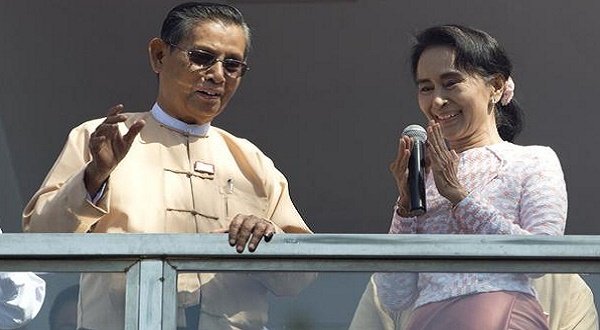
YANGON (Reuters) — The acting chairman of Myanmar’s ruling party conceded defeat to Aung San Suu Kyi’s opposition on Monday and said he would accept the result of the country’s first free national election in 25 years.
“We lost,” Union Solidarity and Development Party (USDP) leader Htay Oo told Reuters in an interview.
The vote count is still under way and no results have been officially announced, but preliminary reports from around the country indicate a wide margin of victory for Suu Kyi’s National League for Democracy (NLD).”We have to find out the reason why we lost,” Htay Oo, a close ally of President Thein Sein said. “However, we do accept the results without any reservations. We still don’t know the final results for sure.”
Htay Oo said he was surprised by the scale of his defeat in his own parliamentary constituency in Hinthada, in the delta region, considered the heartland of the USDP’s rural support base.
“I wasn’t expecting it because we were able to do a lot for the people in this region.” he said. “Anyway, it’s the decision of the people.”
The Southeast Asian nation went to polls on November 8 in what was touted to be its fairest election in decades.
Here’s a timeline of the country’s turbulent political past:
| 1988: Disastrous economic mismanagement and political repression see Burma erupt in protest. The military responds brutally, killing an estimated 3,000 people. Suu Kyi emerges as a key Opposition leader. |
| 1990: Suu Kyi’s National League for Democracy wins a landslide victory in elections but the result is ignored by the military who launch a new crackdown. Suu Kyi is placed under house arrest. |
| 1991: Suu Kyi wins the Nobel Peace Prize while under house arrest. |
| 1992: General Than Shwe becomes the new junta chief. |
| 2005: A new isolated city Naypyidaw (“Abode of Kings”) is revealed as the country’s capital. |
| 2007: Major protests partially led by Buddhist monks, dubbed the “Saffron Revolution,” break out over the summer. Junta eventually responds once more with violence. |
| 2010: Junta holds elections in early November and the military-backed Union Solidarity and Development Party claims victory. NLD and many other parties refuse to take part. Observers do not consider the poll free or fair. Less than a week later, Suu Kyi is released. |
| 2011: In a surprise move, the junta relinquishes power to a quasi-civilian government under former General Thein Sein, who pursues reforms. Many basic rights are restored, including the lifting of restrictions on assembly and expression. Hundreds of political prisoners are freed. |
| 2012: NLD wins 43 out of 45 seats in April by-elections. Suu Kyi becomes an MP. The United States and the European Union begin lifting sanctions and Western businesses start flocking to the country. Sectarian violence flares in western Rakhine State, mainly aimed at the Rohingya Muslims. |
