

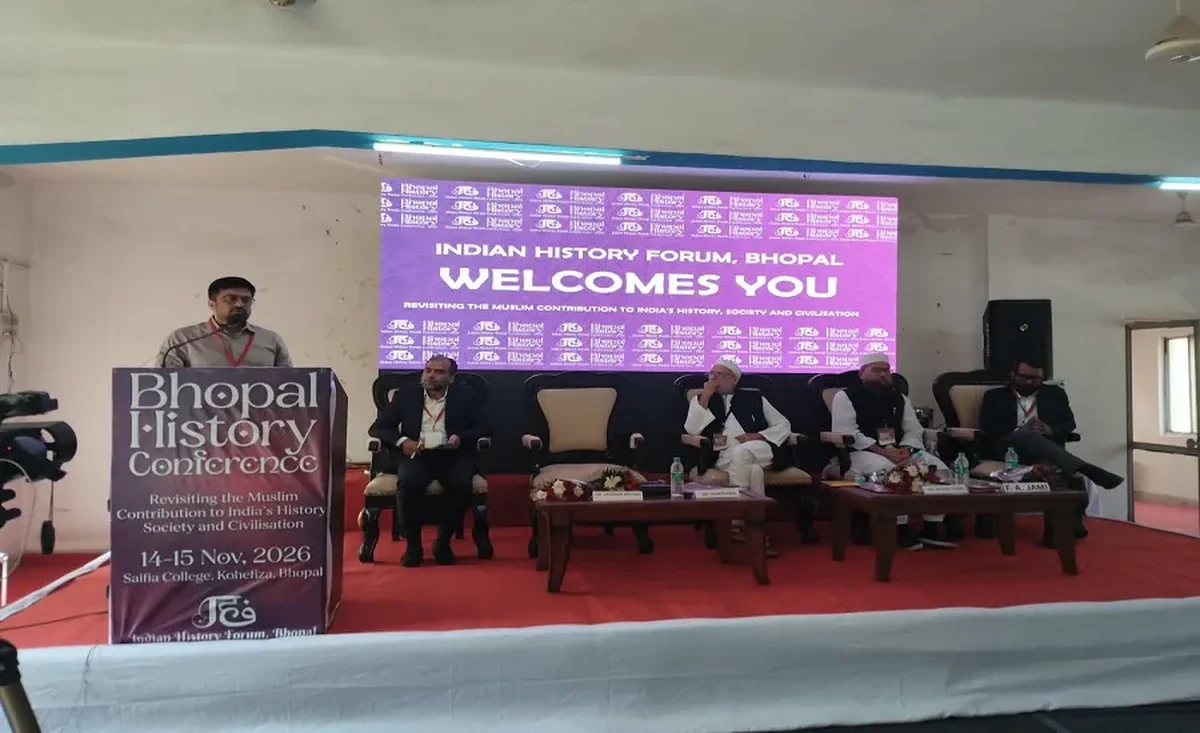
BHOPAL — History should be understood through authentic sources, documents, and research, rather than viewed from the perspective of any one religion, community, or political ideology, emphasised speakers as the Bhopal History Conference concluded here on Sunday.
The two-day conference stressed that history is not merely a collection of past events, but a crucial foundation for a society’s identity, collective memory, and future direction.
Renowned historians, journalists, writers, and academics at the event addressed important topics such as a reassessment of Indian history, impartiality in history writing, the role of media and films, the socio-economic achievements of medieval India, and the country’s shared cultural heritage.
The Role of the Media
Senior journalist Parvez Bari spoke extensively on the social understanding of history and the role of the media in constructing historical narratives. He stated that the media plays a crucial role in shaping the perception of history in society. Presenting historical events in a specific way can influence the opinions and thinking of the general public, he said.
“Portraying victory as an invasion, repeatedly depicting a historical figure as a hero or villain, and constantly repeating the same claim on social media can establish it as truth in the minds of people,” he said.
He questioned the presentation of the history of Muslim rulers as limited to the destruction and looting of temples. He said that the alliances, cooperation, and good relations between Hindu and Muslim rulers should also be made part of public discourse.
Parvez Bari pointed out five major problems in the media’s presentation of history—misrepresentation of historical events, selective reporting, repetition of the same narrative, emotionally influencing people, and dividing historical figures into heroes and villains. He also identified the misuse of photographs and the division of history along religious lines as serious problems.
He said that in the study of history, the question of who wrote it, for whom, and from what perspective is crucial. In a society where history is viewed from a political perspective rather than for understanding, social unity and collective bonds begin to weaken.
Writer and journalist Daya Shankar Mishra expressed sharp views on the current state of the media and its role in democracy. He began his address with a quote from Munshi Premchand: “Will you not speak the truth for fear of harm?”
He said that in the fight for truth, people step back for small gains. According to him, a large part of the Indian media has today deviated from its independent and accountable role. He alleged that a segment of the media is acting like an extension of the IT cell and has failed to fulfil its fundamental responsibility of questioning the government.
He stated that the media’s role is not to act as an opposition, but rather to act as an impartial referee in a democracy, questioning both the ruling party and the opposition and presenting the facts to the public. He expressed concern over the lack of newspapers questioning the government in the last 12 years. He also raised questions about the acquisition of media institutions, pressure, and media independence.
He questioned the media’s reporting on incidents of mob lynching, asking, “If the Indian media is truly independent, why does such incidents not receive adequate coverage?” He said that if big media organisations avoid speaking and writing about the atrocities against Muslims, then it is natural to question their journalistic role and the role of films. He stated that numerous examples exist in public discourse of how historical facts are presented wrongly. He emphasised the need to verify historical facts, citing claims such as Jawaharlal Nehru’s love for Babur and the Taj Mahal being built after demolishing a Shiva temple.
Mishra stated that the media has often portrayed Muslims as the primary villains, creating an environment that justifies violence and action against them. He stated that today’s young generation, especially Gen-Z, who are raising their voices on every issue, are the true representatives of democracy. He also appealed to the public to boycott media that fails to fulfil its democratic responsibility.
Distortion of History Through Films
Aditya Menon, Political Editor of The Quint, highlighted the role of the media in the distortion of history in India. He said that numerous examples exist in public discourse of how historical facts are presented inaccurately.
He said that while some Muslim rulers destroyed temples, history also highlights instances of Hindu Maratha rulers damaging temples. Many times, such actions were not based on religious grounds, but rather on political conflicts, plunder, or the purpose of weakening local rulers. Therefore, it is not appropriate to view every historical event solely through a religious lens.
He stated that when filming history learned from books, it is often mixed with fiction and propaganda, becoming a means of spreading hatred. He also mentioned the death of Krishna Bhaskar Kulkarni in the context of Afzal Khan and emphasised the importance of highlighting all aspects of historical events.
Referring to the film Bajirao, he said that historical figures are often associated with political and ideological terms that do not accurately reflect the true thoughts and circumstances of the era. He stated that propaganda-based films are promoted, while films that reveal real facts are often banned or censored.
Referring to the concept of ‘Monopoly of Victimhood,’ he said that attempts are also made to determine which community should be portrayed as the victim and which as the perpetrator. He said that fabricating lies is easy, but providing a factual answer is difficult. We must challenge the darkness surrounding us.
Attempts to Erase History
Parvez Nazir from the Department of History, Aligarh Muslim University (AMU), began his talk with a line from a famous couplet by Faiz Ahmed Faiz—”This time too will pass.”
He said that there have been many reasons for the cultural decline of various nations across the world. Some nations recognise challenges early and address them, while others raise questions too late. “Today, we face economic, political, and cultural challenges. If our response is strong, we will be able to meet these challenges; otherwise, we may slide into decline,” he said.
The academic said attempts are being made to erase history and change its narrative, but through initiatives like the History Forum, historical contributions and services will be remembered. Referring to the “Satyameva Jayate” inscribed on the national emblem, he said that truth will prevail.
He appealed not to despair and to pass on our history from generation to generation. He stated that the Muslim community has played a significant role in advancing India in the fields of science and technology. Muslim rule also played a role in the development of trade, agriculture, culture, and the industrial system.
He pointed out that India played a significant role in maritime trade and shipbuilding. “The primary objective of British rule was to transport India’s wealth to Europe. Tipu Sultan made significant efforts to transform Mysore into an industrial hub. He promoted sericulture and took numerous steps to improve agriculture and the prosperity of farmers,” he said.
Referring to Sher Shah Suri’s contributions to road construction, Parvez Nazir discussed the Grand Trunk Road, inns, police stations, and facilities for travellers. He explained that during that period, special attention was paid to the monetary system, market control, military management, and irrigation system, ensuring the well-being of farmers and merchants.
Economic Prosperity in Mughal India
Rafiullah Azmi, Head of the Department of History, Maulana Azad National Urdu University (MANUU), Hyderabad, elaborated on the Mughal Empire’s economic prosperity and the contribution of its infrastructure development.
He stated that India, at one point in its rich history, accounted for approximately 24 per cent of the world’s economy. Referring to the Mughal Empire’s administrative and economic system, he emphasized that infrastructure plays a crucial role in the strength of any empire.
He discussed Mughal-era highways, royal routes, and the transportation system connecting various parts of the empire. He stated that inns were not merely places for travellers to stay, but were part of a vital system of transportation, hospitality, trade, and administrative oversight.
Referring to the important ports and maritime trade of the Mughal period, he explained that roads, ports, inns, and trading centres together formed a comprehensive economic network. This integrated infrastructure played a crucial role in promoting trade, movement, and economic activity.
He stated that to understand the economic power of Mughal India, it is not enough to study only the rulers and wars; it is also necessary to study the trade system, transportation, administration, and infrastructure of that time.
Advance Research, Dialogue, and Shared Heritage
Dawood Ibrahim, Assistant Professor, Department of History at MANUU, also participated in the conference.
Speakers in various sessions of the two-day conference emphasised that Indian history should be viewed free from communal divisions and political propaganda. It is essential to study each period of history within its social, economic, cultural, educational, and political contexts.
They emphasised that universities, research institutions, libraries, media, and social organisations must work together to disseminate historical facts to the new generation. Fact-checking historical information disseminated in films and on social media is also essential.
The core message of the conference was that India’s history is not the heritage of any one community, but a shared trust of all citizens. It is our collective responsibility to pass it on to future generations with impartiality, research, and mutual respect.
