

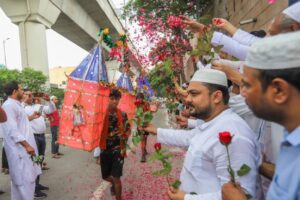
IN present-day India, even as the vise of state and social oppression tightens further around the minority Muslim population, a segment of this very minority is rolling out the red carpet to felicitate and honour the religious symbols of the dominant majority. These sycophantic gestures include showering flower petals on the Kanwar Yatra, welcoming Ram Navami and Ganesh Utsav processions, and decorating Durga Puja pandals.
This contradiction is not a passing or superficial occurrence. It is a tragic reflection of a deep psychological, political, and theological crisis whose stormy waves are shaking Indian Muslim society to its core. To dismiss this behaviour with naive labels like “tolerance,” “interfaith brotherhood,” or “service to humanity” is to play hide-and-seek with the real issue.
The reality is that these acts are not expressions of a reciprocal relationship based on equality. They are a profound tragedy born of intellectual misconceptions, the erosion of religious boundaries, and a desperate quest for political survival in an atmosphere of fear.
An examination of political psychology and the behaviour of subjugated nations makes this clear: when a minority is subjected to systematic violence, legal injustice, economic boycott, and a constant sense of insecurity over a prolonged period, survival mechanisms develop that may appear moral on the surface but are fundamentally driven by fear and a psychology of submission. In this prejudiced atmosphere — where houses are demolished through bulldozer politics, hopes for justice from the judiciary are suffocating, and mob violence has become a routine social norm — showering flowers on Kanwar Yatris, grandly welcoming religious yatras, and lining up to lay floral wreaths for the majority processions is not the free choice of a sovereign and equal community. Rather, it is a subconscious defensive tactic to appease the dominant force. In psychological terms, this is called “obedience born out of fear” or “the victim’s psychological attachment to the aggressor.”
In contemporary political psychology, it is also described as internalised oppression and Stockholm Syndrome. Under these conditions, the victim embraces the religious and social symbols of the aggressor to escape ongoing atrocities, seeking a guarantee of temporary safety. This attitude does not represent interfaith harmony. It is an admission of political and collective helplessness resulting from the erosion of constitutional safeguards. When the state fails to provide equal rule of law to all its citizens, a subjugated minority — instead of striving to reclaim its legal rights — is forced to beg for its existence through religious appeasement of the dominant community, vainly wrapping this temporary refuge in the attractive shroud of “brotherhood.”
Cultural Hegemony
Italian philosopher Antonio Gramsci’s theory of cultural hegemony demonstrates how the dominant power instills in the minds of the subjugated group the idea that showing reverence to the dominant power’s religious symbols is the only “normal” behaviour. At this precise point, it becomes immensely critical to understand the clear theological and intellectual demarcation that exists within Islam’s civilisational and moral framework between “service to humanity” (Khidmat-e-Khalq) and “reverence towards the symbols of disbelief” (Ta’zeem-e-Sha’a’ir-e-Kufr). Islamic jurisprudence and monotheistic teachings establish a very subtle yet firm distinction between Mudaarat (courtesy, good manners, and diplomatic prudence) and Mudaahanat (compromising on faith and monotheism). Treating non-Muslims with kindness, moral chivalry, assisting them in times of need, and protecting their human rights constitutes Mudaarat — which is not only permissible but highly commendable. Islam’s moral philosophy is built upon fulfilling the basic needs of every human being without distinction of religion or creed, helping the poor, offering water to the thirsty, and standing by the oppressed. A study of the Prophet Muhammad’s biography (Seerah) reveals that even before his commission as a prophet, his life was adorned with magnificent virtues such as maintaining family ties, bearing the burdens of the destitute, earning for the helpless, and showing hospitality to guests. At the time of the first revelation, the Mother of the Believers, Hadrat Khadijah cited these very noble traits to reassure his blessed heart, noting that Allah would never humiliate such a benefactor of humanity.
However, this very moral system of Islam draws an insurmountable dividing line between serving humanity and honouring polytheistic rituals. Qur’anic teachings explicitly command goodness and fairness toward non-Muslims, provided they were not fighting against the Muslims on account of religion:
“Allah does not forbid you from those who do not fight you because of religion and do not expel you from your homes — from being righteous toward them and acting justly toward them. Indeed, Allah loves those who act justly.” (Surah Al-Mumtahanah: 8)
Unequivocal Mandate of the Qur’an and Sunnah
But sacrificing one’s religious principles, monotheistic foundations, or belief boundaries to please the dominant majority falls under Mudaahanat, which is religiously forbidden (Haram). Regarding religious symbols, the mandate of the Qur’an and Sunnah is unequivocal: veneration of disbelief and polytheism (Kufr and Shirk) or active participation in their religious rites is impermissible. Assisting any individual as a fellow human being — if they are weary from travel, sick, or in need of food and water — is a civilisational and moral duty carrying immense reward, without any distinction of religion. However, showering flowers upon the Kanwar Yatra or other similar polytheistic practices is not merely assisting an ordinary human journey or transit of travellers; it is a fundamental ritual of a specific religious belief, organised within a psychological and political context to display the dominance of that belief and its polytheistic concepts. The jurisprudential rule dictates:“Approval of disbelief constitutes disbelief.”
When Muslims shower flowers on these yatras and processions or decorate their routes, they are not serving humanity; they are revering and exalting an un-Islamic and polytheistic symbol — an act that directly contradicts the foundation of Islamic monotheism (Tawheed) and represents an impermissible compromise.
The gravity of this intellectual and devotional contradiction becomes even more glaring when we analyse the internal sectarian, behavioural, and intellectual intolerance within Muslim society itself. It is a tragic reality that the very Muslim society that lacks even a modest degree of nerve to tolerate minor jurisprudential or ideological differences among its own co-religionists displays immense flexibility and submissiveness before the most explicit polytheistic symbols of non-Muslims. Looking at the internal environment of Muslim society, one finds that people hesitate to cooperate, offer practical help at religious gatherings, or show mutual empathy over minor procedural or sectarian differences, purely out of fear that it might be perceived as endorsing another school of thought. A barrage of religious decrees (Fatwas) is unleashed over trivial jurisprudential or traditional disagreements, to the point that mutual ties are severed.
Genuine Humanity
This internal behaviour is living proof that while Muslims are unwilling to display any open-mindedness or “service to humanity” toward their own co-religionists and intellectual brethren over minor differences, the moment a convoy of Kanwar Yatris passes by — or when any other polytheistic affair is concerned — that very spirit of humanity swells within them to such an extent that they become desperate to shower them with flowers. This contradiction gives rise to the question: Are co-religionist Muslims outside one’s own sect not human beings? Does showing kindness, winning their hearts, and exercising tolerance toward them not count as service to humanity? When hearts harbour narrowness, boycotts, and harshness toward one’s own brothers while flowers are showered on the religious symbols of disbelief and polytheism, this act can in no way be rooted in genuine humanity or morality. It is, in reality, evidence of a double standard and intellectual decay — representing the worst form of internal prejudice coupled with external subservience.
A major role in exacerbating this situation is played by the conduct of certain religious and community organisations that, in the name of interfaith harmony and national integration, promote activities that blur belief boundaries in the minds of the public. Although the services rendered by representative community organisations through legal battles, relief for the oppressed, and aid work in devastated areas are commendable and their sincerity unquestionable, the collective activities popularised under the titles of “brotherhood” and “message of humanity” have diminished the abhorrence of polytheism and symbols of disbelief from the hearts of not only the general public but also the educated Muslim class.
Polytheism and Tolerance
When community leaders and individuals wearing religious attire welcome non-Muslim religious processions and shower flowers upon them, the general Muslim mind receives the mistaken impression that all religions are equal and that respecting polytheistic rites is simply part of tolerance. This conduct has subtly fuelled the intellectual fitnah of “Universalism of Religions” (Wahdat-e-Adyaan), which aims to erase Islam’s exclusive monotheistic identity and reduce it to just one among many religions. The erosion of sensitivity toward the doctrine of monotheism and viewing the symbols of disbelief as ordinary social or recreational activities represents an intellectual decline that cannot be remedied without long-term reform.
Another important aspect of political and psychological analysis is that the Kanwar Yatris and the dominant community themselves are fully aware of the true reality hidden behind this Muslim behaviour. They know that a people whose homes are threatened daily with bulldozers, whose youth are slapped with baseless cases, and who are made to feel insecure at every moment do not shower flowers out of sincerity, love, or religious respect. The dominant community does not attribute this act to Muslim nobility or moral superiority; rather, it views it as the ultimate victory of its numerical, political, and social dominance and proof of the minority’s complete subjugation.
Social scientist John Berry’s model of minority survival indicates that this behaviour represents a dangerous trend toward Assimilation into the dominant group, which is the exact opposite of coexisting with equal status (Integration). When a terrified and weak community displays submissiveness before a powerful entity, it does not evoke mercy in the opponent; instead, it reinforces a sense of arrogant dominance. Such a negative posture can neither guarantee the life and property of Muslims nor safeguard their honour and dignity; rather, it further wounds their self-respect and reduces them from sovereign citizens to a community living at the mercy of others.
The Constitutional Perspective
Article 25 of the Indian Constitution grants every citizen the fundamental right to practice, profess, and propagate their faith, and to live with their religious identity. Viewed from a constitutional perspective, Muslims possess equal citizenship and religious freedom, and the responsibility for their safety rests on the law of the state, not on pleasing any majority. When Muslims bow before religious symbols to beg for temporary safety, they not only violate theological boundaries but also repudiate the very concept of sovereign citizenship granted by the Constitution of India. The protection of constitutional rights is never achieved through political helplessness and flattery, but solely through determined constitutional and legal struggles.
A study of Islamic and world history reveals the truth that protecting one’s existence as a minority has never been achieved by surrendering before the symbols of disbelief. At the most critical juncture in Makkah, when the Muslim minority was besieged in Shi’b Abi Talib and subjected to an economic and social boycott, the polytheists offered a mutual compromise and religious flexibility, which the Qur’an rejected: “They wish that you should compromise, so they too would compromise.” (Surah Al-Qalam: 9)
Similarly, during the migration to Abyssinia, when Hadrat Ja’far al-Tayyar stood in the court of the Negus (Najashi), he did not dilute his belief in monotheism or the Islamic view regarding Prophet Isa in the slightest to secure political asylum; rather, he presented the truth with absolute self-respect. In subsequent eras — whether during the decline of Muslims in Andalusia or the Mongol invasion of Baghdad — history bears witness that only those nations maintained their existence, survival, and civilisational impact that kept their feet firmly planted on their ideological and monotheistic boundaries even under the most adverse circumstances. Nations that blurred their religious and moral principles for the sake of temporary safety or political concessions gradually merged into dominant civilisations and lost their very existence.
In these unfavourable conditions in India — where the state apparatus and courts often appear helpless or indifferent regarding the protection of the Muslim minority — the greatest scholarly, political, and theological imperative for Muslims is to emerge from the psychology of fear and submission and adopt a wise, sustainable strategy. The solution does not lie in flattering anyone by showering flowers, but in adopting a balanced approach where, on one hand, relief and kindness (Mudaarat) are extended to every needy and oppressed person as a fellow human being, while on the other, sensitivity toward the doctrine of monotheism and religious symbols is strictly maintained. Muslims must set aside their sectarian and minor differences to build mutual unity, pursue an untiring legal and political struggle within the constitutional framework, achieve self-reliance in educational and economic spheres, and prove through their actions that they neither believe in encroaching upon anyone’s rights nor are willing to compromise with their identity and theological boundaries out of fear. To this end, Muslim leadership must formulate a clear and practical action plan — including the establishment of independent legal aid organisations (to firmly challenge bulldozer actions and arbitrary arrests in court), sustained initiatives for economic self-reliance and educational awareness, organised dialogue on equal terms with fair-minded non-Muslim intellectuals and civil society for constitutional rights, and the active shaping of media narratives.
True and lasting interfaith brotherhood can only flourish between two equal, self-respecting, free, and principled human beings who mutually respect each other’s existence, fundamental rights, and faith boundaries. For one party to forget its core beliefs and monotheistic sensitivity to shower flowers on the religious yatras of the dominant group is not brotherhood — it is the worst expression of psychological slavery. Muslims, as an Ummah, are obligated to invite the world to a just, moral, and monotheistic system, rather than collapsing the boundaries of their own faith out of fear and helplessness. Only through this intellectual insight, logical depth, and theological consciousness can Indian Muslim society navigate out of the present dark era and build its sustainable, dignified, and faithful future.
—————–
Mohammad Alamullah is a UK-based academic, author, and journalist, holding two Master’s degrees from Swansea University, UK, and Jamia Millia Islamia. He has authored three books: A Brief History of Muslim Majlis Mushawarat, Few Days in Iran, and Media: Paper to Screen — Scenarios, Problems and Possibilities. The views expressed are solely his own.
