

April 15 marks the second death anniversary of noted journalist, poet and litterateur
Syed Athar Hasnain Rizvi | Clarion India
MY initial meeting with Tariq Ghazi Sahab in 1993 was truly memorable. I vividly recall every detail of our cherished 15-minute ‘ice cream pay charcha’ with the legendary journalist, author, poet, and litterateur. Though I spent hours and hours with him later, the imprints of the initial meeting are still fresh in my memory and will continue to be revered forever.
I arrived in Jeddah on September 23, 1993 (Saudi National Day), to take up my new role as editor at the esteemed Saudi Gazette newspaper. Tariq Ghazi Sahab served as the paper’s Managing Editor. My cousin brother, Mansoor Razvi, who lived next door to Tariq Sahab, arranged for us to meet before I officially started work the following day.
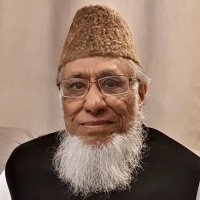
One piece of wisdom from the insightful journalist particularly stuck with me: ‘When in doubt, cut it out’ – a golden rule in Saudi journalism. I held onto Tariq Sahab’s advice throughout my 27-year tenure at the Saudi Gazette, finding it especially crucial in a Saudi Arabia that, at the time, offered journalists very little space for individual expression.
I first came to know about Tariq Sahab in Mumbai on my way to Jeddah from Delhi. My close friend, though much older in age, Afzal Usmani, introduced me to Tariq Sahab’s Mumbai-based younger brother, Salman Ghazi. During that meeting, I was acquainted with the Ghazi family’s history and background.
Born on 3 March 1941 in Deoband, Uttar Pradesh, Tariq Sahab, son of prominent freedom fighter and journalist Maulana Hamidul Ansari Ghazi, was an Alig, a distinction he shared with my illustrious father and renowned journalist and lawyer, late Syed Ameenul Hasan Rizvi Sahab (Editor, Radiance Weekly). Tariq Sahab, a maternal grandson of Qari Tayyab Sahab, great Islamic scholar and Rector of Darul Uloom Deoband, began his poetic journey in 1959 and over the years became a respected literary figure with equal flair and command of English, Urdu and Arabic. At Aligarh Muslim University, Tariq Sahab was a classmate of former Indian Vice President Mohammad Hamid Ansari.
Hamid Ansari, as the ambassador of India in Riyadh, paid a visit to the Saudi Gazette office in Jeddah sometime in 1995 and all the Indian staff at the paper were introduced to him. Tariq Sahab was magnanimous in introducing me as the son of an Alig, and that brought a glimmer to the eyes of Hamid Ansari Sahab. I was then offered a seat next to him.
Tariq Sahab enjoyed a very cozy relationship with our then Editor-in-Chief, Rida Muhammad Larry, who held him in high esteem because of Tariq Sahab’s invaluable services in transforming the newspaper into an international daily. But Tariq Sahab had his share of detractors too; a lobby which wanted to sideline the Urdu-speaking staff completely and establish full and unchecked control over the affairs of the newspaper. To counter the lobby, Tariq Sahab got the admirable support of Mir Ayub Ali Khan, Mirza Muhammad Nawab, Syed Yusuf Hussain and Abul Hasnat. This was before the recruitment of new staff, including me. We learnt about this war of attrition much after joining the office. Unfortunately, the other group prevailed despite Rida Larry’s support enjoyed by the losing party. That shows the Machiavellian tactics of the group which ultimately gained the upper hand.
This left Tariq Sahab, always a doer, heartbroken. He immersed himself in other activities, including those involving his alma mater at Aligarh. Moreover, to accomplish his literary pursuits and to channel his energy and sate his journalistic hunger, he went into overdrive. In Ausaf Sahab from the Islamic Development Bank, Ziauddin Nayyar of the Saudi British Bank, and Mir Ayoob Ali Khan of the Saudi Gazette, Tariq Sahab found trusted friends who also shared his literary taste. Tariq Sahab embarked on his aesthetic journey of research and study on a variety of social issues affecting the global Muslim community. I initially attended the Thursday weekend gatherings. However, this had to stop when I was entrusted with the task of the final late-night edition of the newspaper, requiring me to be in the office almost every evening. During one such meeting, Tariq Sahab presented a well-researched and purposeful paper on the apathy and callousness of the Organisation of Islamic Cooperation, which was then known as the Organisation of Islamic Countries. The paper earned Tariq Sahab numerous accolades from the august gathering of intellectuals and literary figures.
Tariq Sahab’scareer spans across several countries and roles:He served as an editor for various Urdu and English publications, including Abul Kalam Weekly (Mumbai), Daily Chinar (Srinagar), Daily Asr-e-Jadeed (Kolkata), and the Saudi Gazette in Jeddah.
Tariq Sahab has authored several significant books in Urdu and English: Nazariya-e-Tahzeeb is a detailed analysis of five major world civilisations using a unique historical approach, Zikrak, Khutbat-e-Ghazi: A biography of his father, Maulana Hamidul Ansari Ghazi, Nazara-e-Tahzeeb, a historical/cultural exploration, and Tazkar-ul-Ansar, a biographical account of the Ansar of Madinah whose descendants migrated through Afghanistan to India and eventually settled in the West.
Tariq Sahab penned a series detailing his impressions of various personalities with whom he remained in touch or who had left a lasting impression on him. The Yakta series in the Yahoo NRI group was so engrossing that it captivated the hearts of all its members. Of course, Tariq Sahab had his detractors there as well, but he successfully warded them off with his witty and commendable responses and his loyal fan following.
During my professional association with Tariq Sahab (from 1993 to probably 2004, when he moved to Canada), I had the opportunity to learn a great deal from his technical fluency, erudition, far-sightedness, journalistic acumen, and the intricacies of the profession, especially in the sensitive Saudi milieu.
Tariq Ghazi was not merely a journalist or a litterateur; he represented an era. His personality was a beautiful blend of knowledge, dignity, integrity, and courage, a combination rarely seen today. He accepted differences of opinion with an open heart and possessed the art of reasoned discourse. Politeness in his conversations and dignity in his writing were always prominent.
His literary taste was exceedingly refined, and even in poetry, he had his unique style. In his final days, he presented several ghazals and nazms in the NRI group, which received immense appreciation from learned circles. He wished to work on many scholarly projects, which he often discussed with Mirza Muhammad Nawab (I was told later), but alas, time did not permit him, and we lost a high-calibre journalist, writer, and poet.
All beings have to meet death and Tariq Sahab was no exception. He was hospitalised in Toronto, Canada, where he had moved after resigning from Saudi Gazette. All his friends, acquaintances, admirers, and followers prayed for his early recovery. However, he left this transitory world for his heavenly abode on April 15, 2024. May Allah grant him maghferat, amen!
_________________
Syed Athar Hasnain Rizvi is a senior journalist. He was associated with the National Herald in New Delhi and the Saudi Gazette in Jeddah. He can be contacted at: sahrizvi35@yahoo.com
Photo: Tariq Ghazi and Anis Siddiqui at Saudi Gazette office, Jeddah in 1989.
