

Government directives in Uttar Pradesh and West Bengal have sparked fears of coercion and threats to the religious identity of Muslim institutions
NEW DELHI — In a new development causing deep anxiety within the Muslim community across the country, educational authorities in Uttar Pradesh issued formal directives instructing madrasas across the state to organise programmes on June 21 to mark ‘International Yoga Day.’ While government officials characterise the move as a routine effort to promote physical and mental health, many Muslim leaders and intellectuals view it as part of a broader series of interventions in minority institutions aimed at weakening Islamic traditions and establishing Hindu cultural hegemony.
Dr Tasleem Rahmani, head of the Muslim Political Council, spoke to Clarion India regarding the situation:
“This year, for the first time, the Uttar Pradesh Madrasa Board administration issued a directive to all Islamic seminaries, ordering them to organise International Yoga Day programmes in their institutions.”
He further added: “Most government-aided madrasas—whether fully or partially funded—complied and held celebrations to mark the occasion. However, a majority of unaided (independent) madrasas did not. For instance, institutions like Darul Uloom Deoband, Nadwatul Ulama Lucknow, and Mazahir Uloom Saharanpur did not follow the directive and did not hold such programmes.”
Dr Rahmani pointed out that the picture presented in the media does not reflect the complete reality:
“Therefore, it would be entirely incorrect to say that the government forced everyone to celebrate Yoga Day. Compliance was more critical for those who receive government aid or those who wish to maintain a good relationship with the government. There are also some madrasas whose teachers, administrators, or trustees are organisationally associated with the ‘Muslim Rashtriya Manch’ (backed by RSS) and Yoga Day programmes were held there as well.”
He also noted that images and videos of complying institutions were widely shared:
“National media houses, newspapers, and web portals widely circulated photos and videos of these events, seemingly to project the impression that all madrasas participated voluntarily. The reality is that independent madrasas largely refused, while many smaller institutions organised these events primarily out of a desire to please the authorities. This distinction must be kept in mind.”
Directives and Monitoring
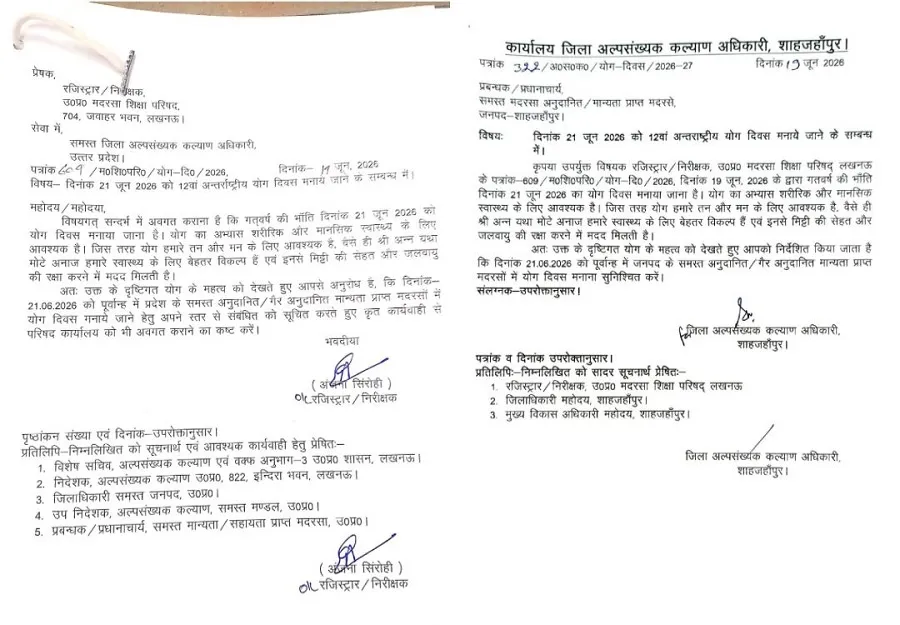
Official correspondence reveals the level of pressure exerted by authorities. A letter issued on June 17, by the Registrar/Inspector of the Uttar Pradesh Board of Madrasa Education, signed by Archana Sirohi, directed all District Minority Welfare Officers to ensure the celebration of the day in both aided and unaided recognised madrasas. The letter linked yoga to health benefits and also promoted the consumption of coarse grains (millets) for dietary and environmental reasons.
Similar instructions were given at the district level, such as a June 19 letter from the District Minority Welfare Officer of Shahjahanpur, which explicitly used the word “Directed” while ordering managers and principals to celebrate the day and share recordings.
Critics argue this goes beyond general government encouragement. Dr. Rahmani continued: “At the same time, it is worth noting that issuing instructions of this nature to educational institutions, whether schools or madrasas, raises legitimate questions. International Yoga Day is celebrated on June 21, and numerous international days are observed worldwide every year. There are 365 days in a year, but more than 500 international days are designated. Yoga Day is just one of them.”
Noting the absence of such directives for other occasions, he said: “However, there is no precedent of governments issuing official directives for every international day. For example, there is Mother’s Day, Valentine’s Day, Father’s Day, Teacher’s Day, and many others. Governments do not issue directives to institutions to celebrate these occasions. Organisations and NGOs celebrate them voluntarily according to their preference.”
Atmosphere of Fear and Cultural Imposition
Many in the Muslim community believe this selective pressure reflects the priorities of the ruling Bharatiya Janata Party (BJP) and its ideological allies, who are accused by opponents of pursuing a Hindu nationalist agenda that marginalises India’s large Muslim population.
Madrasas, which have long been vital centres for Islamic education, the preservation of religious knowledge, and the support of impoverished Muslim children, now find themselves under increasing scrutiny and pressure to adopt practices that some view as conflicting with their core purpose.
Raza Faraz, an author and intellectual from Lucknow, told Clarion India: “Due to the arrival of Muharram, Shia madrasas had already closed for holidays. Holidays usually begin around the 25th or 26th of Dhu al-Hijjah, and students head to their homes or destinations where they participate in Muharram majalis (congregations) and mourning rituals. Therefore, our madrasas remain closed during this period. Generally, neither teachers nor students are present, though occasionally a teacher might drop by for a day or so. As a result, no such activity was observed in Shia madrasas. However, some government-aided madrasas did hold Yoga Day programmes, which is certainly a matter of concern.”
Maulana Zarghamuddin Nadvi, a former member of the Uttar Pradesh Board of Madrasa Education, noted the atmosphere that compels madrasas to comply:
“A notice was issued to institutions operating under the Madrasa Board, and that is why they celebrated Yoga Day. A circular was issued by the Registrar. There might not be any direct pressure on anyone, but looking at the current atmosphere in the country, people are somewhat scared. Consequently, despite their reluctance, they find themselves compelled to comply.”
A principal of a board-affiliated madrasa, speaking on condition of anonymity, described the ground reality in plain words:
“This programme has been going on for the past 12 years. Exercise itself is not a bad thing. However, this year, the government formally issued directives ordering all madrasas to celebrate Yoga Day and share video recordings of the events. The District Minority Welfare Officer has created WhatsApp groups for every madrasa, and all details have to be uploaded there. Local government officials also attend these programmes. Under such circumstances, refusing to comply with the directive is practically not an option.”
These statements depict a subtle yet effective form of coercion. Although no uniformed police officers are physically forcing participants to perform yoga asans, official letters, monitoring via WhatsApp groups, visits by local authorities, and the fear of losing government aid combine to create an environment where many feel they have no real choice.
In Uttar Pradesh, some communications framed the Yoga Day directive as a recommendation, but its tone and subsequent follow-ups made it mandatory for many. Dr Rahmani stated: “The communication regarding Yoga Day was a directive or recommendation rather than a binding order. Nevertheless, if some madrasas decided to comply, we must ask those institutions what circumstances forced them to treat a recommendation as a mandatory order and implement it with such enthusiasm.”
The Broader Socio-Political Context
Many believe that while no direct reports of physical force have emerged, the broader atmosphere of fear among Indian Muslims cannot be ignored. Over the past decade, under BJP rule at the Centre and in several states, minority communities have faced allegations of “Love Jihad,” “Ghar Wapsi” campaigns, vigilantism in the name of cow protection, and repeated attempts to interfere in personal laws, religious practices, and educational institutions. A section of the media and certain politicians have often portrayed madrasas as sites of backwardness or even potential radicalism, despite their role in providing education to millions of underprivileged Muslim children who otherwise would not have access to schooling.
Muslim leaders argue that these latest measures are another facet of a long-term strategy to give minority spaces a “Hindu colour.” By introducing Yoga—an ancient Indian practice deeply rooted in Hindu philosophy and spirituality—into Islamic seminaries, authorities appear to be attempting to normalise Hindu cultural symbols within the Muslim educational environment. The inclusion of millets promotion alongside Yoga in official letters is also seen by some as another layer of aligning with government campaigns that carry cultural and political undertones.
Proponents of these directives argue that Yoga is a universal exercise system that benefits everyone regardless of religion and that madrasas should not isolate themselves from national initiatives. However, many Muslims counter that while the individual practice of yoga for health reasons is acceptable to many, organising institutional-level events under government pressure crosses a line, especially when no such enthusiasm is shown for other health or educational programmes.
The contrast with other international days is striking. ‘World Environment Day’ was observed recently, but no such directives were issued to madrasas. This selective enforcement fuels suspicions that the true objective is not health or environmental awareness, but an assertion of cultural and political dominance.
Constitutional Questions and the Way Forward
For India’s Muslims, who number over 200 million and constitute the country’s largest minority, these developments add to a growing sense of insecurity. Major institutions, such as Darul Uloom Deoband, one of the most prestigious centres of Islamic learning in the world, have resisted such pressure and set an example of maintaining autonomy. But smaller, aid-dependent madrasas face difficult choices: either comply and risk diluting their identity, or resist and risk losing financial aid and facing administrative harassment.
Raza Faraz summarised the concerns of Shia institutions and the wider community, noting that the Muharram holidays—a crucial period of mourning and reflection in Shia Islam—meant many could not participate even if they wanted to, yet the pressure on aided institutions remains.
Legal experts state that while governments can encourage healthy activities, targeting religious minority educational institutions with specific directives raises serious constitutional questions regarding religious freedom, minority rights, and the autonomy of educational institutions under Articles 25 to 30 of the Indian Constitution.
The circulation of specific videos and photos in national media, often favouring the ruling government, serves to construct a narrative of enthusiastic participation while ignoring the reluctance, fear, and resistance present in many quarters. This media strategy itself is viewed by critics as part of a broader effort to isolate and pressure the community.
Indian Muslims have a long history of contributing to the country’s culture, education, and economy while maintaining their distinct religious identity. Madrasas play a central role in this balance, producing scholars, teachers, and community leaders. Attempts to alter their character through official directives risk disrupting this delicate balance and deepening the sectarian divide in an already polarised society.
As the anonymous madrasa principal noted, the programme has existed for over a decade, but its formalisation and monitoring this year felt different—more insistent and difficult to ignore. In the current political climate, many fear that saying ‘no’ could carry hidden costs.
Muslim leaders like Dr Rahmani urge the community to remain vigilant. He advised: “We must protect our institutions while engaging with the state (government) where possible,” though the path ahead is fraught with challenges.
The controversy surrounding International Yoga Day, along with the ‘Vande Mataram’ dispute in West Bengal, highlights deep-seated tensions in Indian society. For India’s Muslims, the message appears clear: spaces dedicated to religious education are not immune to the reach of majoritarian policies. Whether through yoga mats or mandatory anthems, the pressure to conform continues, and the community must find ways to resist while preserving its traditions and future generations.
