

Speakers at the Jamiat Ulama-i-Hind’s Bharat Samvad programme stress the need to promote inter-community engagement and strengthen constitutional values
NEW DELHI — Jamiat Sadbhavna Manch, a wing of the premier Muslim organisation in the country, Jamiat Ulama-i-Hind (Mahmood Asad Madani group), is to organise over 2,000 ‘Bharat Samvad’ programmes across the country over the next six months. The objective is to address social prejudice, promoting inter-community engagement and strengthening constitutional values.
This was announced at a Bharat Samvad programme organised by the Manch here on Thursday, being celebrated as Constitution Day. The programme brought together intellectuals, social leaders, political representatives and environmental activists to deliberate on the country’s social situation, communalism, constitutional values and environmental protection.
Jamiat Ulama-i-Hind chief Mahmood Asad Madani said pollution was not confined to the environment but had also affected people’s hearts and minds in the form of intellectual pollution.
“Pollution is not limited to water and air; intellectual pollution, which has also entered people’s hearts and minds, is even more serious. We must work to eliminate every form of pollution,” he said.
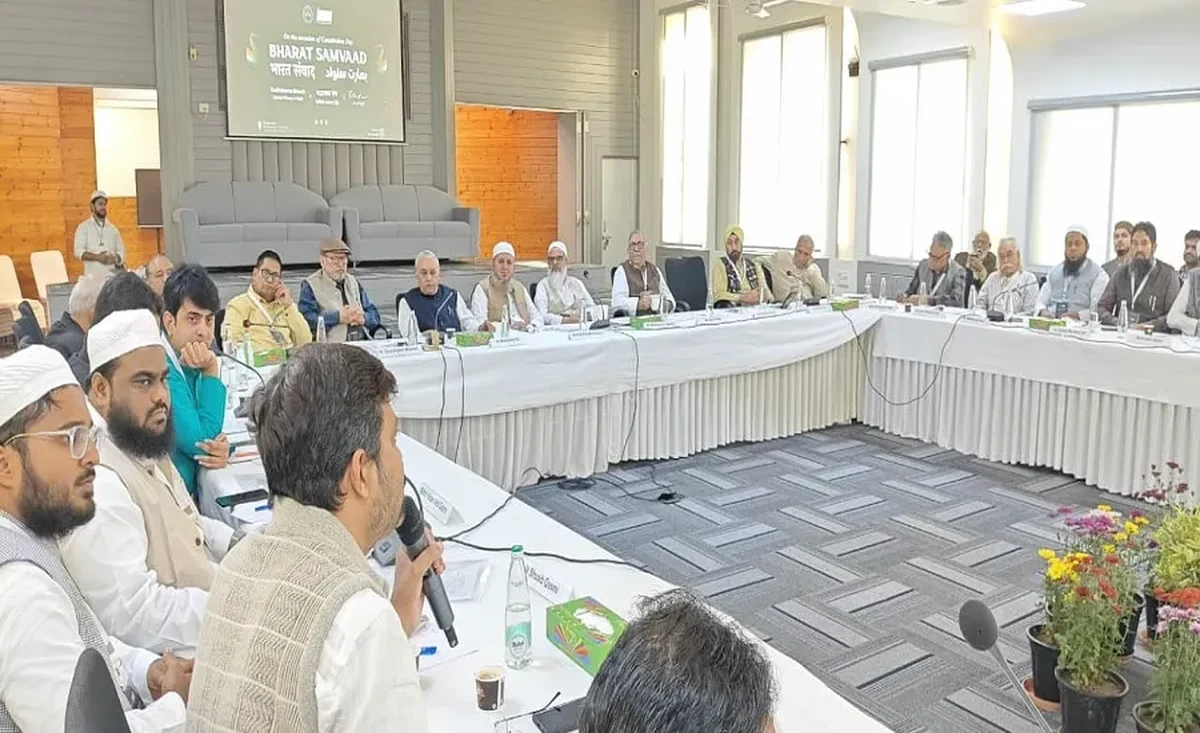
Madani emphasised the importance of maintaining social relations across religious and community boundaries, particularly during marriages and occasions of grief. Such participation, he said, was part of a longstanding social tradition that should not be weakened. He suggested identifying common occasions that could facilitate greater participation and interaction among people from different communities.
Dr Markandey Rai, chairman of the Indo-Pacific Peace Forum, spoke about the role of spirituality in promoting love, mutual respect and tolerance. He called for commitments towards charity, unconditional love and service, and proposed the formation of a common platform of religious leaders to promote peace and tolerance at the global level.
Maulana Mufti Syed Muhammad Affan Mansoorpuri, president of Jamiat Ulama’s Uttar Pradesh chapter, said dialogue was essential in a multi-religious society. He emphasised that engagement should extend beyond people sharing similar views to include those with differing perspectives. He also highlighted the role of young people and social media in disseminating positive messages.
Socialist leader Vijay Pratap described social and political transformation as a long historical process that required sustained efforts, patience and optimism. Expressing concern over the influence of Hindutva politics on the identity of Hinduism, he said the responsibility to address the situation rested with followers of all religions. He called upon Indian Muslims to present the message of the Noble Qur’an before the wider society and welcomed the growing discussion on constitutional values.
Former IIT Delhi professor Vipin Tripathi said governments could function through the use of force, but the consequences were borne by ordinary people. He said the work of Sadbhavna involved bringing facts and truth to the forefront and required the participation of religious leaders, workers, farmers and other sections of society.
Dr Ashok Bharti, president of NAKDOR, identified fear and greed as impediments to dialogue. He called for addressing questions openly and promoting inter-caste dialogue to facilitate the advancement of disadvantaged communities.
Prof Kumar Jha, noted historian, said dialogue should particularly involve people holding opposing views, as discussions on differences could help develop a better understanding of issues and facilitate efforts towards peace and justice.
Interfaith dialogue leader Dr A K Merchant said education and non-violence, along with expanding educational opportunities for economically disadvantaged sections, were important in addressing hatred.
Prof Syed Asghar Wajahat, prominent writer, suggested organising movements through Hindi in northern India, conducting cultural programmes and developing support systems for people in rural areas.
Social leader Dr Indu Prakash said leaders were increasingly hesitant to engage in dialogue. She said opportunities for interaction should be created through everyday social relations even in situations of communal polarisation, and emphasised that humanity should remain central to conversations and writings.
Social activist Dr Chandrakanta K Mathur said dialogue should extend beyond conference halls to socially and economically disadvantaged sections.
Activist Harsh Shikara called for implementing the ideas discussed at meetings through village-level Sadbhavna programmes and peaceful initiatives inspired by Mahatma Gandhi’s satyagraha.
Environmental activist and founder of ‘The Child Movement’, Licypriya Kangujam, highlighted the implications of climate change for children and future generations. She said environmental protection required public awareness, workshops and sustained collective efforts.
Social activist Harjeet Singh said the environmental crisis was linked not only to individual lifestyles but also to the development model. He emphasised the responsibility of governments to provide appropriate infrastructure and said sustained collective action could bring positive change. He also called for greater opportunities for young people to assume leadership roles.
Major Himanshu (retd) said social problems could not be resolved merely through changes in governments and stressed the importance of moral values, awareness and traditions of sharing moments of happiness and grief.
Social activist Jain Jigyasu spoke about intergenerational dialogue and environmental justice, noting that excessive use of chemical fertilisers and exploitation of natural resources had adversely affected the health of the earth. He also highlighted the need to understand the challenges faced by social activists and said dialogue based on love and mutual respect was essential to preserving democracy.
Other speakers included journalist Aditya Menon, Assistant Professor Khushboo Akhtar, Harminder Pal, Anupam, Sudeep Jain, Dr Murtaza Khan, Nishabala Tyagi, Musaddiq Riyaz of the United Religions Initiative, Jayant Jigyasu and Jigyasa Gulati.
