

The investigative journalist’s six-year reporting project draws on hundreds of interviews, police complaints, court cases and accounts of interfaith couples
NEW DELHI — Investigative journalist Ismat Ara has published her first book, Under a Saffron Sky: Inside India’s Crackdown on Love, examining how the idea of “love jihad” developed into a narrative that has affected public debate and the lives of interfaith couples.
Published by Penguin Viking, the book is the result of six years of reporting during which Ara travelled across the country and conducted hundreds of interviews. Her reporting took her to villages, police stations, courtrooms, flats, madrasas, vigilante offices and homes affected by suspicion surrounding interfaith relationships.
Announcing the book on X on August 23, Ara said she had begun following “a rumour about love, religion and conspiracy” six years ago.
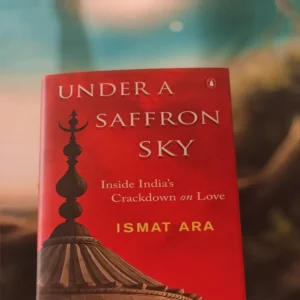
“It took me into villages where couples disappeared overnight. Into police stations where parents filed kidnapping complaints. Into courtrooms, flats, madrasas, vigilante offices, homes that had fallen silent, and lives permanently altered by suspicion,” she wrote.
Ara said she wanted to understand how the idea of “love jihad” travelled “from a rumour, to a conspiracy theory, to something capable of shaping actual lives”.
“How myths originate, and are used,” she wrote.
According to Penguin Random House India, the book examines how the idea of “love jihad” has made love and marriage between people of different faiths a source of political and social anxiety. The book draws on Ara’s reporting from places including Arya Samaj temples, police stations and rented rooms where interfaith couples live.
The publisher describes the book as a record of people whose relationships have been affected by the idea that interfaith love represents a threat. It also examines the experiences of women and Muslim men caught up in the controversy.
“And now, finally, it’s yours,” Ara wrote while announcing the publication.
Ara is a New Delhi-based journalist whose work has focused on politics, human rights, minority issues, gender and social justice. Penguin Random House India lists her bylines in The Times of India, TIME, the BBC, The Wire, The Quint, Al Jazeera, The Hindu, HuffPost and Frontline.
Her reporting has included the anti-CAA protests, the Delhi riots, the COVID-19 crisis, the farmers’ movement and the Hathras gangrape, according to her publisher.
Her work has also received journalism awards. She is a recipient of the UN Laadli Media Award, while in 2022 she was a joint winner of the Human Rights and Religious Freedom Young Journalist of the Year Award for stories published in The Wire.
The publication of Under a Saffron Sky has also prompted reactions on social media. While journalists and readers congratulated Ara, some users criticised the book and described it as “propaganda”.
Journalist Sayema, responding to Ara’s announcement, wrote: “Fabulous Ismat!!! Congratulations on your first book. This will be one hell of a read.”
Other users questioned Ara about interfaith marriage and criticised her approach to the subject. The social media response has included both support for the book and criticism of its subject and author.
Based on six years of reporting, Under a Saffron Sky traces the “love jihad” narrative across different parts of India and examines how it has affected couples, families and their choices.
