Mouin Rabbani
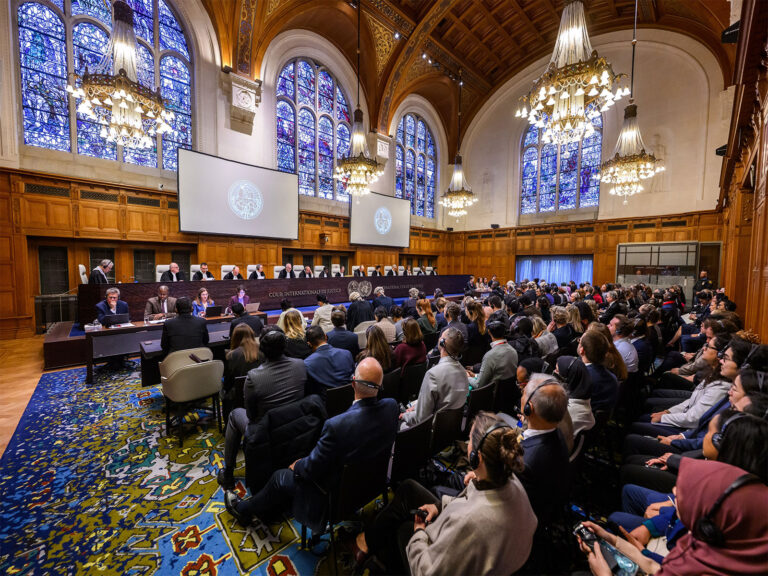
ON Thursday 19 November 2026 the International Court of Justice (ICJ) delivered its judgement on the case submitted by Gambia against Myanmar under the 1948 Convention on the Prevention and Punishment of the Crime of Genocide.
The ICJ ruled that the Myanmar government is directly responsible for the crime of genocide against the Rohingya, that it has failed in its obligations to prevent and punish the crime of genocide, and that it additionally violated its obligation to preserve evidence. The Court determined not only that Myanmar is guilty as accused by Gambia, but also that it violated the various provisional measures it was ordered to implement while the case was before the Court.
The ICJ has additionally required the Myanmar government to institute a number of remedial measures, including permitting the Rohingya to return to their homes and to provide them with compensation.
The case was about Myanmar and justice for the Rohingya, not about Gaza and the Palestinians. The Court’s ruling must therefore be welcomed first and foremost for recognizing the genocidal persecution perpetrated against the Rohingya, and for officially confirming that the government of Myanmar is guilty of the crime of crimes.
Yet the Myanmar case was closely watched not only on its own terms, but also for indications on how it might rule on the genocide case launched by South Africa against Israel with respect to the Gaza Strip.
Some observers, quite rightly, argued that the tendency to interpret the Myanmar case through the lens of the upcoming Gaza ruling detracted from the central issue of justice for the Rohingya. Yet for the same reason, and in the context of the assault on international legal institutions led by the United States on Israel’s behalf, there were also fears that the Court’s Myanmar ruling would be distorted by a fear of subsequently applying the same standards to Israel’s conduct.
In their comments on the Myanmar ruling, international law specialists and scholars of genocide have identified a number of significant issues, which they believe are also relevant for the Gaza case. These include:
1. The Myanmar ruling constitutes the first time the ICJ has found a state directly responsible for the crime of genocide pursuant to the 1948 Genocide Convention. This relieves the Court of making Israel the precedent for such a ruling.
2. A state can be guilty of genocide without explicitly proclaiming its intent to destroy a protected group “in whole or in part”. While this proved highly relevant to the Myanmar case, the volume of explicitly genocidal statements by Israeli leaders since October 2023 makes this aspect of the ruling less important in the Israel case.
3. A state can be guilty of the destruction of a protected group “in whole or in part” even if it does not avail itself of each and every opportunity to kill members of the protected group. Pursuant to the Genocide Convention the applicable criteria are intent, actions, and results.
4. A state is guilty of the crime of genocide if the only reasonable interpretation of its actions is an intention to destroy a protected group “in whole or in part”, even if the state concerned also proclaimed and pursued other objectives such as mass forcible displacement and counter-insurgency warfare. This point is crucial because the claim that what transpired was a counter-insurgency campaign and therefore could not be genocide was not only central to Myanmar’s defense but is also the foundation of Israel’s defense.
5. Pursuant to the 1948 Genocide Convention, the crime of genocide consists of a number of specific acts carried out with an intent to destroy a protected group “in whole or in part”. A number of these acts do not involve killing members of the protected group. Additionally, genocide is not assessed solely on the basis of its impact on those killed, but also by the impact of the prohibited acts on the coherent existence of the protected group as a whole. Given Israel’s systematic destruction of the Gaza Strip and continued campaign to make the Gaza Strip unfit for human habitation, this is an absolutely crucial aspect of the ruling.
6. Reports produced by the United Nations and its agencies are considered credible for the purpose of evidence, even as the Court retains discretion to draw its own legal conclusions from them. This is an important aspect because South Africa’s case draws heavily on such reports while Israel’s contention is essentially that its military and intelligence agencies are the only reliable source of information on its actions in the Gaza Strip.
7. The ICJ’s Myanmar ruling was adopted by a majority of 9-6, which is far from unanimous. An international law specialist at the University of Amsterdam, whose name unfortunately escapes me, was interviewed on Dutch radio shortly after the ruling. He pointed out that although interventions by interested states may or may not influence the views of the Court’s judges, where rulings are adopted or rejected by a slim majority they may well have played an important role. It is in this respect noteworthy that a number of Western governments, some time prior to October 2023, submitted interventions to the Court in which they set forth their views on how the Court should interpret and apply the 1948 Genocide Convention with respect to Myanmar. To the extent these interventions played a role in persuading a majority of judges in the case that has now been decided, the governments concerned can hardly now turn around and claim their interpretation of the Genocide Convention applies only to Myanmar and Israel should be exempt from the same interpretation. Correction: they probably will, but it won’t work
The majority of judges concluded that their ruling was based on a strict application of the 1948 Genocide Convention rather than any innovation in interpretation or application.
The Hasbara Symphony Orchestra has already launched a campaign of vilification against the Court, making spurious claims that it reached its conclusions by rewriting the Genocide Convention and using a different definition of genocide. They are simply terrified that the Convention’s criteria will now be applied to Israel and that the customary exemption it enjoys from the standards applied to every other entity may have run its course.
The same flunkies who have been falsely claiming that it is only a genocide if the ICJ confirms it, are now denouncing a formal ICJ ruling that a genocide has been perpetrated in a desperate campaign to ensure there is not a second such ruling.
On the available evidence it is now very difficult to see how Israel persuades the ICJ judges that it is not guilty of genocide because it has the most moral army in the galaxy.
That said, a different cohort of judges will be ruling on the Israel case, so it is not a foregone conclusion. More importantly, an unprecedented campaign of political pressure and dirty tricks will now be directed at the Court and its personnel to enshrine Israeli impunity as the central foundation of international law.