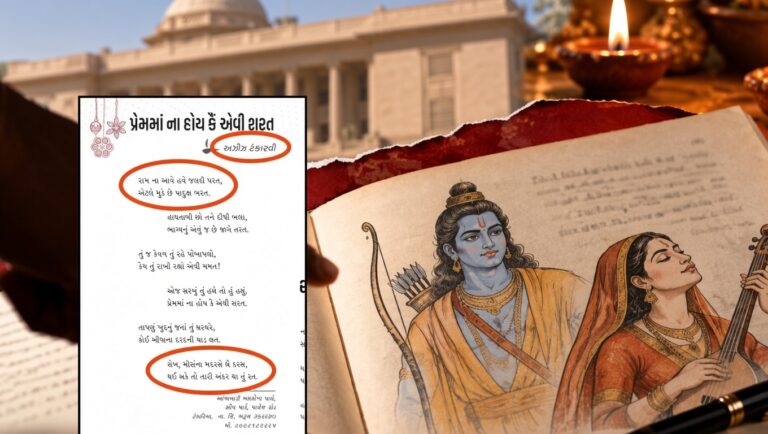
Aziz Tankarvi’s poem invoking Mirabai and Lord Ram triggers a dispute over religious sensitivities, literary expression and editorial decisions in a government publication
GANDHINAGAR — The Gujarat government has come under scrutiny after the Vishva Hindu Parishad (VHP) objected to a poem by Gujarati poet and journalist Aziz Tankarvi in the government’s annual Diwali magazine, Gujarat Deepotsavi Ank. The poem, titled Prem Ma Na Hoy Kai Evi Sharat (There Are No Such Conditions in Love), refers to Lord Ram and Mirabai and uses the word madarsa, commonly associated with an Islamic educational institution.
The poem appeared on page 389 of an earlier version of the publication, which runs to more than 450 pages. The VHP has alleged that some of its lines are objectionable to Hindu religious beliefs and has demanded the poem’s removal and disciplinary action against both the poet and the senior official who approved it.
In a letter dated 23 October to Gujarat Chief Minister Bhupendra Patel, VHP state secretary Ashwin Patel raised objections to the poem’s inclusion. The organisation argued that the references were inappropriate for a publication associated with Diwali, a festival linked to Lord Ram’s return to Ayodhya after 14 years of exile.
The VHP’s complaint focused on two passages. The opening lines read: “Ram na aave have jaldi parat, etle muke chhe paduka Bharat.” They refer to Bharat placing Ram’s sandals on the throne when his brother does not return as expected.
The closing lines read: “Sheikh, Mirana madarse lai daras, thai shake to tari andar tha tu rat.” The lines invite a sheikh, or religious teacher, to learn from Mirabai’s devotion and become absorbed in spiritual contemplation. The VHP objected particularly to the use of madarsa in this context.
The organisation has called for the poem to be removed and for disciplinary action against Tankarvi and the official responsible for approving it. It has also demanded that copies containing the poem should not be distributed further.
Reports have offered differing accounts of the government’s response. One account said the Chief Minister’s Office ordered a halt to the magazine’s distribution and sale, with recalling of the copies sent to government offices and libraries. Another report, quoting an unnamed government official, said the poem had appeared in an earlier electronic draft but was omitted from the final edition, of which 10,000 copies had been printed. It remains unclear whether distribution of the entire magazine was halted or what happened to the printed copies.
The controversy has prompted debate on social media platforms, including X, Facebook and Instagram. Some users supporting the VHP’s position have called for Tankarvi’s arrest and the suspension of officials responsible for approving the poem. Others have defended the work, arguing that its references should be understood in their literary and devotional context rather than treated as an insult to Hindu religious figures.
The dispute has a religious dimension because of the use of an Islamic educational term within a poem drawing on Hindu devotional tradition. However, the available reports do not establish that Tankarvi intended to insult Muslims, nor do they establish that the controversy has led to direct action against the Muslim community.
Tankarvi had not publicly responded to the controversy at the time of reporting. The Gujarat government had not issued a detailed public explanation of its decision.
The incident has raised questions about editorial scrutiny in government publications and the way authorities respond to objections from religious organisations. The VHP’s allegations and demands remain the organisation’s position, rather than established findings about the poet’s intentions.
The Gujarat Deepotsavi Ank is a special Diwali edition produced by the Gujarat government’s Information Department. It features literary and cultural contributions, including poetry, short stories, essays, travel writing, photographs, humorous pieces and historical research.
The edition forms part of Gujarat Pakshik, also known as Gujarat Magazine, which began publication when Gujarat was formed on 1 May 1960. The Directorate of Information in Gandhinagar publishes the magazine twice a month, on the first and 16th. Its regular editions carry information about government policies, welfare schemes and development programmes, and are read by members of the public, including students preparing for competitive examinations.
The annual Diwali edition focuses primarily on literature and the arts. The controversy over Tankarvi’s poem has placed the publication’s editorial process and the government’s response to religious objections at the centre of public discussion.
Tankarvi’s response and a detailed statement from the Gujarat government were not available. Accounts also differ on whether the entire magazine’s distribution was halted or the poem was removed before the final edition was circulated.