

“We lie on the ground at the side of the road, watching the aid trucks carrying our food and water drive away to escape the bullets. On those days, we don’t have anything to eat or drink.”
Palestinians in the Gaza Strip, especially those residing along the so-called yellow line, which the Israelis keep pushing westward by the day, live in constant fear of being killed by a stray bullet, as the Israelis keep firing towards their tents with alarming regularity.
At the start of the “ceasefire” in October 2025, the Israelis occupied 53 percent of the Gaza Strip; now they occupy 70 percent and keep squeezing Palestinians further. Even in their cramped living spaces and plastic tents, Palestinians are forced to evade bullets when the Israelis shoot for fun at random hours, in an attempt to force them out of their homeland.
Many families living along the “yellow line” have left their camps, making it even scarier for those still staying put.
‘Everyone is terrified’
“Watching families leave our camp every day makes us feel even more afraid. We wish we could move away from the bullets, but we have nowhere to go,” Shereen al-Kafarna told Middle East Eye.
“Even if we had somewhere to go, we can’t afford the extremely expensive cost of transportation,” she added.
Shereen was recently wounded when an Israeli bullet struck her inside their tent. She described how gunfire brings life to a standstill in the camps.
“When the shooting starts, life stops in our camp. Neighbours warn each other. We leave everything and hold the children, then lie on the ground to avoid the bullets hitting around us. Everyone is terrified, especially the children,” she said.
The gunfire and drone strikes also make it impossible for Palestinians to obtain basic necessities, including food and water. “Sometimes while we are waiting in queues for water and food, Israeli tanks and quadcopter drones start shooting directly towards us,” Zaid, Shereen’s son, said.
“Everyone panics. We lie on the ground at the side of the road, watching the aid trucks carrying our food and water drive away to escape the bullets. On those days, we don’t have anything to eat or drink.”
Digging trench
As Israeli shelling and gunfire become increasingly frequent, some have resorted to digging trenches to survive. Beside his tent, Shadi Siam dug a small trench to protect his family of five.
“I fear for my children’s lives every time I hear Israeli stray bullets flying low,” Siam told MEE. “My children wake up terrified, and I carry them to the hole where we all hide for two to five hours until the shooting stops.”
However, in Gaza’s dystopian landscape, where survivors have endured more than three years of nonstop bombings, starvation, and repeated displacement, even that potentially lifesaving hole in the ground comes with an expiry date.
“I don’t know how I will protect them when the winter comes, and the hole becomes unusable,” Siam added.
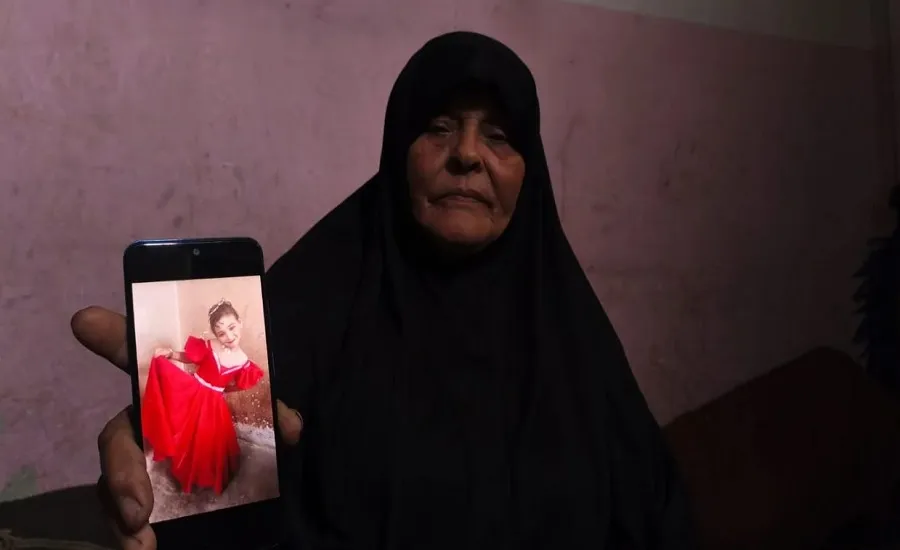
‘Fatima was my best friend’
Not everyone survives indiscriminate Israeli fire, however.
Fatima al-Bayouk, 8, was playing with her friends outside her grandmother’s home in Deir al-Balah, in central Gaza, when an Israeli bullet hit her.
Fatima died after a week in hospital.
She was the sole survivor of her family after an Israeli air strike on the family home in Khan Yunis on December 13, 2023. Fatima went to live with her grandmother Safia Abo Amra in Deir al-Balah, where Safia and other relatives tried to help her rebuild her life amid the devastation of the ongoing genocide.
“Fatima was my best friend,” Safia told Middle East Eye. “We did everything together, cooking, going on walks; we even slept on the same mattress. I have seven sons and six daughters, yet Fatima was more precious to me than all of them.”
Despite everything she had endured, Fatima had brought joy back into her grandmother’s life.
“The best thing about Fatima was her smile that always brought joy to everyone around her. She was smart, responsible and loved happy occasions like weddings and family gatherings,” her uncle, Ahmad Abo Amra, said.
“She always liked to be well-dressed,” he added. “We bought her new clothes for winter, but she was killed before she could wear them.”
‘I wish I could die after her’
Fatima’s presence helped her grandmother deal with the grief of losing her children and grandchildren, but now her death has left Safia despondent.
“We did our best to provide everything Fatima needed and make her feel cared for and surrounded by people who love her,” Safia said. “I wanted to make up for the loss of her family, but with her beautiful soul, she was the one to help me through my grief for my daughter and grandchildren.”
Safia did everything she could to ensure Fatima was safe. She refused to send her to a UN school after hearing that stray Israeli bullets frequently reached the area. Instead, she paid monthly fees to enrol her in a local school.
“I walked Fatima to school every day. She was very smart and always did her homework before playing,” Safia said.
Fatima’s killing has reopened her grandmother’s wounds.
“I was shocked and couldn’t speak or move. Her death was twice as painful for me; it reminded me of my daughter and grandchildren who were killed at the beginning of the war,” Safia said.
“My life was attached to Fatima’s. I wish I could die after her.” — Palestine Will Be Free
