

“The pain of losing my family remains with me every day, and memories of the life we shared continue to live on in every detail of my life.”
Amirah al-‘Arabi has survived the past three years of the ongoing genocidal Israeli assault on the Gaza Strip, but she has lost all three of her sons and her husband, completely erasing the life she ones knew in her homeland.
Amirah’s story of enduring Israeli barbarism and losing everything in the genocidal carnage is typical of the Palestinians in the Gaza Strip, where the most conservative counting puts the death toll at around 75,000, with thousands more buried under the rubble of their homes.
Amirah, 35, was living with her family in Gaza City’s al-Zaytoun neighbourhood when the Israelis launched their genocidal assault on Palestinians in Gaza on October 7, 2023. She fled with her children on October 29 as bombardment intensified around her home. She described the harrowing scene al-Zaytoun neighbourhood when she first left her home:
As we made our way out, we saw bodies lying in the streets, including people whose limbs had been severed.
She later moving through al-Tuffah, New Nuseirat Camp, Rafah and back to al-Nuseirat in a relentless cycle of forced displacement.
A family torn apart
Throughout Amirah’s painful journey, her husband, Ahmed Na’im Ramadan ‘Ashour, remained in Gaza City to care for his widowed mother. “He did not want to leave her alone or abandon her there,” Amira said in testimony published by the Palestinian Centre for Human Rights (PCHR) on Thursday.
The couple were separated as she moved south with their children, “holding on to the hope that we would soon return to each other and reunite our family.”
On April 13, 2024, after hearing that the route to Gaza City had reopened, she set out with her children and her 23-year-old cousin, Mohammed Mustafa al-N’eizi, hoping to reach her husband. “Exhausted by repeated displacement and the prolonged separation from my husband, I decided to make the journey in the hope of reaching him,” she said.
A journey ends in grief
Tragedy struck. At Wadi Gaza, the family came under Israeli fire and bombardment. Her cousin Mohammed was killed. “When we reached Wadi Gaza, however, we came under fire and bombardment, witnessing horrific scenes of people being killed and others wounded,” she said. “Unfortunately, my cousin Mohammed was among those killed.”
“Unable to continue our journey or reach Gaza City, I had no choice but to turn back to al-Nuseirat,” Amirah added.
The following morning, on April 14, 2024, she tried repeatedly to cross towards Gaza City, waiting until around 11 am before returning to the building where she was staying in the New Nuseirat Camp. She bathed her children for the asr prayer (prayed in late afternoon) and prepared sandwiches for them, having not yet eaten lunch.
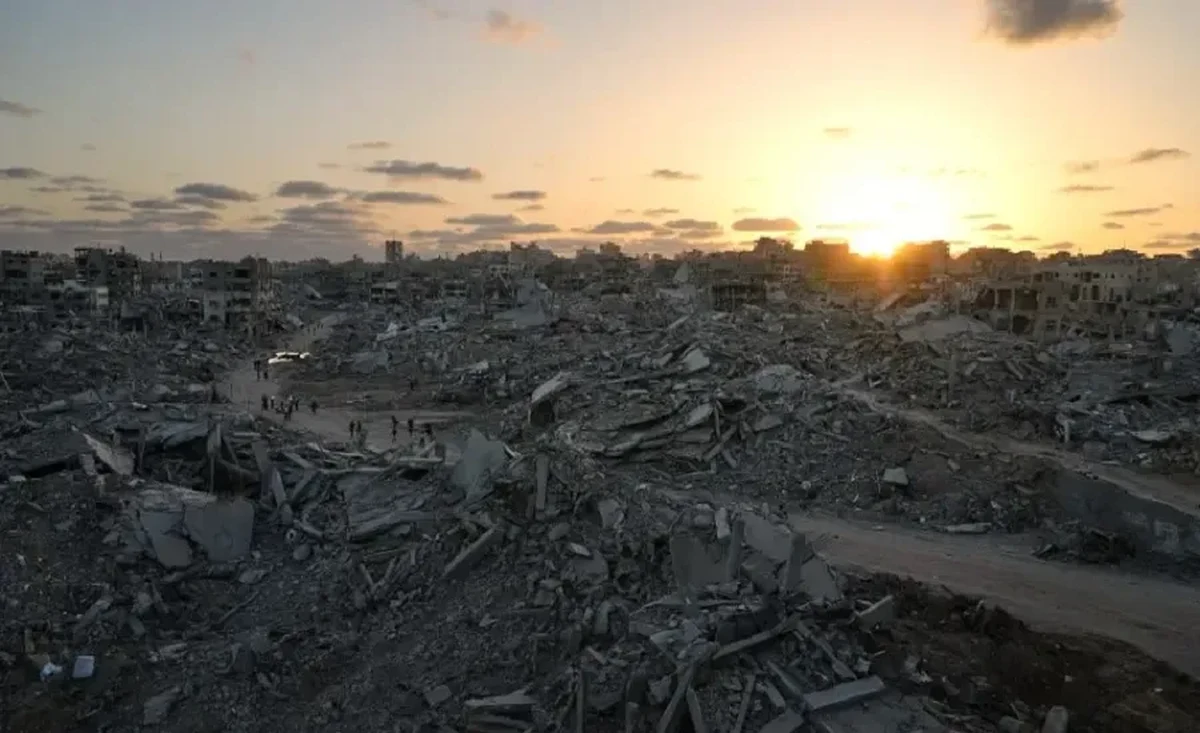
However, at about 3 pm, the three-storey building, whose first floor was occupied by Amirah and her children, was struck by Israeli bombs. The bombing collapsed the building, burying Amirah, her children, and several relatives, under the rubble.
Buried beneath the rubble
Amirah said she lost consciousness for roughly three hours following the bombing. When she regained consciousness, she found herself trapped beneath concrete slabs and a massive amount of debris, bleeding from wounds to her forehead and eyebrows.
“I tried to stop the bleeding by tearing off a piece of my gown and wrapping it around my wound,” she said. “As I gradually regained my senses, I began hearing voices around me, including my uncle’s voice and that of another person reciting the shahada (the Islamic declaration of faith). I began reciting it too.”
She then crawled towards a narrow beam of light, moving debris with her left leg while her right leg appeared injured.
Between 9 and 10 pm — by which time six to seven hours had passed since the bombing — as she was still trying to free herself, another explosion struck the area. “The explosion filled the place with dust and the smell of gunpowder, leaving me struggling to breathe and feeling as though I was suffocating,” she said.
At about 5 am the next day, she heard a man calling to ask whether anyone remained alive beneath the rubble. “I shouted back, telling him that I was trapped underneath and still alive,” she recalled.
Rescuers dug through the debris and pulled her out. “However, as soon as I was exposed to fresh air, I lost consciousness again,” she said.
“Those hours were the hardest of my life. I was overwhelmed by fear as I lay trapped beneath concrete slabs, injured and bleeding, with no idea when anyone would reach me or whether I would make it out alive.”
“Despite the fear and pain, I continued struggling to find a way out, clinging to every glimmer of hope that I might survive.”
Three sons murdered
Amirah was taken to the overcrowded al-Aqsa Martyrs Hospital, where she lay on the floor because there were not enough beds.
Amirah had suffered extensive injuries but she couldn’t get the medical care she needed at the overstretched hospital at the peak of the ongoing genocide:
I had sustained serious injuries to my face, including a severe wound around my mouth and nose, as well as another wound to my forehead and eyebrow. I had also suffered severe bruising to my left leg and an injury to my right leg. Because of my facial injuries, I had difficulty speaking. I also needed intravenous fluids and medical care, but the hospital was struggling to provide adequate treatment amid severe overcrowding and a lack of medical resources.
“I remained in the hospital for 20 days before being discharged, despite not having fully recovered from my injuries,” she said.
During her time in the hospital, she repeatedly asked about her children. Relatives eventually told her that her nine-year-old son, Yamen, had been killed instantly in the Israeli strike.
“His body was recovered from beneath the rubble, still in her embrace, with severe burns,” Amirah said. “When they tried to bring him to me to the hospital, I could not bear to see his body wrapped in a white shroud, as he had sustained severe burns across his body. I fainted and was unable to say goodbye to him.”
Her other two sons, Adham, 12, and Na’im, 14, remained buried beneath the rubble. Civil Defence crews told the family that they would keep trying to recover their bodies, but the destruction was too extensive and no equipment was available at the time.
Two and a half years without a grave
The remains of Adham and Na’im were not recovered until October 11, 2026, nearly two and a half years after the Israeli attack martyred them.
“Throughout that period, I endured the pain of losing my children, compounded by the knowledge that their bodies were still buried beneath the rubble,” Amirah said. “I was unable to say goodbye to them or lay them to rest.”
“As time passed, the pain of this loss only deepened, as I had been denied the final farewell that every mother wishes to have with her children.”
When Civil Defence personnel finally reached their bodies, only skeletal remains were found. Amirah chose not to see them.
“I could not bear the thought of seeing them in that condition,” she said. “I wanted to preserve the beautiful image of them in my memory, as I had known and loved them throughout their lives, rather than have my last image of them be their skeletal remains after they had lain buried beneath the rubble for so long.”
The brothers were buried together in the same grave at al-Nuseirat cemetery. “The long wait for their recovery and burial did nothing to ease the pain of losing them; instead, it only deepened my suffering and sorrow,” Amirah said.
Husband killed weeks later
After her discharge, Amirah moved into her father’s tent in al-Nuseirat refugee camp. Her family home had been destroyed, leaving her with nowhere else to go.
Two days after her arrival, her brother told her that her husband had been killed on May 8, 2024 in an Israeli airstrike on a residential building in northern Gaza.
“My husband had been on his way to visit people staying in the building, accompanied by his brother,” she said. “They had just entered the building when it was struck, killing them both and 12 other residents. At the time, I was displaced in the southern Gaza Strip.”
“When I received the news of my husband’s death, I fainted from shock,” she said. “I could not bear the fact that I had lost my three children and then my husband within such a short period of time.”
She said she experienced severe psychological distress for 40 days, repeatedly losing consciousness before her family took her to psychiatrists.
A life rebuilt amid genocide
“In addition to the loss of my family, I found myself having to cope with the consequences of my physical injuries, repeated forced displacement, and the destruction of the places where I had sought shelter and the loss of any sense of safety and stability, all amid extremely dire humanitarian and living conditions,” she said.
Amirah now lives with her brother and his family in al-Tuffah, Gaza City. She works as a teacher near his home and says she works to support herself rather than rely on others. “I chose to stay with him in particular because of its proximity to my workplace, which allows me to continue working and meet my basic needs,” she said.
As a widow, she receives a small payment once every four months, which she says is not enough to cover basic needs. “Working has therefore become a necessity, despite the physical and psychological toll of everything I have endured and the loss of my family,” she said.
She continues to carry the physical injuries and emotional scars of Israel’s barbarism that has erased the family she once knew. “Although I survived, my suffering has never truly ended,” Amirah said. “The pain of losing my family remains with me every day, and memories of the life we shared continue to live on in every detail of my life.”
“Today, I have no choice but to keep going, to work and provide for my basic needs, while carrying with me the physical and emotional scars of everything I have endured. They remain with me every day, a constant reminder of the family and life I have lost.” — Palestine Will Be Free
