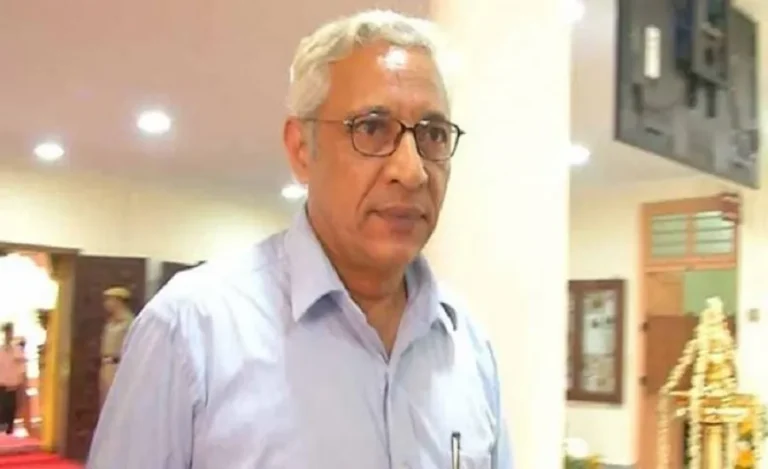
Gopinath Ravindran criticises alleged administrative high-handedness, calls for students’ union elections and revival of teachers’ association as protests continue despite university’s poll announcement
NEW DELHI — Former Jamia Millia Islamia (JMI) professor Gopinath Ravindran has appealed to the university administration to restore democratic representation on campus, withdraw threats of disciplinary action against protesting students and initiate unconditional dialogue with them amid an escalating agitation for the revival of the students’ union.
In an appeal reflecting on the university’s recent history and the ongoing protests, Ravindran, formerly a professor in the Department of History and Culture, expressed deep distress over images of students allegedly being manhandled and threatened by university authorities while peacefully demanding the restoration of their democratic rights.
“Jamia is the only central university in Delhi without a Students’ Union since 2006,” he said, recalling that elections were held in 2005, when he believes he served as the returning officer. The union came to an abrupt end in 2006 following an altercation with its leadership, he added.
Ravindran said that although Jamia expanded its funding and infrastructure in the years that followed, the absence of an elected students’ union did not prevent various student organisations from remaining active on campus.
‘Jamia has been battered into silence’
Recalling his return to the university at the end of 2024 after a prolonged period on secondment to another institution, Ravindran described a campus where, in his assessment, dissent had been systematically weakened.
He referred to what he described as traces of students’ blood on the staircase of the Central Library, the disbanding of the Jamia Teachers’ Association (JTA) through administrative action and the suspension of a senior professor for agreeing to serve as returning officer for teachers’ association elections that were never held.
“The teachers were a frightened lot,” he wrote, arguing that an atmosphere of fear had contributed to self-censorship among faculty members.
As an example, he recalled proposing a discussion on Mahatma Gandhi and Palestine that was quickly abandoned amid anticipated objections from the administration.
According to Ravindran, students had become the university’s principal critical voices, repeatedly raising concerns over inadequate hostel facilities, arbitrary hostel allotments, alleged mistreatment by proctorial staff, restrictions on assembly and disciplinary notices against those questioning the authorities.
He also alleged that vocal undergraduate students were subsequently denied admission to postgraduate programmes, describing the university as increasingly resembling a prison, with armed paramilitary personnel stationed outside on many days.
Protests reflect years of denied democratic rights
Ravindran argued that the present agitation was not an isolated episode but the culmination of more than a decade of restrictions on students’ democratic rights.
He recalled that Jamia was founded during the Non-Cooperation Movement and linked the current unrest to wider concerns about undemocratic governance in the country.
Referring to the restoration of the students’ union at Aligarh Muslim University, he questioned why demands for elected representative bodies by Muslim students appeared to provoke such apprehension among those in power.
He argued that elected student representation would give students a legitimate platform to raise their concerns rather than leave them vulnerable to being labelled extremist or fundamentalist.
Ravindran also referred to the long history of police action against Jamia students, arguing that the presence of right-wing groups had added another dimension to the pressures faced by them.
Questions teachers’ participation in march against protest
The former professor expressed disappointment with colleagues who, he said, had participated in a march led by the university’s registrar to end the agitation while remaining silent as students faced alleged physical intimidation.
He acknowledged that some teachers had subsequently said they were misled by the administration.
Ravindran urged faculty members to demand the restoration of the Jamia Teachers’ Association, which he said remained defunct despite a High Court order requiring its revival.
He cautioned against treating statements issued by heads of departments, directors and deans as evidence of the teaching community’s collective support for the administration, arguing that their official positions could constrain their ability to speak independently.
Without an active teachers’ association, he warned, the administration’s position could be presented as the opinion of the entire faculty, creating an unnecessary divide between teachers and students.
He called on Jamia’s teachers to press for the restoration of their representative body and defend democratic participation within the institution.
University agrees to hold elections, but deadlock continues
Ravindran’s appeal comes amid renewed confrontation over the restoration of the Jamia Millia Islamia Students’ Union (JMISU).
The university administration announced on October 26 that elections would be held within 15 days of the approval of the union’s constitution. It also ordered the revocation of suspensions and show-cause notices issued during the protests and said a committee would investigate the conduct of security personnel during the agitation. However, the order did not specify a deadline for approving the constitution.
The announcement failed to resolve the impasse, with protesting students insisting on a definite election schedule and a clear timeline for finalising the constitution.
On October 27, reports said the agitation was continuing, with police imposing restrictions on assemblies outside the campus and students challenging the administration’s conditions for ending the protest. The university also extended online classes and examinations until November 8 amid the continuing unrest.
The protest began on October 12, with students demanding the restoration of the union and a formal election schedule. The dispute has also involved disciplinary action, restrictions on access to campus and allegations concerning the conduct of security personnel.
Calls for unconditional dialogue
Concluding his appeal, Ravindran urged the university administration to stop treating its students as adversaries and accept their demand for a representative body through a time-bound process.
He called on Vice-Chancellor Mazhar Asif to initiate meaningful dialogue with the protesting students without preconditions and take immediate steps towards restoring an atmosphere conducive to critical learning and the advancement of knowledge.
He also invoked the final verse of the Jamia Tarana, drawing attention to its emphasis on conscience, intellectual exploration and the willingness to confront new challenges.
For Ravindran, the restoration of the students’ union is not merely an administrative question but part of a wider struggle to recover Jamia’s democratic and intellectual character.