

Reframing representation through Just relations and autonomy
TO see power from below is to understand that it rarely rearranges itself innocently. What appears as technical correction from above often feels like dispossession from below. It is in this tension that the coming exercise of delimitation must be located – not as a neutral administrative act, but as a political reorganisation of voice, power, and federal balance.
Delimitation is often presented as a matter of arithmetic -an exercise in aligning political representation with population. The language of numbers suggests objectivity, inevitability, even fairness. Yet this framing conceals more than it reveals. Delimitation does not simply redraw constituencies; it reshapes relationships between regions, between citizens, and between the state and its constituent units.
The principle of “one person, one vote” carries undeniable moral force. But when applied mechanically in a deeply unequal society, it can produce outcomes that are formally equal yet substantively unjust. Population is not a neutral fact; it is shaped by decades of policy choices, social investments, and political priorities. Southern states such as Tamil Nadu, Kerala, Karnataka, Andhra Pradesh, and Telangana did not arrive at demographic stability by accident. They invested in education, public health, and women’s empowerment, consciously moderating population growth. In contrast, states such as Uttar Pradesh, Bihar, Madhya Pradesh, and Rajasthan continue to experience higher population expansion.
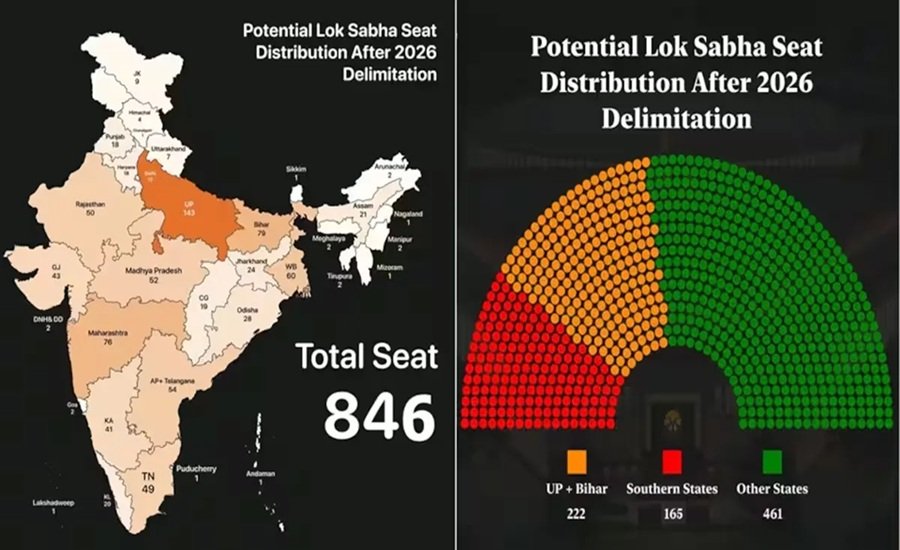
A strictly population-based delimitation therefore risks producing a profound inversion—rewarding demographic expansion while diluting the political voice of those who pursued stabilisation. It raises an uncomfortable question: can a democratic system claim fairness if it penalises governance and rewards its absence? What is presented as neutrality begins to look, on closer examination, like a structural disincentive for responsible policy.
This inversion does not remain confined to the arithmetic of seats. It spills into the larger architecture of federalism. India’s Constitution envisions a Union of States, not a hierarchy ordered by demographic weight. Yet a sharp redistribution of parliamentary representation in favour of a few populous state’s risks unsettling this balance. Over time, the Lok Sabha could come to reflect not the diversity of the federation, but the dominance of particular regions.
The unease expressed by political formations such as the Dravida Munnetra Kazhagam (DMK), which has described the prospect as an “assault on federalism,” must be read not as partisan exaggeration but as a warning signal. Federal systems rarely unravel through dramatic rupture. They erode gradually, through persistent asymmetries that begin to feel permanent.
The consequences extend further into fiscal terrain. The logic of population is not confined to representation; it also informs the distribution of financial resources through Finance Commission formulas. A reweighting of representation may thus be accompanied by a reduction in fiscal share for states that have already achieved higher levels of development and demographic control. The result is a dual burden—diminished voice in Parliament and diminished access to national resources. Such an outcome risks deepening, rather than correcting, regional inequalities.
At the same time, delimitation cannot be understood outside its sociological effects. It alters how regions perceive themselves within the Union. Changes in representation are read as signals of importance or marginalisation, of inclusion or exclusion. These perceptions are grounded in lived histories and political experience, and once formed, they are not easily reversed.
Concerns about the possibility of gerrymandering intensify this unease. The redrawing of boundaries always carries the risk of manipulation, whether through the concentration or fragmentation of particular communities. When such fears take hold, delimitation ceases to be seen as a constitutional exercise and begins to appear as an instrument of political engineering.
Uncertainty around the process compounds the problem. The reliance on the 2011 Census, due to delays in subsequent enumeration, and the lack of clarity regarding the precise formula for seat allocation introduce a degree of opacity that is difficult to ignore. Proposals to loosen the rigid constitutional linkage between delimitation and the most recent Census, while administratively convenient, risk expanding the scope for political discretion. Even the emerging possibility of judicial review—should decisions be deemed arbitrary – signals that what was once considered a settled institutional mechanism is now entering contested ground.
The proposed expansion of the Lok Sabha to upwards of 800 seats is often advanced as a solution—an attempt to ensure that no state loses its existing representation. Yet this measure addresses the optics of loss without resolving the underlying imbalance. The gap between large and small states will continue to widen in absolute terms, and the concentration of influence will persist. At the same time, an excessively large legislature may weaken the quality of parliamentary deliberation, diluting the very purpose of representation.
What emerges, then, is not a crisis of arithmetic, but a crisis of design.
If delimitation is to strengthen rather than strain the Union, it must be reframed as a question of just relations, not merely proportional allocation. Representation cannot be reduced to numbers alone; it must also reflect the principles that sustain a federal democracy. A more balanced approach would recognise not only population, but the efforts made toward population stabilisation, the contribution of states to the national economy, and the broader indicators of human development. Such a framework would align political power with responsibility, rather than allowing demographic momentum to dictate influence.
Alongside this, the question of autonomy becomes unavoidable. As parliamentary representation shifts, the need to preserve meaningful state autonomy grows more urgent. Without it, changes in representation may be experienced as changes in control, fuelling perceptions of domination rather than participation. Strengthening the federal compact through clearer protections of state powers, more transparent fiscal arrangements, and robust mechanisms of intergovernmental consultation is not an optional reform; it is a necessary counterbalance.
Equally important is the management of perception. Delimitation is not only a legal or administrative act; it is a narrative moment. How it is explained, justified, and debated will shape how it is received. Yet narrative cannot compensate for structural imbalance. Trust must be built into the process itself.
At its core, the primary criticism of the impending delimitation is stark and difficult to ignore. A process anchored solely in population will, in effect, penalise southern states—Tamil Nadu, Kerala, Karnataka, Andhra Pradesh, and Telangana – that consciously invested in family planning and human development. At the same time, northern states such as Uttar Pradesh, Bihar, Madhya Pradesh, and Rajasthan, with higher population growth, stand to gain a significant expansion in parliamentary representation. What is presented as democratic correction begins to resemble a redistribution of power that rewards demographic expansion over governance.
This leads to a deeper structural inversion. States that prioritised education, healthcare, and population stabilisation may see their parliamentary influence shrink, while those that lagged behind gain greater voice. Such an outcome unsettles a foundational democratic expectation—that progress and responsible governance should strengthen, not diminish, political standing.
The implications for federalism are equally profound. A sharp shift in representation risks concentrating power in a handful of populous states, altering the delicate balance of India’s Union of States. Political warnings, including those from the Dravida Munnetra Kazhagam (DMK), that this could be perceived as an assault on federalism reflect a deeper anxiety—that Parliament itself may come to mirror demographic dominance rather than federal diversity. If such perceptions take root, they carry the potential to trigger not just protest, but a deeper political estrangement.
This imbalance is not confined to representation alone. It extends into the fiscal domain. Since population figures inform Finance Commission allocations, the same states that risk losing parliamentary weight may also face a reduction in their share of national resources. The result is a compounding disadvantage—less voice in decision-making, and fewer resources to sustain their developmental gains.
Layered onto these concerns are fears of manipulation. The redrawing of constituencies always carries the risk of gerrymandering, of boundaries being shaped through “packing” or “cracking” to favour particular political outcomes or weaken specific communities. In the absence of full transparency, even the perception of such practices can erode public trust in the process.
The proposed solution – a substantial increase in Lok Sabha seats to around 800 or more—offers only partial reassurance. While it may ensure that no state loses its current representation, it does little to address the underlying imbalance. The absolute gap between larger and smaller states will continue to widen, entrenching disparities rather than resolving them. At the same time, an expanded House raises legitimate concerns about parliamentary efficiency, with the risk that deliberation may give way to dilution.
Compounding this is the uncertainty surrounding process and timing. The decision to rely on the 2011 Census, rather than waiting for updated data, introduces questions of accuracy and fairness. Proposed changes that weaken the constitutional linkage between delimitation and the most recent Census risk shifting the process from a rule-bound exercise to one shaped by parliamentary discretion. Even the emerging possibility of judicial review—should delimitation outcomes be deemed arbitrary – underscores that this is no longer a settled institutional terrain, but one open to contestation.
Taken together, these concerns point to a moment of profound consequence. The upcoming delimitation is not a routine administrative exercise; it is a transformative political event. If pursued without broad consensus and careful design, it risks weakening regional voices, deepening the North–South divide, and introducing long-term instability into India’s federal structure.
A more balanced path remains possible. One that moves beyond population alone and incorporates considerations of population control, economic contribution, and human development. Such an approach would not abandon democratic principles; it would refine them, aligning representation with responsibility.
The choice, ultimately, is not between delimitation and delay. It is between a narrow arithmetic that redistributes power and a more thoughtful framework that sustains the Union. If this distinction is ignored, the consequences will not be immediate rupture, but something far more enduring—a slow, accumulating loss of faith in the fairness of the system itself. And once that faith erodes, no institutional correction, however well-intentioned, can easily restore it.
_________________

Ranjan Solomon is a writer, researcher and activist based in Goa. He has worked in social movements since he was 19 years of age. The views expressed here are the author’s own and Clarion India does not necessarily share or subscribe to them. He can be contacted at ranjan.solomon@gmail.com
