

Unverified analyses suggest a higher Muslim share among newly registered voters; poll officials reiterate that voter data is not maintained based on religion
LUCKNOW — With the 2027 Uttar Pradesh Assembly elections drawing closer, claims regarding the state’s voter list have sparked a fresh political debate, particularly over reports suggesting a rise in the proportion of Muslim voters and their share among newly registered electors.
The discussion follows the Special Intensive Revision (SIR) of electoral rolls, after which several unofficial analyses and political commentaries began circulating. Some of these analyses claim that the proportion of Muslim voters in Uttar Pradesh has increased from around 18.6 per cent to nearly 19.5 per cent.
The same reports have also claimed that Muslims account for nearly 35 per cent of newly registered voters in the state. However, these figures have not been officially verified, and authorities have stressed that the Election Commission does not maintain voter records based on religion.
State Chief Electoral Officer Navdeep Rinwa has clarified that the Election Commission does not collect or maintain religious data of voters.
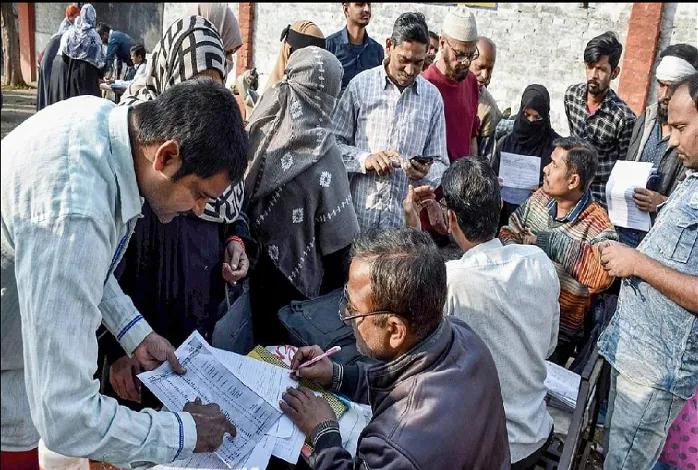
He said that voter registration is carried out according to established electoral procedures and that the commission does not categorise electors on the basis of faith.
Officials have also stated that if complaints regarding duplicate, suspicious or incorrect entries are received, they are examined under prescribed rules and appropriate action is taken where necessary.
According to election authorities, the process of updating voter rolls is a routine exercise aimed at ensuring accuracy and removing ineligible or duplicate entries.
Alongside the claims regarding voter demographics, reports have also emerged alleging technical and administrative irregularities in some voter registrations.
According to sources cited in various discussions, instances have been reported where individuals were allegedly found with multiple voter identification numbers or registrations at more than one location.
Election officials say such cases, if identified, are investigated and corrected through established procedures.
However, no official data has been released to support broader claims regarding the scale of such irregularities.
Political observers note that Muslim voters play an important role in the electoral politics of Uttar Pradesh and can influence outcomes in a significant number of constituencies.
As a result, any discussion relating to voter registration, demographic trends or changes in electoral rolls often attracts considerable political attention.
Analysts say parties across the political spectrum closely monitor voter list revisions because even small shifts in voter composition can have implications for electoral strategies.
Election experts have advised caution in interpreting claims about the religious composition of voter rolls.
They point out that because the Election Commission does not release religion-based electoral data, estimates regarding the number or percentage of voters belonging to a particular community are generally based on indirect calculations and demographic assumptions.
Experts argue that such claims should not be treated as facts unless supported by verifiable evidence and official confirmation.
“Any assessment regarding the religious composition of voters should be viewed carefully because there is no official religion-wise voter database available,” one election analyst said.
According to the 2011 Census, Muslims constituted approximately 19.3 per cent of Uttar Pradesh’s population.
Against that backdrop, claims regarding a sharp rise in the share of Muslim voters have generated debate among political commentators and social groups.
Some observers argue that the discussion is being used to create concern about demographic changes despite the absence of official religion-based voter data.
Others have linked the debate to voting patterns witnessed in recent elections.
Political analysts note that a large section of Muslim voters has generally supported opposition alliances in recent major elections. In the 2019 Lok Sabha elections, many Muslim voters were seen backing the alliance between the Samajwadi Party and the Bahujan Samaj Party. In the 2022 Assembly elections, a significant section of Muslim voters supported the Samajwadi Party-led alliance, while in the 2024 Lok Sabha elections many were seen backing the alliance between the Samajwadi Party and the Congress.
Because of these political trends, discussions surrounding voter registration and the size of the Muslim electorate often become politically sensitive.
With the 2027 assembly elections still some distance away, the issue is expected to remain part of the political conversation in Uttar Pradesh.
For now, election authorities maintain that voter registration exercises are conducted without reference to religion and that all claims regarding religious proportions in electoral rolls should be viewed cautiously unless backed by official data.
As political parties prepare for future electoral contests, discussions surrounding voter rolls, demographic trends and electoral participation are likely to continue generating debate across the state.
