

Former JMI students from across the United Kingdom assemble on Sunday (July 12), strengthening institutional ties and student support networks
LIFE in a foreign land is strange. The constant rush from morning till evening, the demands of an expensive lifestyle, and the merciless pace of time keep a person so occupied that sometimes even close friends and family begin to feel like strangers.
Living far from one’s homeland, in a completely different culture, presents numerous challenges that everyone must face on a daily basis. The social structure and economic system here demand hard work from every individual, which gradually reduces opportunities for mutual meetings and close relationships. In such an environment, when old bonds, shared memories, and people connected through the same alma mater come together, it becomes more than just a meeting — it turns into a beautiful moment that bridges the distances between hearts. These moments are no less than an oasis for migrants, where for a few hours they forget the exhaustion of earning a livelihood and take shelter in the shade of their original identity and the pleasant days of the past.
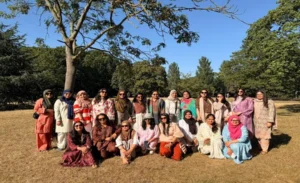
Under this beautiful human need and cultural bond, on Sunday (12 July 2026), a delightful gathering of Jamia Millia Islamia alumni was held at the well-known Valentine’s Park & Gardens in London (located on Emerson Road, Ilford). The serene and historic atmosphere of the park, famous for its beautiful lakes and centuries-old British-style mansion, proved ideal for the event — especially as the bright and pleasant sunshine added immensely to the park’s beauty. Whether one calls it a picnic, a friendly get-together, or an informal family reunion of the Jamia fraternity, everything fits. The truth is that it was an occasion that once again connected hearts scattered across the seven seas to the courtyard of Jamia. The everyday distances vanished in the peaceful setting, and the air suddenly became fragrant with the familiar breezes of the homeland.
Alumni from various British cities — London, Cardiff, Birmingham, Oxford, and other areas — were all there in the gathering. The presence of friends who had travelled from far and wide was clear proof that geographical distances hold no value in the face of love for one’s mother institution. Some faces had seen Jamia’s golden days decades ago, while others belonged to the relatively new generation. The elders’ faces carried the long experience of life and memories of the 70s and 80s, while the eyes of the youth sparkled with ambitions and new dreams for the future. Yet the most amazing thing was that despite differences in age, department, and era, there was one common bond: Jamia Millia Islamia. This connection threaded them all together on a single string, and this very difference in ages, rather than creating distance, gave the gathering a special intellectual and cultural dignity.
The most captivating aspect of this beautiful gathering was that every conversation eventually led back to memories of Jamia. Someone recalled the teachers of their student days, speaking of their kindness and traditional teaching style. Another brought up the old buildings, values, and lanes of Jamia, while someone else discussed how Jamia has changed today. When the elders painted a picture of the smaller, family-like Jamia of the past, the new-generation students described today’s modern, world-class infrastructure. As old and new alumni shared their experiences of their respective eras, it felt as if the long distance of time had shrunk into just a few moments.
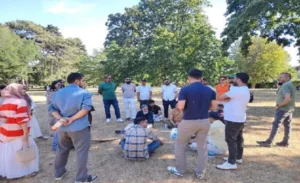
During this educational and historical comparison, the conversation naturally moved from physical buildings to Jamia’s grand ideals and the sacrifices of its founders, upon whose intellectual foundations the institution stands. With great pride, participants recalled how Maulana Muhammad Ali Jauhar — a great leader of the independence movement and a graduate of Oxford University — despite his high Western education, envisioned a purely indigenous, self-respecting, and national educational institution. Along with Mahatma Gandhi, Dr Mukhtar Ahmed Ansari, and other freedom fighters, he laid the foundation of Jamia Millia Islamia during the Non-Cooperation Movement. Today, on this very soil of Britain, the branches of the tree he planted are fluttering, and the echo of his dream could be discerned from the conversations of the new generation. This scholarly and friendly exchange made it clear that although the physical campus has changed greatly with time, Jamia’s educational heritage, the golden principles of its founders, its spirit of brotherhood, and its human values remain as strong today as they ever were.
To give the entire programme a traditional touch, an excellent arrangement of food was also made. The dining spread featured biryani, cool raita, sweet kheer, delicious desserts, and other delicacies, which doubled the joy of the occasion. In a foreign land — and that too in the pleasant summer season — the presence of the flavours of one’s soil brings a special kind of happiness. People around the food were not just savouing the tastes, but were also spreading the tablecloth of memories, where everyone was busy narrating some story or anecdote. The laughter, jokes, and anecdotes turned the atmosphere extremely light-hearted and full of warmth and belonging.
After the phase of food and conversation, recreation and physical activity began. Later, a friendly cricket match was also played, which added even more excitement to the event. It seems cricket is a passion that runs in the blood of people from the Indian subcontinent. As soon as the bat and ball entered the field, everyone’s ages and positions became equal. Even the serious-minded alumni holding high positions could not stop the child within them from coming out in this pleasant weather. Running in the field, laughing, and encouraging one another, these people appeared not just as players but as members of one single family. On one side was the agility of the youth, and on the other the traditional experience of the seniors. With every boundary and six, the entire field echoed with laughter.
At the end of the match, when everyone sat again under the shade of the trees, the conversation took a very constructive turn. Senior alumni encouraged the juniors, listened to their problems, and assured them that if anyone needed any help, they should not consider themselves alone. Drawing from their own experiences of British life, they guided the youth on employment, housing, and other practical matters, and helped them overcome the feeling of loneliness that comes with living abroad. In a foreign land, perhaps this feeling — that someone is there to ask about your well-being and hold your hand — is the most precious of all.
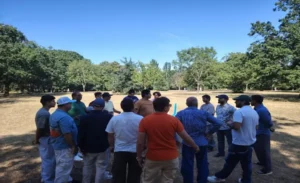
In the spirit of this same brotherhood and empathy, an incident was also discussed that brought tears to the eyes of all those present. A few months earlier, a former Jamia student had passed away suddenly in Britain. He was completely alone here, and his elderly family in India wished for his body to be repatriated. However, under international laws, the process involved severe legal, administrative, and heavy financial difficulties — something no single person could handle. In this delicate and difficult situation, the members of the JMI Alumni UK demonstrated such sincerity, compassion, and responsibility that it deserves high praise. Many alumni immediately became active, utilised all their resources, provided day-and-night help in official and diplomatic matters, hosted the grieving family, and completed all stages of repatriating the body with utmost respect. This incident is a living example of the fact that the bond of Jamia is not limited to educational affiliation alone; in the most difficult times, it becomes a strong support for one another. It proves that the bond of humanity does not depend on geography.
To make this act of human compassion more organised and sustainable in the future, participants also mentioned the services of the JMI Alumni Association UK, which has been active for many years as a registered organisation in Britain. This association not only works to connect former students but also strives at various levels for the welfare and progress of Jamia Millia Islamia and its students. An important part of the conversation was also linked to the future, where serious consideration was given to expanding the scope of the organisation. Participants discussed how effective help could be provided to Jamia students, especially the youth who come to Britain for higher education or better opportunities. Several constructive suggestions emerged regarding the arrangement of scholarships, guidance for newcomers, professional networking, and solutions to various practical problems, so that no new Jamia graduate feels unsupported upon arriving here. In this regard, an indication was also given of organising a larger and more structured programme in September, so that more alumni could be brought together on one platform and these efforts could be given the shape of a permanent action plan.
In this thoughtful gathering, while discussing a broader vision, the participants felt that in the progress of the world’s great universities — such as Oxford, Harvard, and other international institutions — the role of their alumni has always been prominent. They contribute substantially to the development of their alma mater, student support, and educational and research projects through funding, and brighten the name of their institutions worldwide. Our educational institutions in the subcontinent also urgently need to strengthen their alumni networks on a global level in the same way. We must energise this tradition in our universities so that the educational journey of the coming generations becomes easier. It is heartening that serious steps are now being taken in this direction. If sincerity, dedication, and continuity are maintained, the seed sown today will surely become a mighty tree tomorrow — one whose shade will spread far and wide, and whose fruits will benefit countless students.
The entire beautiful and well-organised day was made successful, and all picnic arrangements were executed perfectly, through the tireless efforts of dedicated Jamia alumni who worked with heart, soul, and resources. On this occasion, special mention goes to Bunty Bhai, Masroor Siddiqui Bhai, Ayman Khalid, Syed Omar, Nabeel Khan, Imran Khan, Rubina Siddiqui, Naheed Sultana, Zainab Jabeen, Dr Prerna S. Nirmal, Kasam Dhar Pandey, Neelam Sukhramani, Rashmi Nigam, Shishu Ranjan, and others who played a leading role and made the event truly memorable. At the end, a group photo was taken to preserve this memorable day forever, one in which the smile on every face and the pride of connection with their alma mater were clearly visible.
_____________
Mohammad Alamullah is a UK-based academic, author, and journalist, holding two Master’s degrees from Swansea University, UK, and Jamia Millia Islamia. He has authored three books: A Brief History of Muslim Majlis Mushawarat, Few Days in Iran, and Media: Paper to Screen — Scenarios, Problems and Possibilities. The views expressed are solely his own.
