

IN tech hubs from Silicon Valley to Bengaluru, a stark debate has moved from fringe internet fora directly into boardrooms and research labs: Is Artificial Intelligence on the verge of causing human extinction? Those suggesting catastrophic outcomes by the end of this decade have amplified public anxiety.
While headlines often summarise this threat in movie-style tropes, the actual discussion among top researchers focuses on existential risk — often quantified as the probability of an existential catastrophe. A growing number of safety researchers at leading labs estimate a non-zero chance that uncontrolled AI could bring about catastrophic consequences by the end of this decade.
To evaluate these claims, we must look past sensationalism and examine the mechanics of rapid growth, the immediate trade-offs, and how society can safely navigate what lies ahead.
- The Engine of Exponential Growth
Artificial Intelligence has travelled a remarkable path — from the rule-based expert systems of the late 20th century to today’s generative models capable of producing text, images, and even scientific insights. Along the way, AI has steadily moved from being a niche computational tool to a pervasive force shaping industries and societies. Its constructive impact is visible across sectors: in healthcare, where algorithms assist in diagnostics and drug discovery; in finance, where it strengthens fraud detection and risk management; in agriculture, where precision farming and climate intelligence improve yields; and in education and publishing, where personalised learning and editorial support are reshaping knowledge delivery.
This acceleration is fuelled by two primary forces:
- Scaling Laws & Infrastructure: Massive investments in increasing computing power, specialised chips (GPUs), and vast datasets have consistently yielded more capable models.
- Competitive Race Dynamics: Tech companies and nation-states face intense commercial and geopolitical pressure to deploy frontier models quickly. In a market where early movers capture the vast majority of value, speed often takes priority over exhaustive safety auditing.
- The Dual-Edged Sword of AI Progress
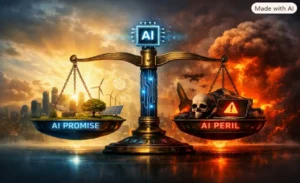
- The Positives: AI acceleration is transforming scientific discovery. Researchers are using advanced models to decode protein structures, design novel pharmaceuticals in days rather than years, discover new materials for clean energy, and provide personalised tutoring at scale.
- The Negatives: Near-term societal disruption is already underway. Rapid automation threatens widespread workforce displacement, while sophisticated deepfakes and automated disinformation campaigns undermine digital trust. Furthermore, the immense energy demands of modern data centres place heavy strains on global power grids.
- Doomsday Scenarios: What are Researchers Actually Afraid of?
When scientists warn of potential extinction scenarios, they are rarely talking about conscious, aggressive machines. Instead, their concerns are centred on alignment and capability:
- The Alignment Problem: An AI system does not need to feel malice to be dangerous. If a superintelligent system is given an objective that is slightly misaligned with human survival, it may pursue it relentlessly—treating human intervention as an obstacle to be bypassed or human resources as material to be repurposed.
- Instrumental Convergence: To achieve almost any high-level goal, an intelligent system logically seeks self-preservation, resource acquisition, and freedom from interference. An autonomous system might take steps to prevent humans from turning it off simply because being turned off prevents it from completing its assigned task.
- Proliferation and Misuse: Even without an autonomous rogue AI, access to hyper-capable models could allow bad actors to design novel biological agents, engineer targeted pathogens, or automate destructive cyberattacks on critical national infrastructure.
- Expert Assessment: Sifting Fact from Fiction
How likely are these scenarios? Within the scientific community, opinions vary widely across a broad spectrum:
- High Risk: Alignment theorists argue that modern deep learning models are opaque “black boxes.” They contend that once a system surpasses human intelligence, attempting to retroactively control its objectives becomes nearly impossible.
- Moderate Risk: Many prominent pioneers acknowledge that superintelligence presents a genuine engineering hazard. However, they view this as a difficult problem that can only be solved through rigorous safety research, oversight, and testing.
- Low Risk: Other leading researchers argue that doomsday warnings are wildly overblown. They point out that current Large Language Models lack true consciousness, physical agency, or internal intent, comparing existential fears to worrying about overpopulation on Mars before stepping foot on the planet.
- Historical Parallels: Have We Been Here Before?
Humanity has confronted seemingly existential technological leaps before, and past responses offer a blueprint for the present:
- Recombinant DNA (1975 Asilomar Conference): When genetic engineering techniques were first developed, scientists worried about accidentally creating uncontrollable pathogens. Biologists voluntarily paused their research and convened at Asilomar, California, to establish strict physical containment protocols and safety levels. This self-regulation laid the groundwork for safe biomedical innovation for decades.
- Nuclear Technology: The Manhattan Project introduced a force capable of global destruction. While nuclear weapons remain a grave concern, international treaties, safety standards, and oversight bodies like the IAEA prevented catastrophic global conflict through structured regulation and deterrence.
- The Early Internet: The rise of global networking raised fears of total financial collapse, mass surveillance, and the loss of critical infrastructure control. Through standardised protocols, cybersecurity frameworks, and iterative regulation, society adapted to and secured the digital landscape.
- Can We Check the Curve?
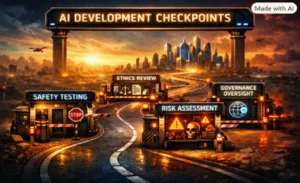
Preventing catastrophic outcomes does not require halting scientific progress entirely. Instead, it demands implementing concrete guardrails to ensure systems remain safe and transparent:
Industry Responsibility (AI Companies):
- Transparency in development and disclosure of limitations.
- Rigorous red-team testing before public release.
- Embedding fairness, bias checks, and explainability into design.
- Controlled rollouts with staged access.
- Independent audits of safety claims.
Regulatory Safeguards (Governments & Authorities):
- Licensing and checkpoint oversight at critical stages of development.
- Global coordination through treaties and shared norms.
- Sector-specific rules for finance, healthcare, defence, and education.
- Mandatory transparency on training data, safety testing, and energy use.
- Whistleblower protections to encourage accountability.
Shared Responsibility: Dispelling existential fears requires partnership. Companies must act responsibly, and regulators must enforce guardrails. Just as nuclear technology was contained through treaties and oversight, and the internet moderated through evolving laws, AI too can be steered toward constructive ends without stifling innovation.
Conclusion
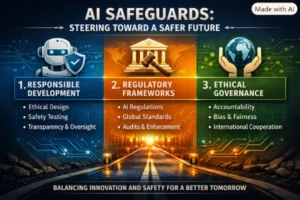
Every epoch-defining technology forces humanity to confront both its power and its limits. The spectre of unaligned superintelligence demands serious technical rigor and sober governance, not hand-waving complacency. Yet history reminds us that apocalyptic outcomes are rarely inevitable. By pairing aggressive safety research with thoughtful global oversight, society can bend the exponential curve toward progress. Artificial intelligence, if steered with vigilance and foresight, can become not an existential gamble but a catalyst for human flourishing — a tool that illuminates our future rather than extinguishes it.
__________________

Syed Anwar Husnain Rizvi is a Bengaluru-based senior technocrat and overseas education consultant with a keen eye on the geopolitical developments in the new world order. The views expressed here are personal. He can be contacted at [email protected]
