
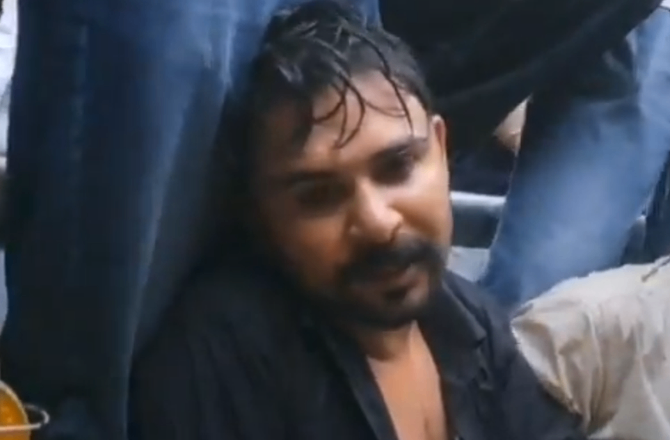
MA Urdu student Yasar Fahad alleges administrative pressure and suppression of dissent; the university cites unauthorised protest and violation of campus rules
ALIGARH — An MA Urdu student at Aligarh Muslim University (AMU) has launched an indefinite hunger strike demanding the restoration of the Aligarh Muslim University Students’ Union (AMUSU) and the conduct of fresh elections. The fast is bringing renewed attention to the absence of a democratically elected students’ body on the campus for nearly eight years.
Yasar Fahad completed six days of his hunger strike on Saturday after receiving no response from the university administration to a memorandum submitted by students seeking the revival of the students’ union.
According to the memorandum, the last AMUSU elections were held during the 2018–19 academic session. Students said the university has been without an elected students’ union since then, depriving students of formal representation. They have demanded that the administration begin the process of restoring the union, constitute an election authority, announce an election schedule and conduct polls in accordance with university regulations, University Grants Commission (UGC) norms, court directions and the recommendations of the Lyngdoh Committee.
On the same day that Fahad began his hunger strike on 20 September, the university administration suspended him pending a detailed inquiry.
Speaking to Maktoob Media, Fahad alleged that the suspension was linked to his campaign for the restoration of the students’ union.
“After we organised a peaceful march for the restoration of the union, I received the suspension letter at around 2 am the same night. It shows that the university is against any form of activity or dissent,” he said.
Fahad also alleged that members of the university’s proctorial team attempted to forcibly remove him from the protest site and physically mishandled him.
“The entire proctorial team came to the protest site at around 4 pm and pressured me to end the hunger strike. Videos are showing me being dragged by my collar and pocket,” he said.
Student protesters further alleged that a medical team from Jawaharlal Nehru Medical College was prevented from conducting a health examination of Fahad during the hunger strike.
The university administration, however, has offered a different account of the events leading to his suspension.
According to the administration, Fahad organised an “unauthorised protest march” from Duck Point to Bab-e-Syed on 14 September and, along with around ten others, blocked the university’s main gate.
The university alleged that slogans insulting and defaming the administration were raised during the protest and that the demonstration violated directions issued by the Allahabad High Court regarding obstruction at Bab-e-Syed.
The suspension order also referred to Fahad’s remarks regarding developments involving students of Abdullah Hall and the Women’s College. The administration said he made statements alleging that the Women’s College had been turned into a “battlefield”.
It further alleged that Fahad used social media to encourage female students to continue their protest and avoid engaging with the administration.
The university said attempts were made to contact him on 15, 19 and 20 September to obtain his version of events, but no response was received. Based on its preliminary assessment, the administration said his conduct amounted to serious misconduct under the AMU Students’ Conduct and Discipline Rules, 1985.
Pending further proceedings, the university has barred him from entering the campus and associated institutions without written permission from the competent authority.
Responding to the allegations, Fahad said the dispute stemmed from a protest held by students of Women’s College and Abdullah Hall on 14 September over what they described as unhygienic conditions and poor-quality food in hostel dining facilities.
“The proctorial team abused and mistreated the students. We were present only to support the women students who were demanding better food facilities,” he told Maktoob Media.
The protest has also drawn support from former AMUSU office-bearers and student leaders.
Former AMUSU president Salman Imtiaz said the students’ union was an integral part of university life and that its restoration involved more than reopening a building.
“It is about restoring student representation and leadership. The historical foundation of Aligarh Muslim University is rooted in developing responsible leadership among students,” he said.
Imtiaz expressed concern that the students’ union building had remained closed for nearly eight years and argued that academic excellence and student representation were complementary rather than conflicting goals.
Former Maulana Azad National Urdu University Students’ Union president and former AMUSU cabinet member Mateen Ashraf also backed Fahad’s hunger strike and criticised the alleged prevention of a medical examination by the JNMC team.
He appealed to students to support the protest, saying silence could result in the loss of student representation within the university.
Another former student leader, Mustafa Muqeet, said students required a representative platform to raise their concerns before the administration.
“If democratic voices are suppressed on campus, it will affect democracy in the country as well,” he said.
The demand for students’ union elections at AMU comes amid similar discussions on student representation in universities across the country.
At Maulana Azad National Urdu University, the administration issued a notification for student union elections earlier this year following student protests. At Jamia Millia Islamia, no students’ union elections have been held since the union was banned in 2006.
AMU students maintain that their objective is not to disrupt academic activities but to establish a formal channel of communication between students and the administration.
Fahad has said he will continue his hunger strike until his demands are addressed.
“Either I will get a date for the AMU Students’ Union election or I will die. The decision now lies with the AMU administration. We are only demanding student leadership, which is our right, and the university cannot take that right away from us,” he said.