

The Dhubri tribunal rules that the woman had established her family links and longstanding presence in Assam through land records, electoral rolls and NRC entries
DHUBRI — A Foreigners Tribunal in Assam’s Dhubri district has ruled in favour of Sakina Bibi, rejecting the allegation that she entered India illegally from Bangladesh on or after 25 March 1971. The tribunal found that she had established her relationship with her father, Gafoor Ali, and supported her claim through documentary and oral evidence tracing her family’s presence in the state to at least 1933.
In its order dated 29 April 2026, Foreigners Tribunal No. 9, Dhubri, held that Sakina was not a foreigner or an illegal migrant under the relevant provisions of the law. The order, passed by tribunal member Kirti Kamal Das, followed an examination of land records, electoral rolls, National Register of Citizens (NRC) documents and witness statements submitted during the proceedings.
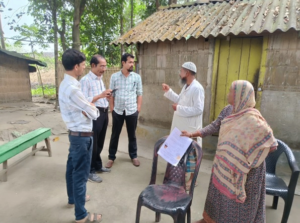
A copy of the order was delivered to Sakina and her family at their home in Sher Nagar village on 16 November, bringing relief after years of uncertainty and legal proceedings.
Notice That Changed the Course of Her Life
Sakina was born on 1 July 1971 in Malipara village, then in Assam’s Barpeta district. Her parents were Gafoor Ali and Rahaton Nessa, and her grandfather was Chelimuddin, also known as Chelim. She married Noor Islam, son of Monser Ali, a resident of Sher Nagar village in Dhubri district. The couple have five children – three sons and two daughters.
Noor Islam works as a daily-wage labourer and often travels to different parts of the state in search of work. The family’s financial circumstances made the legal proceedings particularly difficult.
Their troubles began when Sakina received a notice from the Border Branch of Agomoni police station alleging that she had entered India illegally from Bangladesh on or after 25 March 1971. She was asked to establish her citizenship before the Foreigners Tribunal in Dhubri.
The proceedings began with a police reference, IM(DT) Case No. 5740/98, and were later registered as State of Assam versus Sakina Bibi, case number FT-9/120/GKJ/2019. The case had earlier been handled by Foreigners Tribunal No. 2 before being transferred.
For Sakina and her husband, navigating the legal process was a formidable challenge. They had limited financial resources and little familiarity with the procedures involved in obtaining old government records and establishing family links before a tribunal.
In 2022, the couple came into contact with Citizens for Justice and Peace (CJP) during a meeting organised by the organisation’s team in Agomoni. CJP subsequently assisted the family with legal support and the collection of documents needed to establish Sakina’s family history and her father’s presence in Assam.
Records Dating Back to 1933
The documentary evidence submitted in Sakina’s defence included records relating to ancestral land, land settlements and revenue payments. Some of these documents predated India’s independence.
Among the most significant was an annual kheraj patta issued on 4 September 1933 by the Deputy Commissioner/Settlement Officer. The document recorded the family’s connection with land in Chengelidia village. Another land patta, issued on 30 October 1948, provided further evidence of the family’s longstanding presence in the area.
Gafoor Ali’s name also appeared in the 1951 National Register of Citizens for Chengelidia village, under the then Barpeta district. The record carried Legacy Data Code 120-0037-7809.
The family’s history was also reflected in subsequent land settlement records, pattas and revenue payment receipts. These documents helped establish the continuity of the family’s connection with the land.
The records showed that Gafoor Ali, his father Chelimuddin and other family members had lived in Chengelidia. However, repeated changes in the course of the Brahmaputra and riverbank erosion destroyed the family’s home, forcing them to move from Chengelidia to Malipara.
The tribunal took account of this displacement while examining the family’s records and the evidence concerning their continued presence in Assam.
Electoral rolls provided further evidence. The names of Sakina’s parents and other family members appeared in the 1966 and 1970 electoral rolls for the 54 Chenga Assembly constituency, when the family lived in Chengelidia.
Later electoral rolls from 1997 and 2005 recorded the names of her brother, Sarbesh Ali, and other family members in Malipara, under the 47 Chenga Assembly constituency. After her marriage, Sakina’s name appeared in the electoral records for Sher Nagar, under the 25 Golakganj Assembly constituency. Her Electoral Photo Identity Card (EPIC) was also submitted.
Tribunal Accepts Family Links
A central issue before the tribunal was whether Sakina had established her relationship with Gafoor Ali. The tribunal examined the documentary evidence alongside the oral testimony presented during the proceedings.
Sakina appeared before the tribunal on 1 October 2022 and submitted her written statement on 21 December 2022. She produced 26 documents in support of her case.
Her brother, Sarbesh Ali, appeared as a defence witness and testified about their family relationship and history. Other witnesses also gave evidence, including Kaseruddin Ahmed and Dinesh Chandra Das, the panchayat secretary.
The tribunal considered the testimony of Dinesh Chandra Das in relation to a panchayat certificate submitted in the case. However, it did not treat the certificate as reliable evidence because the issue register produced to substantiate it did not establish the details recorded in the certificate.
The tribunal nevertheless found that the weakness in this particular document did not undermine the other evidence. It held that the consistent oral testimony of the witnesses, together with the land and electoral records, independently established the relationship between Sakina and her parents.
In its order, the tribunal found that the evidence demonstrated that Gafoor Ali had been living in India before 1933 and that his family had longstanding roots in Assam. It considered the land documents reliable and admissible, noting that they had been issued by the appropriate authorities and carried evidentiary value.
The tribunal also considered the burden of proof under Section 9 of the Foreigners Act, 1946, which places the responsibility on the person whose citizenship is questioned to establish that they are not a foreigner.
It concluded that Sakina had discharged that burden by establishing her parental relationship with Gafoor Ali and presenting documentary and oral evidence of her family’s presence in Assam. The allegation that her family had entered India illegally after 25 March 1971 was therefore not sustained.
The tribunal answered the reference in the negative and held that Sakina could not be declared a foreigner under the law.
Years of Uncertainty Ends
On 16 November 2026, representatives of CJP visited Sakina’s home in Sher Nagar to hand her over a copy of the tribunal’s order.
The team included Nanda Ghosh, CJP’s Assam state in-charge; community volunteer Ilyas Sarkar, known as Rabbi; legal team member Iskandar Azad; and office driver Ashiqul Hussain.
For Sakina and her husband, receiving the order marked the end of a prolonged period of anxiety. The family expressed gratitude to CJP and those who had supported them throughout the legal process.
The case involved years of identifying relevant records, obtaining certified documents, visiting government offices and establishing links between successive generations of the family. CJP’s support helped the family navigate these procedures and present its evidence before the tribunal.
