

The Bongaigaon tribunal accepted his documentary evidence after a case initiated in 2004, while his wife remains a D-voter until 2029.
BONGAIGAON — A Foreigners Tribunal in Assam has declared Kashem Ali an Indian citizen, ending a prolonged legal battle that began with proceedings initiated in 2004 but for which he received a notice only in March 2022.
The Foreigners Tribunal No. 1 in Bongaigaon delivered its order on 25 October 2026, holding that Ali had successfully discharged the burden of proof under Section 9 of the Foreigners Act, 1946, and established that he was not a foreigner.
The case was contested with legal assistance from Citizens for Justice and Peace (CJP), which provided representation through its legal team. Ali submitted 18 documents, including electoral rolls dating back to 1966, land and revenue records, school certificates and identity documents, to establish his family’s long-standing connection with Assam.
The decision has brought relief to Ali, a handcart vendor who earns his living through daily physical labour and supports his wife, Suraton Khatun, and their two sons, Shahjahan Ali and Shahjamal Ali.
His wife’s citizenship-related difficulties, however, remain unresolved. She was classified as a doubtful voter, or D-voter, in 2019 and, according to the information provided by CJP, remains unable to exercise her voting rights until 2029.
The proceedings in State of Assam vs Mohd Kashem Ali were heard by Foreigners Tribunal No. 1 in Bongaigaon. The case originated as BNGN/IM(D)T Case No. 1944/2003 and was subsequently registered as BNGN/FT Case No. 1205/2010.
According to the case records, proceedings had been initiated in 2004 on the basis of an order issued by the Superintendent of Police (Border). Despite this, Ali did not receive a notice until March 2022, leaving an 18-year gap between the initiation of proceedings and the notice.
For Ali, whose livelihood depends on daily earnings, the prolonged uncertainty meant having to deal with a foreign reference while continuing to work to support his family.
He had earlier faced considerable expenses when his wife’s case came up, as he was unaware of CJP’s legal assistance at the time. After learning that the organisation could help him with his own case, he approached its team.
CJP’s legal team was led by legal member Dewan Abdur Rahim, assisted by two junior colleagues. They challenged both the basis of the reference and the manner in which the investigation had reportedly been conducted.
In his written statement filed on 10 December 2025, Ali maintained that he was born in Assam and was not a foreigner. His defence argued that the reference against him was unsupported by facts and could not be sustained in law.
Born in Assam, With Family Records Predating 1971
Kashem Ali was born in 1968 in Village No. 1 Dhupuri, under Manikpur police station in Bongaigaon district. He is the son of Nojamuddin Sheikh, also known as Naju Sheikh, and Panful Nesa, also referred to as Panful.
His father died in 1974 and mother died in 2018. His grandfather, Nazirullah, also recorded as Najib in some documents, had four children: Naju Sheikh, Yunus Ali, Khalik Mia and Khatim Bibi.
Ali has a sister, Toshiran Bibi. According to the information placed before the tribunal, no foreigners case was pending against her.
In 1988, Ali married Suraton Khatun, daughter of late Toyab Ali of Village No. 2 Dhupuri. The couple has two sons.
His defence placed particular emphasis on electoral records showing that his parents were registered as voters in Assam in 1966, five years before 25 March 1971, the cut-off date relevant to the determination of citizenship in Assam.
Subsequent electoral records also listed Ali and his wife as voters over several decades. The defence argued that these records, taken together, established the family’s longstanding presence in the state.
18 Documents Submitted
To discharge the burden of proof under Section 9 of the Foreigners Act, 1946, Ali submitted 18 documents before the tribunal. They were marked as Exhibits A to Q, with an additional document marked A-1. He also obtained a panchayat certificate.
The documents included electoral rolls, land and revenue records, school certificates, identity documents and death certificates. Together, the defence sought to establish Ali’s identity, family relationships, place of birth and connection with Assam.
Among the most important records were certified copies of the 1966 electoral roll for Dhupuri Part-I under the Bijni Assembly constituency. The list recorded Nojamuddin, son of Nozir Ullah, and his wife Panful as voters.
The 1971 electoral roll for Dhupuri Part-I also contained the names of Nojamuddin Sheikh, son of Nojib, and his wife Panful Nesa, along with other members of the family.
Ali’s own name appeared in the 1997 electoral roll for Dhupuri Part-II, alongside his wife, Suraton Khatun. Both were also listed in the 2008 electoral roll.
His name appeared in subsequent electoral rolls for 2010, 2014, 2017, 2018, 2019 and 2020. The records contained some variations in the spelling of his name and that of his father.
The defence also submitted land records identifying Ali’s father as the owner and possessor of 4 bighas, 1 katha and 17 lessas of land in Village No. 1 Dhupuri under Annual Patta No. 27. The land included Dag Nos. 155, 156 and 200. A revenue payment receipt in Ali’s name was also submitted.
A school certificate issued by the headmaster of No. 480 Dabaguri Lower Primary School recorded that Kashem Ali, son of Noju Sheikh, had enrolled in Class I in 1975.
Other documents included an Elector Photo Identity Card (EPIC) issued by the Election Commission of India on 6 March 2024, a ration card issued in the name of Suraton Khatun identifying her as Ali’s wife, and Ali’s PAN and Aadhaar cards.
The defence also submitted the death certificate of Panful Bewa, issued by the relevant health authorities in Manikpur.
The documents were presented as a connected body of evidence linking Ali to his parents, his wife, his birthplace and the family’s land and electoral records in Assam.
Defence Questions the Investigation
A central part of Ali’s defence concerned the investigation that led to the reference against him.
CJP’s legal team argued that the investigating officer had submitted a report without carrying out an adequate inquiry. According to the defence, the officer had neither visited Ali’s home nor recorded his statement, seized any documents or questioned witnesses.
The defence also challenged the credibility of witnesses associated with the case.
The allegation against Ali was based on the claim that he had entered Assam from a particular area after 25 March 1971. He rejected this assertion, maintaining that he had never migrated to Assam from East Pakistan or Bangladesh and had been born in the state in 1968.
Another issue raised by the defence concerned inconsistencies in the spelling of names across government records.
Ali’s name appeared variously as Kasem Ali and Kashem Ali. His father’s name was also recorded in different documents as Nojumuddin, Nasimuddin, Najim Uddin Sheikh and Nojim Uddin Sheikh.
The legal team argued that these were clerical variations and did not establish that the records referred to different individuals.
Such discrepancies can complicate citizenship proceedings, especially when records were handwritten several decades ago or names were recorded differently by government departments. In Ali’s case, the defence asked the tribunal to assess the variations alongside the wider documentary evidence rather than treating them as grounds for questioning his identity.
Revenue Official Verifies Land Records
Ali and two other defence witnesses appeared before the tribunal.
The second defence witness, Subhash Medhi, a revenue official (S.K.) at the Manikpur Revenue Circle, produced the Jamabandi as Exhibit A. He also submitted official documents relating to its issuance.
His testimony provided official support for the land records relied upon by the defence to establish the family’s connection with the area.
After considering the evidence and submissions, the tribunal held that Ali had fulfilled his burden of proof under Section 9 of the Foreigners Act, 1946, and was an Indian citizen.
The ruling brought an end to a legal proceeding that had remained unresolved for more than two decades.
While Ali’s case has been decided in his favour, his wife continues to face a separate citizenship-related proceeding.
Suraton Khatun was declared a doubtful voter in 2019 following proceedings before a Foreigners Tribunal. According to the information provided by CJP, the classification prevents her from exercising her voting rights until 2029.
Her name appeared alongside her husband’s in the 1997 and 2008 electoral rolls. The family’s ration card also identifies her as Ali’s wife.
The couple have lived together and raised their two sons while Ali was fighting to establish his citizenship.
His favourable tribunal order does not automatically restore his wife’s voting rights or settle her separate case. Her D-voter status therefore remains in place despite the ruling recognising her husband’s Indian citizenship.
The situation has left the family facing two different outcomes in citizenship-related proceedings: Ali has been declared an Indian citizen, while his wife continues to be deprived of her right to vote until 2029.
CJP Team Hands Over Tribunal Order
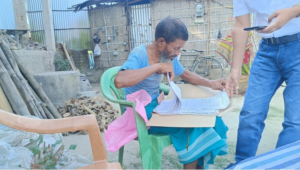
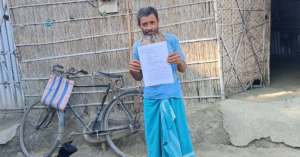
On 25 October, CJP lawyer Dewan Abdur Rahim and the organisation’s Assam state in-charge, Nanda Ghosh, visited Ali’s home and handed him a copy of the tribunal’s order.
After years of uncertainty, Ali welcomed the team with tea and thanked CJP for its legal assistance.
CJP said its Assam team includes community volunteers, district volunteer motivators and lawyers who provide legal assistance and counselling to people facing citizenship-related proceedings across more than 24 districts.
The organisation also said its work helped 12 lakh people successfully submit NRC forms during the 2017–2019 exercise. It conducts monthly interventions in Foreigners Tribunal cases at district level and reported securing favourable outcomes in around 20 cases annually.
CJP said its grassroots work also informs its legal interventions before constitutional courts.
Ali’s case has raised questions about the long delay between the initiation of proceedings and the delivery of notices, the quality of investigations leading to foreigners references, and the difficulties faced by people whose names appear differently in old government records.
It also points to the difficulties faced by people who cannot afford lawyers, obtain certified copies of decades-old documents or arrange witnesses to support their cases.
For Ali, the tribunal’s decision has brought relief after years of uncertainty. His wife, meanwhile, continues to await the restoration of her voting rights.
