

When the judiciary is the midwife of tyranny, the law becomes the most lethal weapon of a fascist state.
Suchitra Vijayan
The US Supreme Court, yesterday, reversed a landmark ruling that had curbed racial profiling by immigration agents. This has far-reaching implications for civil liberties. In Noem v. Vasquez Perdomo, the U.S. Supreme Court issued a deeply troubling 6–3 decision via its emergency or “shadow docket”, which provided no reasoning. It reverses a ruling from two lower courts that has recently barred immigration agents from stopping individuals without reasonable suspicion and from relying solely on four factors: race or ethnicity, speaking Spanish or English with an accent, presence in a public area, or a person’s profession.
The Lower Court’s Findings and Escalation Under Trump
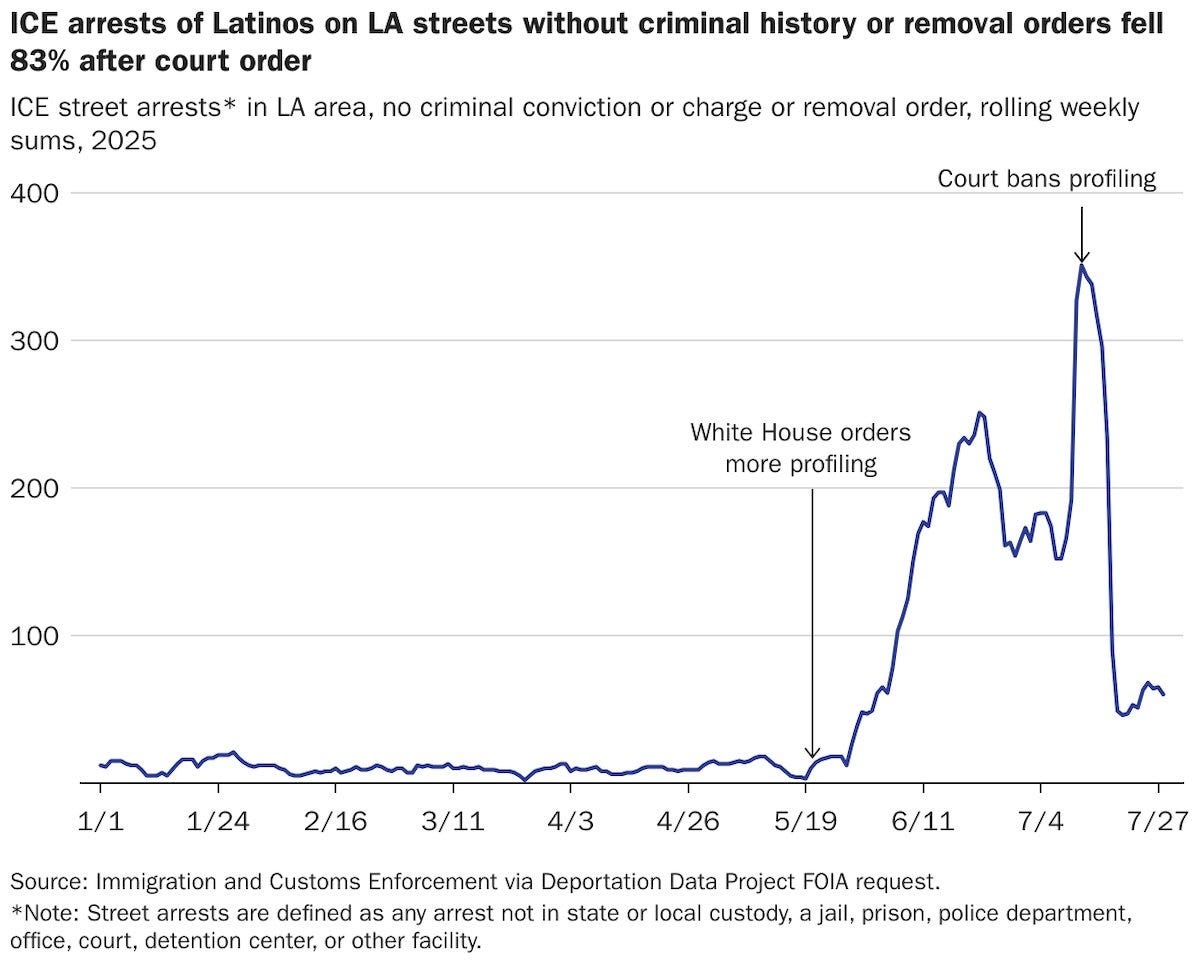
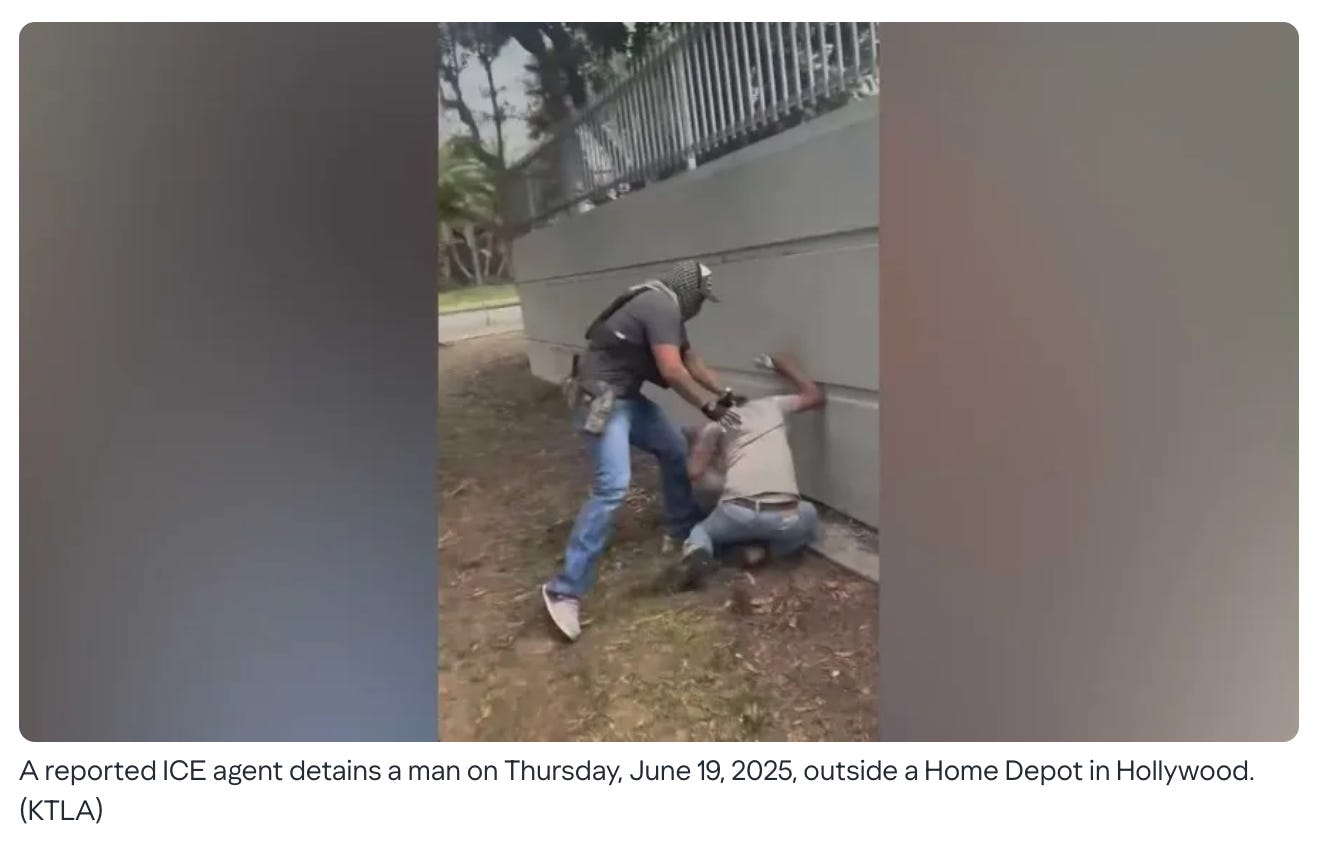
In July 2025, U.S. District Judge Maame E. Frimpong issued a restraining order against ICE’s (Immigration and Customs Enforcement) “roving patrols” in and around Los Angeles, citing a “mountain of evidence” that the agency’s practices violated the Fourth Amendment, which protects one against unreasonable searches and seizures. Her order barred ICE agents from stopping individuals based solely on their race, the language they spoke, their occupation, or their presence at locations such as bus stops, farms, and car washes. Multiple documented abuses, including the detention of U.S. citizens, underscored the court’s decision. One such case involved Job Garcia, a Los Angeles resident and U.S. citizen who was violently arrested at a Home Depot while making a delivery and held for over 24 hours without cause. Judge Frimpong’s decision had a measurable impact—ICE arrests in the region fell by 66% in the 15 days after the order, providing compelling statistical evidence of pervasive racial profiling. That carefully considered and impactful ruling has now been summarily cast aside by the Supreme Court’s emergency intervention.
Credit: Tucson Sentinel
The Trump administration initiated mass raids in June at Home Depot and other workplaces, sparking public unrest and widespread protests. In response, Trump deployed 2,000 National Guard troops and 700 Marines without California’s consent. On September 2, U.S. District Judge Charles Breyer ruled that the Trump administration had violated the Posse Comitatus Act, a 19th-century law barring military involvement in domestic law enforcement, by deploying National Guard troops and Marines to Los Angeles during immigration-related protests. Judge Breyer found the deployment to be a willful breach of federal law. Following the ruling, which the administration has since appealed, White House spokeswoman Anna Kelly derided Justice Breyer as a “rogue judge.” Now, the Noem v. Vasquez Perdomo ruling clears the way for expanded raids, with Trump hinting at federal force deployments in Washington, D.C., and Chicago.
The Supreme Court Ruling
The Court issued its ruling on the shadow docket—no written opinions, no full briefing, no oral argument. Justice Kavanaugh filed a concurrence suggesting that while race alone can’t justify a stop, factors like apparent ethnicity can be weighed alongside others to establish “reasonable suspicion.” Yet, this phrase is not a constitutionally fixed category. It is vague, elastic, dangerous, and infused with racial bias. Legal theorists such as Duncan Kennedy and Bernard Harcourt have argued that these kinds of legal categories often operate as fictions—constructs that lend an appearance of objectivity to what are, in practice, highly discretionary and politically charged decisions. ‘Reasonable suspicion,’ in this context, becomes a malleable justification that hides the racialized logic of enforcement behind the veneer of “neutral” legal reasoning. The Court’s reliance on such fluid categories enables the state to embed racial profiling, thereby legalizing racism into the structure of constitutional jurisprudence under the guise of doctrinal continuity.
Scalding Dissent
The apex court order came with Justices Sonia Sotomayor, Elena Kagan, and Ketanji Brown Jackson issuing a blistering 21-page dissent that excoriated the majority’s decision as a fundamental betrayal of constitutional principles.
“That decision is yet another grave misuse of our emergency docket,” Justice Sotomayor wrote, condemning the Court’s intervention as procedurally unsound and morally indefensible. She laid bare the real-world consequences of the order: “Countless people in the Los Angeles area have been grabbed, thrown to the ground, and handcuffed simply because of their looks, their accents, and the fact that they make a living by doing manual labor. Today, the Court needlessly subjects countless more to these exact same indignities.”
She warned that the decision effectively renders an entire demographic permanently suspect: “We should not have to live in a country where the Government can seize anyone who looks Latino, speaks Spanish, and appears to work a low-wage job.” The ruling, she wrote, now permits ICE agents to treat all low-income Latinos, regardless of their citizenship status, as “fair game to be seized at any time, taken away from work, and held until they provide proof of their legal status to the agents’ satisfaction.” Sotomayor’s dissent is a forceful indictment of the Court’s complicity in racialized state violence, and a roadmap showing how constitutional protections are being hollowed out from within by the very institution tasked with safeguarding them.
Real Consequences
The Supreme Court’s ruling brings far-reaching consequences. First, it renders racial profiling constitutionally permissible, exposing brown, black, working people, and especially Spanish-speaking individuals in Los Angeles to detention. Second, it places Fourth Amendment protections on precarious ground. By reshaping the concept of “unreasonable searches and seizures” to serve political will, the Court elevated executive discretion above constitutional limits.
Third, the decision’s implications extend beyond Los Angeles, offering a judicial endorsement for similar enforcement in cities like Chicago and D.C., suggesting a broader reconfiguration of federalism where political agendas dictate the scope of civil liberties.
Fourth, immigrant communities already live in a climate of pervasive fear: avoiding workplaces, legal services, places of worship, or medical care lest they become targets of state action. Ultimately, the legal ruling lays bare a more profound collapse: when legal norms, especially even the fictions of justice and due process, disintegrate, the consequences fall most heavily upon the already marginalized. These communities’ relationship to law is uneasy: forged in histories of surveillance, dispossession, and betrayal, where the courtroom is not a sanctuary but another site of domination.
The term “reasonable suspicion” now operates as a legitimating fiction—readily invoked to rationalise racialised policing and state violence, all while preserving the facade of constitutional decorum. Within this hallowed legal terrain, agencies like ICE move like unchecked spectres of state terror—unaccountable, extralegal, and emboldened by the courts’ silence.
Implications and Next Steps
The ruling allows ICE to resume aggressive enforcement tactics in Los Angeles immediately, effectively reinstating practices that courts had previously blocked. Immigration advocates have raised alarms that this decision may embolden similar crackdowns in other jurisdictions where federal officials have already signaled intent to expand operations. The broader concern is not merely geographic, but structural: the ruling creates a legal precedent that redefines the limits of federal enforcement authority and narrows the scope of constitutional protections nationwide.
As litigation continues, all eyes now turn to the upcoming hearing scheduled for September 24 in the 9th U.S. Circuit Court of Appeals, where the more profound constitutional questions at the heart of this case will be tested once again.
Legal Rulings as Acts of Terrorism
In London, a new Banksy mural starkly captures the moment we are living through: a hooded protestor, unarmed and fallen on their back, is bludgeoned by a judge whose gavel becomes a weapon.
This US Supreme Court order is an act of terrorism. (I have long argued, as a lawyer, that real terrorism is state terror.) The most pervasive and unacknowledged form of terrorism in modern times is the violence by the state: legalized, bureaucratized, and rendered invisible through court orders and legal language. It weaponizes race, language, and certain forms of labor as tools for surveillance, detention, and violence; It constructs fear as policy and dehumanization as doctrine.
This is not unprecedented. From Korematsu‘s endorsement of Japanese internment to Dred Scott‘s denial of Black citizenship, from apartheid South African courts enforcing racial laws to India’s judiciary sanctioning preventive detention, to English courts denying its subjects their most fundamental of rights to protest a genocide, we have seen this before. Courts do not merely fail to prevent tyranny; they often operationalize it. This latest top court ruling signals not just a grim future, but it also confirms what many of us have always known. The United States Supreme Court will not protect us.
C. The Polis Project


