

Fresh memos by the Waqf Board CEO are seen as sidelining the chairman and elected board, and placing Muslim religious properties at serious risk
HYDERABAD — A fresh controversy has surfaced around the Telangana Waqf Board after new internal orders were issued, allegedly placing pressure on subordinate officers to carry out disputed instructions of the Minority Welfare Department, even as objections from the board’s chairman remain unresolved.
Senior officials and sources within the board say the latest move is aimed at reducing the authority of the statutory Waqf Board and weakening its role in protecting waqf properties that belong to the Muslim community. The development comes days after Siasat reported, on January 11, about what it described as illegal orders issued by the Minority Welfare Department to the Telangana Waqf Board.
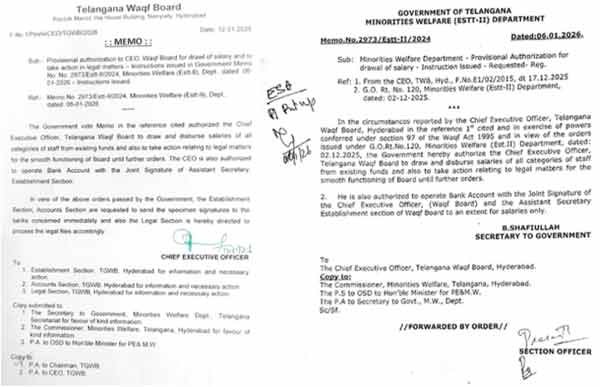
According to officials, instead of correcting the issue after the matter became public, the Chief Executive Officer (CEO) of the Waqf Board issued fresh instructions to ensure immediate implementation of the same disputed memo. Significantly, a copy of these new orders was not sent to the chairman of the Waqf Board but only to his personal assistant, raising further questions about transparency and intent.
An official, requesting anonymity, said, “This is a clear attempt to bypass the chairman and run the board through backdoor orders. The Waqf Act does not allow such interference.”
The controversy centres on Memorandum No. 2973/Estt-II/2024, issued on January 6 by B Shafiullah, Special Secretary, Minority Welfare Department. The memo restricted the powers of the chairman and the board, approved joint signatures for financial matters, and transferred control over salaries and legal affairs to the CEO.
Sources said the CEO, Muhammad Asadullah, showed unusual haste on January 7 to assume these powers. After media reports highlighted the issue, he issued another memo on January 12, bearing file number F.Mo.1/Peshi/CEO/TGWB/2026, directing Assistant Secretaries to act on the Minority Welfare Department’s instructions without delay.
A Board member said, “The elected board cannot be reduced to a rubber stamp. These are not routine matters. They affect waqf lands and ongoing court cases.”
It is learnt that Waqf Board Chairman Syed Azmatullah Hussaini has written to the Chief Secretary of Telangana, the Special Secretary to Chief Minister Revanth Reddy, Minority Welfare Minister Muhammad Azharuddin, and senior officials in the Revenue and Law Departments.
In his letter, the chairman reportedly demanded withdrawal of the disputed memo, stating that the Minority Welfare Department has no authority to take away powers vested in the Waqf Board under law.
“The government or any department cannot snatch the powers of an elected board,” a source close to the chairman quoted him as saying.
Serious concern has also been raised over the transfer of legal affairs to the CEO. Several waqf-related cases are pending in courts, many involving valuable Muslim religious properties.
An advocate dealing with waqf matters said, “There are already allegations that cases were not properly followed in the past. If control shifts further away from the board, many waqf properties may be lost.”
Questions have also been raised about the CEO’s salary claims during a period when he was reportedly transferred back to the Revenue Department following court orders. Though he later approached the court and secured orders to continue at the Waqf Board, officials say there is no clarity about his posting and pay during the interim period.
“No one knows from where he drew salary or under which department he served,” a senior official said.
Sources confirmed that several board members have conveyed their displeasure over what they see as an attempt to weaken the institution from within. They maintain that administrative pressure and departmental interference are paralysing the functioning of the Waqf Board in Telangana.
A board member said, “In Karnataka, the Waqf Board functions with defined rules and respect for its autonomy. In Telangana, meetings are disrupted and decisions are stalled. This only harms Muslims and their institutions.”
Despite these challenges, officials say routine work is being carried out, though major decisions remain affected due to the ongoing tussle.
For many in the Muslim community, the issue goes beyond internal administration. As one community representative put it, “Waqf properties are not government assets. They are meant for mosques, graveyards, schools and the poor. Any move that weakens their protection is an attack on Muslim rights.”
The matter is now being closely watched, with expectations that the state government will step in to restore the lawful authority of the Waqf Board and prevent further damage to waqf institutions.


