

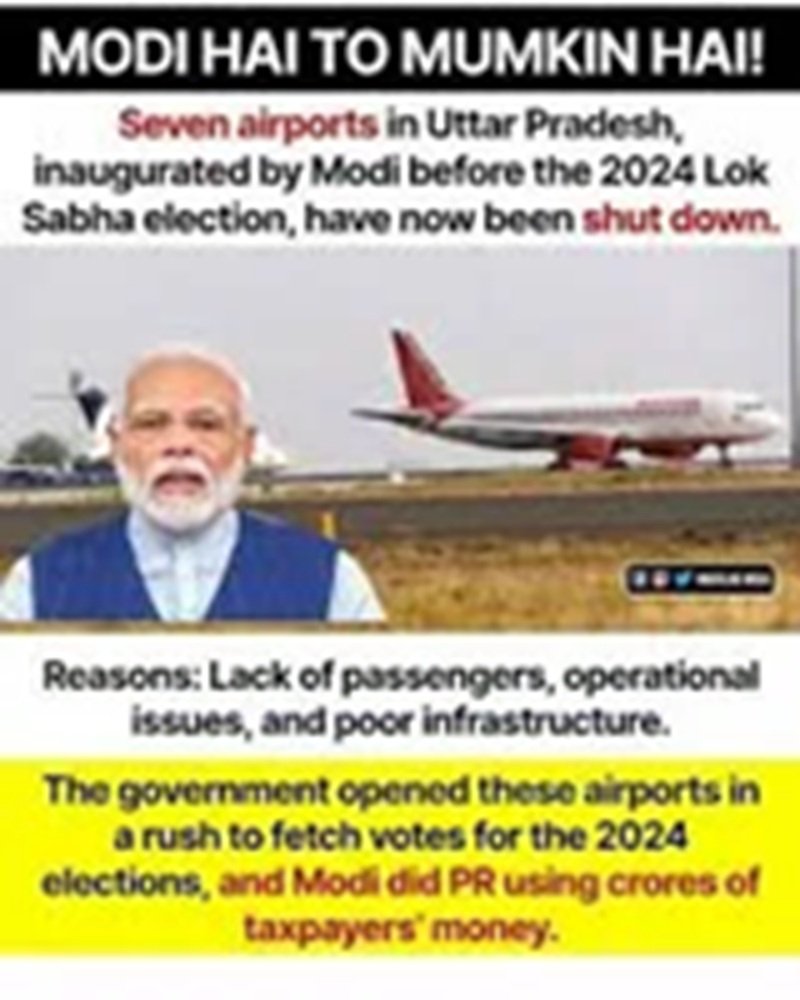
“Seven Airports, Zero Flights in UP” refers to seven newly built airports in Uttar Pradesh (UP) that have become non-operational or seen significant drops in flights shortly after high-profile inaugurations, costing hundreds of crores and raising concerns about planning and viability under India’s regional air connectivity scheme (UDAN), with issues like poor demand, connectivity, and airline participation cited for closures in places like Chitrakoot, Shravasti, Kushinagar, Azamgarh, Aligarh, Moradabad, and Saharanpur.
Ranjan Solomon
SEVEN airports in Uttar Pradesh were built, inaugurated with fanfare, photographed from every angle, and then quietly abandoned. No flights. No passengers. No purpose. What remains are empty terminals, locked doors, maintenance bills, and a public that paid for a dream it never boarded.
This is not a logistical failure. It is a political one.
In a state where public hospitals struggle for oxygen, government schools lack teachers, and drinking water remains unsafe for millions, the construction of airports without passengers is not just bad planning—it is an act of social vandalism. Every rupee sunk into idle runways is a rupee denied to nutrition, health, education, and rural livelihoods.
The airports—Chitrakoot, Azamgarh, Aligarh, Moradabad, Shravasti, Saharanpur, and Kushinagar—were showcased as symbols of “New India.” In reality, they have become monuments to a governance model obsessed with visibility rather than viability. Inaugurations mattered more than operations. Ribbons mattered more than routes.
The government will argue that these airports were built under the UDAN scheme to improve regional connectivity. But connectivity is not created by concrete alone. It requires demand, affordability, integration with local economies, and sustained airline interest. None of this was seriously assessed. What followed was predictable: airlines withdrew once subsidies ended, flights stopped, and public infrastructure turned into dead capital. This is not an isolated error. It reflects a deeper disease in India’s political economy—the substitution of spectacle for substance.
India today builds what looks impressive from the air, not what works on the ground. Statues rise while Anganwadis collapse. Expressways gleam while rural clinics function without doctors. Airports appear in the same space that even bus routes struggle for passengers. Development has been reduced to visual infrastructure -projects that photograph well, trend on social media, and dominate election speeches, while quietly bypassing social reality.
And this story must be placed within the larger context of India’s corporate-centric infrastructure model. While these particular regional airports are not operated by major private airport conglomerates, they exist within a policy ecosystem where public money absorbs risk and private players cherry-pick profit. The state builds, subsidises, guarantees, and inaugurates. When viability collapses, the burden quietly returns to taxpayers. This is privatised gain and socialised loss, dressed up as nationalism.
Uttar Pradesh’s closed airports expose the cruelty of this model. One of India’s poorest states has spent hundreds of crores on aviation infrastructure while lakhs of children remain malnourished. Farmers migrate in desperation while terminals lie empty. Youth are promised “connectivity” but denied jobs, skills, and basic economic security.
What kind of development builds airports for people who cannot afford tickets? What kind of governance prioritises runways over running water? The answer is simple: political optics. Airports photograph well. Hospitals do not. Airports signal modernity to television cameras. Welfare programmes do not. Airports fit neatly into narratives of global ambition and economic ascent. Malnutrition data, anaemia statistics, and water contamination figures do not. But governance is not theatre. It is stewardship of scarce resources.
Defenders of these projects will say that infrastructure creates future demand. That argument collapses when airports shut within months of inauguration. Demand cannot be willed into existence through speeches. It grows from employment, income security, local production, affordable transport, and integrated regional planning—none of which were prioritised. Others will claim these are merely early teething problems. But teething problems do not cost hundreds of crores, nor do they result in complete shutdowns. What we are witnessing is not infancy. It is stillbirth.
The tragedy is not merely financial. It is ethical. Public money is not free money. It carries an opportunity cost measured in human suffering. Every failed airport represents classrooms not built, health centres understaffed, water systems unfixed, and nutrition schemes underfunded. When the state chooses prestige projects over social investment, it makes a moral choice about whose lives matter.
And increasingly, that choice is not in favour of the poor. These closed airports should trigger more than embarrassment. They should trigger accountability. Who approved these projects without credible demand assessments? Who ignored warning signs? Who benefits politically from inauguration ceremonies, and who bears the cost when the cameras leave? Over ₹657 crore was spent on these projects. In essence, it’s a critique of infrastructure projects that build runways but fail to generate consistent air traffic, leaving them idle despite substantial public investment.
A government serious about development would pause, audit, and course-correct. It would stop building symbols and start building systems. It would invest first in water security, health care, education, nutrition, public transport, and local employment before chasing aviation headlines. Instead, we see denial, deflection, and silence.
Seven airports stand closed. But the larger danger is that India’s democratic accountability is closing with them – replaced by spectacle, corporatism, and a politics that mistakes concrete for conscience. Development cannot fly on empty runways. And a nation cannot move forward when governance takes off while welfare is grounded, when optics replace ethics, visibility replaces viability, and power forgets its obligation to the people it claims to serve.
Seven airports. Zero flights.
That is not ambition. That is abandonment.
_________________

Ranjan Solomon is a writer, researcher and activist based in Goa. He has worked in social movements since he was 19 years of age. The views expressed here are the author’s own and Clarion India does not necessarily share or subscribe to them. He can be contacted at ranjan.solomon@gmail.com

