

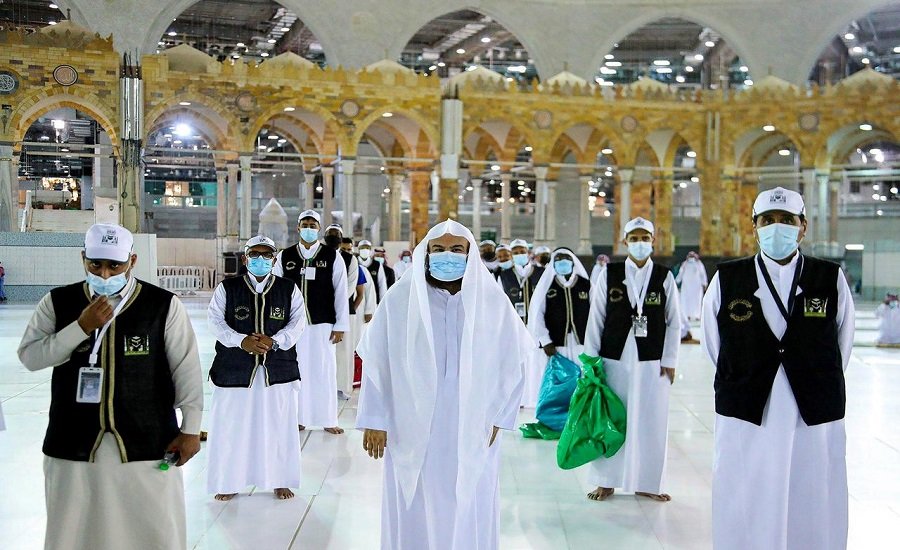
RIYADH — This year’s Haj will be a time of sadness for many Muslims around the world prevented from travelling to Saudi Arabia, but a decision to honour local health and security staff in the front line of the fight against the coronavirus has won praise.
For the first time in the modern era, amidst efforts to curb COVID-19, Muslims from abroad will be unable to attend the pilgrimage.
This year’s event has been limited to about 1,000 pilgrims from within Saudi Arabia, 70% of whom will be foreign residents of the kingdom.
The remaining 30% will be drawn from Saudi healthcare workers and security personnel who have recovered from the coronavirus, as a gesture of thanks for their sacrifice.

“Haj this year is for the heroes who saved the country and saved our people, they deserve it … I personally would have loved to go but there are priorities,” said Saudi citizen Nour al Ghamdi.
Those chosen will receive supplies including special ihram garments, toiletries, and a prayer rug in a suitcase from the Saudi Haj ministry, as well as pre-arranged meals. They will be required to maintain social distancing.
Like many Muslims around the world, Egyptian Mahmoud Ali Mahmoud, 55, laments the restriction to domestic pilgrims.
“As you can see, I had everything prepared. Here is my Quran, my ihram clothing, my garment,” he said, opening his packed suitcase.
“The time that one can spend there could be a time for us to pray that God rids the world of this pandemic,” he said from his Cairo home.
Some 2.5 million Muslims typically visit the holiest sites of Islam in Makkah and Madina for the week-long pilgrimage, due to start on July 28. A once-in-a-lifetime duty for able-bodied Muslims who can afford the cost, it is usually extremely crowded.
Dhera Arizona, 31, had been saving up for seven years to travel to Makkah from Indonesia this year.
“We are disappointed and sad,” she said, but “we understand that in this kind of pandemic situation, it is impossible to hold the worship service”.
Official figures show that the Haj and the year-round Umrah pilgrimage earn the kingdom about $12 billion a year. Minimising the event will hurt government finances, already hit by falling oil prices and the pandemic.
— Reuters


