

Leading scholars, activists, academics and community figures remember Dr Siddiqui as a mentor, institution-builder, and tireless advocate for British Muslims and wider society
LONDON — Glowing tributes were paid to Dr Ghayasuddin Siddiqui, one of the most respected Muslim community leaders in Britain, at a memorial gathering here on Sunday to commemorate his life and work.
His contributions to education, social activism, interfaith engagement and community development were remembered by colleagues, friends, students and family members.
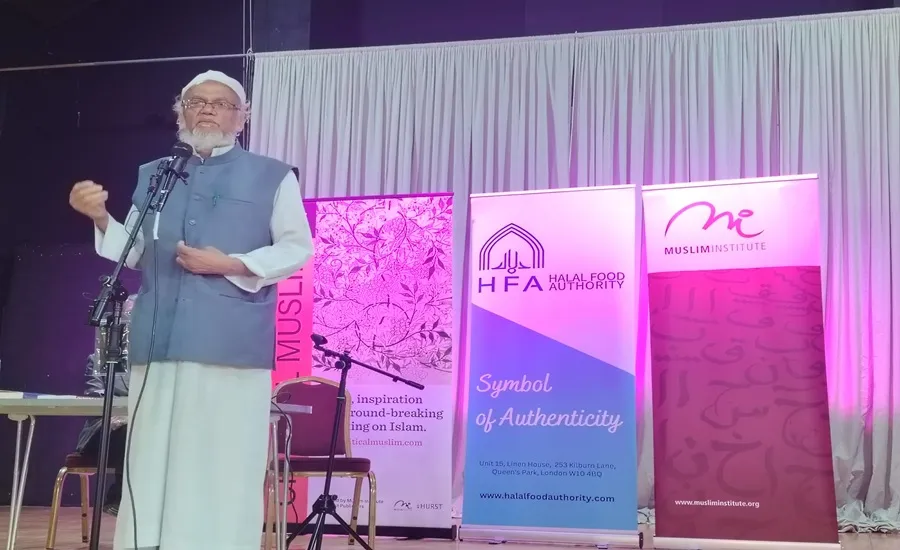
The event, titled “Dr Ghayasuddin Siddiqui: A Memorial Gathering – Commemorating a Life of Service and Sacrifice,” was jointly hosted by the Halal Food Authority and the Muslim Institute at Kenton Hall in Harrow. The programme brought together scholars, activists, writers, academics, religious leaders and community representatives from across Britain.
Dr Siddiqui, the Indian-born British academic and political activist, was the leader of the Muslim Parliament of Great Britain, which he co-founded in 1992. He was also director of one of the oldest Muslim think-tanks in Britain, The Muslim Institute, which he co-founded in 1973.
Dr Siddiqui was born in Delhi in 1939. He migrated to Pakistan on partition in late 1947, and moved to the United Kingdom in 1964.
He died at his home in Chesham, Buckinghamshire, on 18 April 2026, at the age of 86.
At the memorial event, a wide range of speakers shared personal memories and highlighted Dr Siddiqui’s contributions to British Muslim life and international Muslim affairs.
Opening the programme, Asim Siddiqui welcomed attendees and thanked them for gathering to remember a man whose work touched countless lives. A tribute poem was also presented by Talat Siddiqui, recalling Dr Siddiqui’s commitment to justice, service and faith.
Among the speakers was Ziauddin Sardar, who reflected on decades of friendship and cooperation with Dr Siddiqui. He described him as a leader whose influence extended far beyond Britain.
“Dr Ghayasuddin Siddiqui contributed enormously to Britain and to Muslim communities around the world,” Sardar said. “He helped establish and support many organisations and institutions. Although we did not always agree on every issue, our friendship remained strong. He always carried a smile and treated people with respect.”
Sardar said Dr Siddiqui combined strong principles with humility and remained committed to community service throughout his life.
Baroness Shaista Gohir highlighted Dr Siddiqui’s work in public policy, education and social reform. She recalled his involvement in initiatives affecting Muslim families and communities and said he consistently worked to ensure that Muslim voices were heard in public life.
“He was involved in many projects and worked tirelessly to improve the position of Muslims in Britain,” she said. “His efforts in education, community engagement and policy discussions left a lasting mark.”
Several speakers described Dr Siddiqui as a source of support and guidance for younger generations.
One speaker described him as “a voice for the voiceless” and “a powerhouse of energy” who devoted his life to justice and equality. The speaker noted that people paid attention whenever he spoke because his views were rooted in experience, knowledge and a deep commitment to the community.
Humera Khan remembered Dr Siddiqui as a thinker, mentor and supporter of women. She said he encouraged many students and researchers and was always willing to share advice and guidance.
“He respected women and believed in developing future leaders,” she said. “Many students, including doctoral researchers, benefited from his knowledge and encouragement.”
Prof Musharraf Hussain described Dr Siddiqui as a role model who remained firm in his principles throughout his life.
“He lived a life of purpose,” Hussain said. “He was a mentor, a guide and a man of knowledge. He worked tirelessly for the Muslim community and encouraged young people to take responsibility and contribute positively to society.”
He added that Dr Siddiqui possessed deep knowledge of Islamic history and maintained strong relationships with scholars and community leaders across different countries.
Dr Jenny Taylor spoke about her experiences with Dr Siddiqui during her academic research on Islam in Britain. She said his support had been invaluable.
“When I was conducting research and working on my studies, he was always ready to help,” she said. “Whenever I met him, he offered thoughtful advice and practical guidance. He was generous with his time and knowledge.”
She also praised his support for women’s participation and leadership in community life.
Amjad Hussein said Dr Siddiqui’s passing represented a major loss for the community.
“He was always ready to help people,” Hussein said. “His loss is our loss. He was an intelligent man with a remarkable mind and a generous heart.”
Dr Rabia Malik described Dr Siddiqui as someone driven by compassion and public service.
“He had a passion for humanity and community work,” she said. “He was a British Muslim activist who believed in serving society and helping others.”
Ehsan Bari said Dr Siddiqui had been one of the pillars of British Muslim life.
“He contributed greatly to the development of Muslim institutions and public engagement,” Bari said. “His work will continue to influence future generations.”
Tehmina Kazi remembered him as a progressive activist who worked not only for Muslims but for wider society.
“He believed in building bridges and supporting people from different backgrounds,” she said. “His work was not limited to one community.”
Writer Naomi Foyle also paid tribute, describing Dr Siddiqui as a principled individual who spent his life supporting justice and helping others.
“Whenever I approached him with a problem, he would help find a solution,” she said. “He dealt with issues calmly and constructively.”
Dr Iqbal Asaria highlighted Dr Siddiqui’s involvement in mosques, student organisations and publishing initiatives.
“He helped strengthen many institutions and encouraged intellectual discussion among British Muslims,” Asaria said. “His influence reached far beyond the organisations he formally led.”
Prof Iftikhar Malik also reflected on Dr Siddiqui’s contribution to Muslim intellectual life and community development, noting that his work would continue to be remembered by future generations.
Many speakers noted that Dr Siddiqui played an important role in the development of British Muslim organisations over several decades and helped establish platforms through which Muslims could engage with wider society.
Attendees included academics, religious scholars, writers, journalists, community activists, former colleagues, students and members of Dr Siddiqui’s family. Throughout the programme, speakers repeatedly referred to his humility, commitment to service and willingness to support others.
The gathering concluded with a prayer led by Mufti Barkatullah.
“There is no doubt that Dr Siddiqui was a great man,” Mufti Barkatullah said. “May Allah grant patience to his family and loved ones, and may He enable us to continue the kind of beneficial work that Dr Siddiqui devoted his life to.”
The memorial ended with collective prayers for the deceased and an opportunity for attendees to meet, share memories and pay their respects.
Complimentary copies of The Majestic Qur’an, translated by Prof Musharraf Hussain, and A Very British Muslim Activist: The Life of Ghayasuddin Siddiqui were distributed among attendees.
For many present, the event was not only a memorial gathering but also a reminder of the lasting impact Dr Ghayasuddin Siddiqui had on British Muslim life. Speaker after speaker returned to the same theme: a man who dedicated his life to service, encouraged others to work for the common good and left behind a legacy that continues to inspire those who knew him and those who benefited from his work.
