

Donald Trump announced a trade deal with India in which Delhi is supposed to stop buying Russian oil. But India has said nothing about it, writes Betwa Sharma.
Betwa Sharma
DONALD TRUMP claims India and the United States have reached a trade deal in which Prime Minister Narendra Modi agreed to stop buying oil from Russia in exchange for the U.S lowering tariffs on Indian goods from 50 to 18 percent.
In a Truth Social post on Monday, Trump said:
“It was an Honor to speak with Prime Minister Modi, of India, this morning. He is one of my greatest friends … He agreed to stop buying Russian Oil, and to buy much more from the United States and, potentially, Venezuela. This will help END THE WAR in Ukraine, which is taking place right now, with thousands of people dying each and every week!?”
Modi, however, tweeted:
“Wonderful to speak with my dear friend President Trump today. Delighted that Made in India products will now have a reduced tariff of 18%. Big thanks to President Trump on behalf of the 1.4 billion people of India for this wonderful announcement.”
He said absolutely nothing about Russian oil. That was Monday. This is Wednesday and there is still no word from India about any change in purchasing Russian oil. The Indian press has ignored Trump’s words about it.
In Russia, Vladimir Putin’s spokesman, Dmitry Peskov, said Moscow has received no word from India and sees no change in its energy ties. He told reporters:
“So far, we haven’t heard any statements from New Delhi on this matter. We respect bilateral US-Indian relations, but we attach no less importance to the development of an advanced strategic partnership between Russia and India … and we intend to further develop our bilateral relations with Delhi.”
Twenty-five percent of the 50 percent tariffs on India had come because of Indian purchases of Russian oil, which amounted to an average of 1.5 million barrels per day in 2025, or about 33 percent of India’s total oil imports for the year.
As the mystery of the Russian oil claim looms large, the Congress, India’s main opposition party, has slammed the government, warning that India’s strategic autonomy, an enduring challenge, is taking a hit.
Trump made a similar claim last October, saying Modi had assured him that India would stop buying Russian oil, a statement the Indian government rejected.
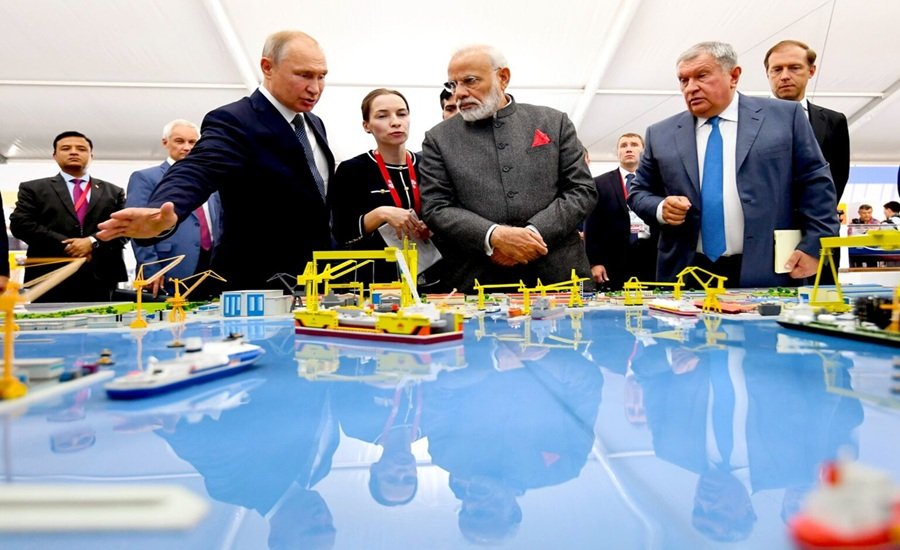
ussian President Putin with Indian Prime Minister Modi, visit a shipbuilding plant in Vladivostok, September 2019. (MEAphotogallery, Flickr, CC BY-NC-ND 2.0)
This time, India has chosen to remain silent on Trump’s claim — so far.
The way Trump treats India and Modi – blunt, unpredictable, and at times bewildering – has left Modi uncharacteristically quiet. Recent events show New Delhi is relinquishing some of the strategic autonomy it always says it maintains.
The Modi government did scale back oil imports from Russia; is withdrawing from Chabahar, the Iranian port that India developed to access Afghanistan and Central Asia while bypassing Pakistan; and is adopting a cautious stance as this year’s leader of BRICS, the bloc of emerging economies that includes Russia and China, which Trump has repeatedly criticised as inimical to US economic interests.
Amid mounting US criticism and tariff pressures, India seemed to win back some of its strategic autonomy last week by finalising the “mother of all deals” with the European Union, a sweeping free-trade agreement two decades in the making.
US Trade Representative Jamieson Greer reacted by saying, “India comes out on top.” Soon after, Washington signalled it was irked by the deal, with US Treasury Secretary Scott Bessent criticising the E.U. for prioritising trade over geopolitics.
He said, “So every time you hear a European talk about the importance of the Ukrainian people, remember that they put trade ahead of the Ukrainian people.”
While Trump’s approach is often unpredictable and undiplomatic, the US has no choice but to regard India as a QUAD partner, a major defence buyer, and a regional counterweight to China, even without a formal alliance.
Courting Trump
Modi went out of his way to court Trump, including travelling to Texas before the 2020 US election to endorse him, an extraordinary step for the prime minister of a foreign country.
In 2019, Indian?Americans packed Houston’s stadium, cheering Trump as he played to the crowd and the frenzied Indian media alongside Modi.
Five years later, the scene is starkly different: this time, Indian-Americans have also been caught in the crossfire of the anti-immigration wave with racist overtones. MAGA forces are calling for H?1B visas to be cancelled—the program that brings so many Indians to work in the U.S—and Indian workers have been deported with handcuffs and shackles on their legs, while India can do little but watch.
US pressure isn’t just shaping India’s energy and regional choices; it also risks straining historic ties with Russia and Iran.
With Russia, the connection goes back to the Cold War and the era of “Hindi-Rusi bhai-bhai” (Indians and Russians are brothers), while ties with Iran stretch back centuries.
Persian (Farsi) was once the language of India’s courts, literature, and administration. Foods and traditions connect the two countries, and many Indian Shia Muslims still look to Iran as a religious centre.
This is not solely Modi’s failure.
India, unlike China, Russia, or the United States, is not a global power and must constantly navigate a complex web of competing interests. While it often advances its agenda through careful balancing, moments like this expose the limits of that approach.
Going South
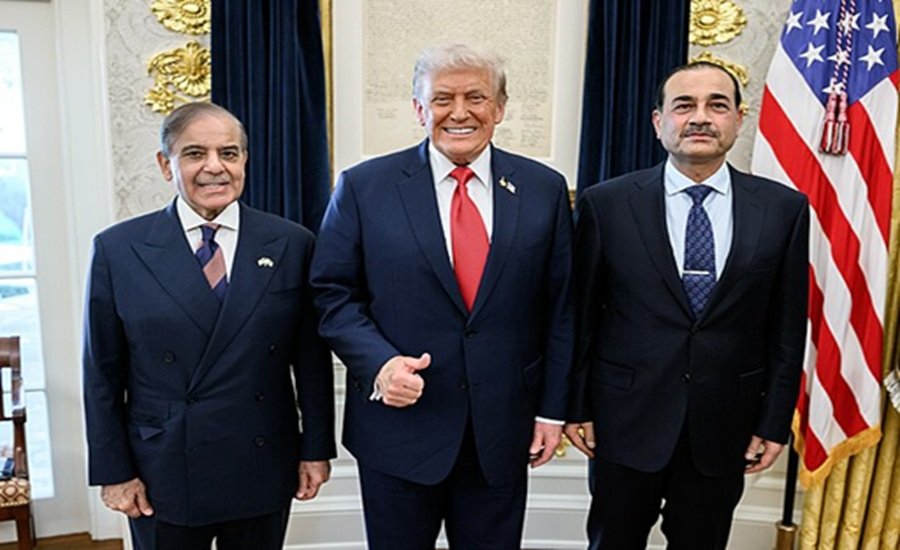
Trump meets with Prime Minister Shehbaz Sharif and Field Marshal Asim Munir of Pakistan, September 25, 2025. (Daniel Torok, White House Photo)
Things really went south for India after Trump claimed credit for ending a deadly four-day India–Pakistan skirmish in April 2025, which was triggered by a terrorist attack in which Hindus were targeted and for which India blamed Pakistan.
The fallout deepened when Trump went on to host Pakistan’s army chief, Field Marshal Asim Munir, while India struggled to win much international sympathy despite the attack taking place on its soil.
Since then, Trump has repeatedly said he stopped the conflict and a potential nuclear escalation by threatening trade consequences, alongside a steady stream of jibes and attacks, some aimed personally at Modi. That undercut the strongman image Modi has cultivated with his domestic base.
Trump said, “India ordered 68 Apaches,” and claimed at the time that Modi asked supplicantly, “Sir, may I see you, please?” He said Modi assured him India would stop buying Russian oil, a statement India’s government rejected.
Losing Strategic Autonomy
India has long relied on Russia for discounted crude oil, especially since global prices spiked after the Ukraine war. For Russia, the West’s economic war against Moscow meant turning towards the East and the Global South, and India has been a big part of that.
After US sanctions on major Russian oil exporters Rosneft and Lukoil took effect in late November 2025, Indian refiners sharply cut back shipments, with imports dropping to their lowest levels in two years in December 2025, down about 29 percent month-on-month to around 1.2 million barrels per day from roughly 1.8 million barrels in November.
For 2025, OPEC’s share of India’s crude imports edged up to 50 percent, from 49 percent a year earlier, while Russia’s share shrank to 33.3 percent from 36 percent in 2024.
While India has said it is diversifying its sources of supply, Russia has downplayed the reduction, calling it temporary and stressing the long-term importance of India’s and Russia’s energy relationship.
Iran Test
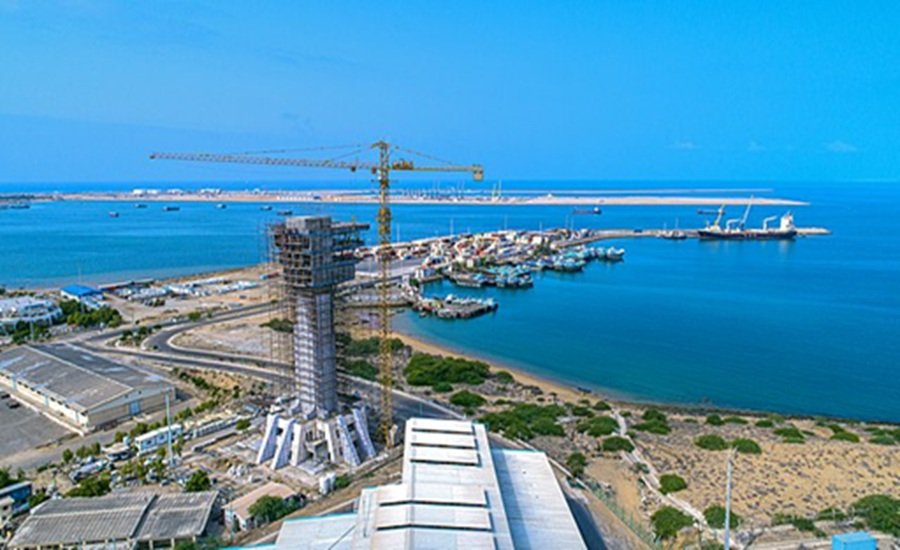
Iran’s Chabahar port on the Gulf of Oman. (Creative Commons ASA 4.0)
India’s relationship with Iran is also being tested like never before after Trump’s warning that any country doing business with Iran could face a 25 percent tariff on all trade with the US.
In September 2025, the US withdrew the sanctions waiver it had granted India, which had allowed the country to use the deep-water port off Oman without facing penalties for dealing with Iran.
After that, India reportedly told the US government it planned to “wind down all activities” at Chabahar port, following which the US Department of the Treasury granted a temporary sanctions exemption until April 2026.
A government source was quoted as saying, “India has no choice but to exit the Chahabhar port….We have to exit unless sanctions are eased by the US again.”
By effectively blocking India’s use of the Chabahar port off the coast of Oman, the US is disrupting New Delhi’s crucial link to Afghanistan and Central Asia, a strategic route that serves as an important alternative to Pakistan’s Gwadar port in Karachi, which is operated by a Chinese state-owned company.
This is no doubt hard for India to accept.
Even as the Indian state-owned entity operating Chabahar has reportedly taken down its website, anonymous government sources insist that India is still exploring a “middle-ground approach” between Iran and the US and winding down operations is not really an option for New Delhi.
Iran has not issued an official condemnation of India’s withdrawal from the Chabahar port.
Then There Is BRICS
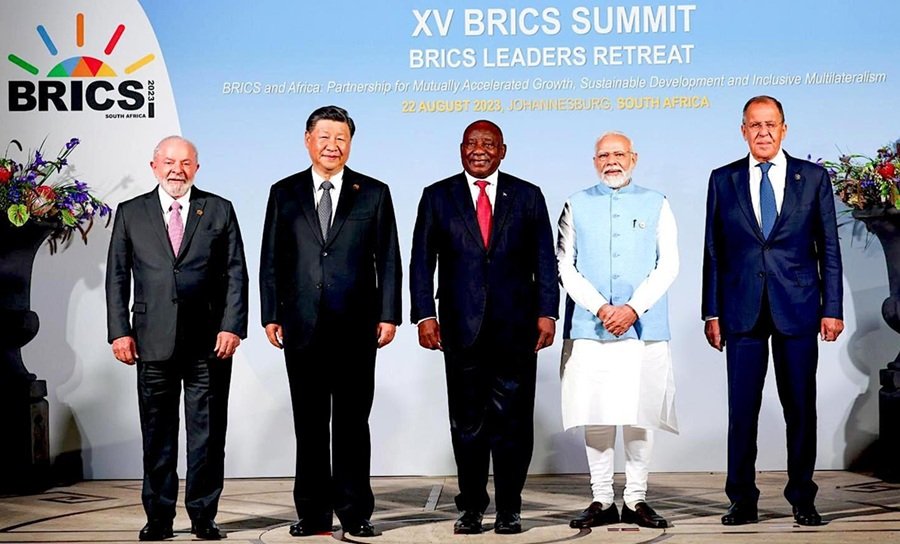
From left, Brazil’s President of Brazil Lula da Silva, China’s President Xi Jinping, South Africa’s President Cyril Ramaphosa, India’s Prime Minister Narendra Modi and Russia’s Foreign Minister Sergei Lavrov at the 2023 BRICS summit in Johannesburg. (Prime Minister’s Office – Press Information Bureau, GODL-India, Wikimedia Commons)
The US is also watching India’s leadership of the BRICS in 2026, a forum that is becoming an alternative to US-led economic institutions.
India has already framed its leadership around multilateralism.
BRICS, originally composed of five countries, Brazil, Russia, India, China, and South Africa, added five new full members in 2025: Egypt, Ethiopia, Iran, the United Arab Emirates, and Indonesia.
In addition, BRICS has created a separate “partner country” category for Belarus, Bolivia, Cuba, Kazakhstan, Malaysia, Thailand, Uganda, Uzbekistan and Nigeria.
India has backed Saudi Arabia’s entry into BRICS, but Riyadh has been cautious, given its close strategic ties with the United States and its reluctance to formally join a group that includes Russia and China in a way that could upset Washington.
Trump has mocked BRICS, calling it “a little group… fading out fast,” saying its attempts to challenge the US dollar’s global role have largely failed under his pressure. He has threatened 10 percent tariffs on members for aligning with what he describes as “anti-American policies.”
Trump has said countries must commit to not replacing the dollar or “face 100 percent tariffs” and “can go find another sucker nation.”
To manage sensitive US relations while leading BRICS, India has since 2025 sent its foreign minister, Subrahmanyam Jaishankar, as its representative to key meetings, such as a BRICS virtual summit and a BRICS foreign ministers’ gathering in New York during the U.N. General Assembly. This signals engagement while maintaining a measured profile.
It would be deeply problematic for India if the US manages to impose its international posture on a multilateral forum where India has maintained autonomy.
A Hard Place & a Thawing With China
While Trump’s approach is often unpredictable and undiplomatic, the US sees little choice but to value India as a QUAD partner, a major defence buyer and a regional counterweight to China even without a formal alliance.
But with ties between India and the US cooling under Trump, the Modi government has been quietly recalibrating toward China.
Last September, Modi attended the Shanghai Cooperation Summit in Tianjin — his first visit to China in seven years, since the April 2020 border standoff. And just this month, Reuters reported that India is planning to reopen the doors to Chinese companies bidding on government contracts, reversing restrictions put in place after those clashes.
The clash in Galwan Valley in India’s Ladakh region claimed the lives of 20 Indian soldiers. China has not confirmed the number of dead soldiers on its side. Estimates vary from four to 42.
The move to offer concessions has drawn sharp criticism, as the 2020 border confrontation remains unsettled and Chinese troops repeatedly cross the disputed Himalayan boundary.
Just this week, Rahul Gandhi, leader of the Opposition, caused a ruckus in Parliament when he cited an unpublished memoir by a former army general claiming Chinese tanks were approaching the border in 2020 and criticising the government’s handling of the situation.
c. Consortium News


