

“When I woke up, I found her frozen, like a piece of wood.”
During its ongoing genocide in the Gaza Strip, Israel has “systematically targeted and dismantled the conditions necessary for safe pregnancy, birth, and postpartum recovery” as part of a “methodical and systematic assault on Palestinian mothers and reproductive life generally, constituting a wide array of international crimes,” a new report has revealed.
The eight-page report, titled Violence Against Mothers in Gaza: Birth, Postpartum, and Death amidst an Ongoing Genocide, also includes harrowing testimonies of mothers losing their children to hypothermia due to the destruction of healthcare infrastructure, a tight siege, and a lack of adequate shelter for mothers and newborns. It was published by the Palestinian human rights organisation Al-Haq on February 13 and submitted to the United Nations Special Rapporteur on Violence Against Women, Reem Alsalem.
According to the Gaza Health Ministry, which takes into account only the bodies that reach hospitals, the death toll during the ongoing genocide has exceeded 72,000. Civilians comprise more than 90 percent of the fatalities during this Israeli campaign of extermination, while children and women have borne the brunt of Israeli barbarism.
Al-Haq’s report places a special focus on pregnant women and their newborns to highlight the unbearable conditions they are being forced to endure by the Israelis and the impact of those conditions on the health of the mothers and their children born during the genocide.
“Israel’s actions, including its systematic, widespread attacks on reproductive health facilities, and severe restrictions on food, shelter and medical supplies have resulted in devastating and foreseeable, yet preventable, harm to Palestinian mothers in Gaza,” the report states.
It adds, “The suffering and death of newborns, often born prematurely as a result of Israel’s creation of conditions of life calculated to destroy Palestinians in Gaza and detrimentally impacted by a lack of medical care, starvation, and exposure to cold, has further compounded the trauma experienced by mothers. Together, this targeted violence amounts to: mental and physical torture, grave violations international human rights law; war crimes; crimes against humanity; and acts of genocide.”
The Israelis destroyed Gaza’s healthcare infrastructure as the first order of businessduring the start of their genocidal campaign, ensuring Palestinians could not count on any safe spaces across the besieged enclave. The near-total destruction of the healthcare facilities has made it extremely dangerous for expectant mothers. Those who could reach the barely-functioning hospitals suffered due to a chronic shortage of medicines and other essentials under the Israeli blockade.
“Israel’s restrictions on medical supplies have been described by clinicians as ‘extreme, inconsistent, and deliberately opaque’,” the report states. “A wide range of items, including anaesthesia, antibiotics, blood supplies, and sterile surgical equipment, were denied or delayed under ‘dual-use’ classifications or unclear bureaucratic procedures which breach the relevant standards set by international export and sanctions regimes.”
The excruciating pain of witnessing the suffering of their newborns has resulted in “profound psychological trauma” for the mothers. “For mothers, witnessing the death of a newborn – or surviving a near-fatal delivery devoid of all necessary medical provisions and in an unsterile environment, with often no home to return to as a result of being repeatedly forcibly displaced – leads to profound psychological trauma and lasting mental harm, often compounded by an immense sense of helplessness, guilt, and grief,” the report adds.
Israel’s full-spectrum blockade last summer — during which the genocidal state put a complete halt to all aid entering the enclave, ultimately leading to a famine that killed hundreds — had a particularly adverse effect on pregnant women in the devastated territory. “Pregnant and breastfeeding women were among the most severely affected, experiencing prolonged hunger, dehydration, and micronutrient deficiencies that directly undermined foetal development and subsequent maternal health,” the report highlights.
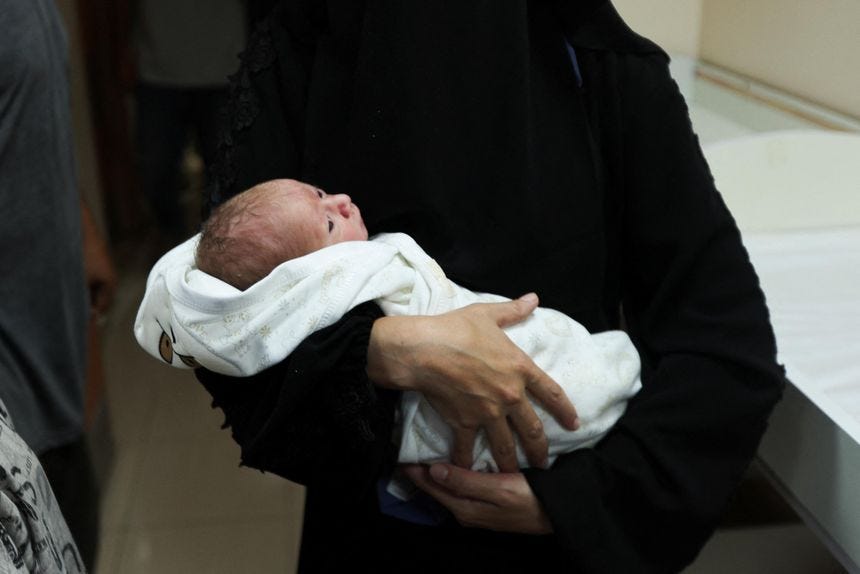
Deaths of the newborns
First-hand testimonies of mothers witnessing their newborns die in their embrace due to severe cold under flimsy tents comprise the most harrowing parts of the document.
The Al-Haq report documents the account of a woman, who lost her premature newborn boy, Ali, due to the severe cold in her tent in Khan Yunis in December 2024:
After a week [of his birth], I woke up at night and held my baby to feed him. He opened his mouth, he wanted to breastfeed, but then he closed it. I put him down, and blood started to pour down from his nose and mouth. I screamed for my husband, who took him to the hospital. The doctors told us that he died of hypothermia.
Another woman forcibly displaced to Khan Yunis lost her one-month-old son due to hypothermia. She described in agonising detail how her son was “frozen solid, like a block of ice”:
So he woke up at 1:00 am, I fed him, and then we went to sleep. I always put him to sleep in my arms, against my body to keep him warm. But my arm started to hurt, so I laid him down beside me and went to sleep. When I woke up, I noticed he hadn’t stirred to feed in a while. I started nudging him, trying to get him to move – nudging his body – but there was no movement at all. Nothing. Thank God… (crying) […] I swear by God – he was frozen solid, like a block of ice. I opened his blanket to try to move him – his fingernails were blue, his toes and hands too, all blue. I knew. […] I just held him to my chest to warm him up. Then my husband said, “I’ll take him to the hospital.” He took him. Later, he came back and brought me some clothes – but he didn’t bring the baby.
Aisha was just 22 days old when she froze “like a piece of wood” next to her mother in December 2024. Her mother recounted the story of that fateful night in her tent to Al-Haq:
When I left the hospital and went back to the tent, the temperature was very low, it was very cold. Although my baby was healthy, she caught a cold as a result. It’s a tent after all. I took her back to the hospital, and they told me that nothing was wrong with her. So, I went back to the tent. Nothing was wrong with her; the baby was normal. The day she passed away, she breastfed. She was sleeping in my arms the entire night. I was so happy as it was the first day she breastfed properly. We slept together, while she was in my arms, at dawn. That Friday night was very cold. She passed away here in the tent. When I woke up, I found her frozen, like a piece of wood. [Her father] took her to the hospital right away. The doctors told us that she passed away from the cold [hypothermia], freezing.
The report details another mother’s extremely difficult circumstances at the time of the birth of her daughter, Sila: “Due to exhaustion and malnourishment [the mother] was unable to produce any milk at the beginning – nor did she have any nappies or clothes after repeated rounds of forced displacement.”
Three-week-old Sila barely stood a chance in such circumstances. Her mother recounted the night she passed away:
The night my daughter passed away—it was freezing. The night we went through was like ice. The sea is close to us, and we had no mattresses or blankets. We were sleeping on the sand. After I gave birth, some people took pity on us and gave me a few blankets to lay down so the tent could stay warm. […] At around 5:00 am, I told my husband, “I feel like Sila didn’t nurse well tonight.” He got up and lit a fire so I could prepare a bottle for her. Then he went to wake her to feed her—he lifted the blanket from her face and found her completely blue—blue, stiff—and her nose and mouth were bleeding, bleeding all over. Her little hands were frozen stiff. I was in shock—she had been fine, breastfeeding all night, nothing was wrong with her. And then suddenly she was like that. […]
After examining her, the doctor said: “The baby has been dead for an hour and a half from the cold—her heart stopped because of the freezing temperature.” I was completely shocked. She had been perfectly fine when I gave birth—born naturally— and then suddenly I lost her. We were going through incredibly hard times, and when God finally blessed me with her, I was so happy. Her father was so happy too. Losing my daughter—it’s something unbearably painful.
All four deaths of the newborns due to hypothermia, documented in the report, took place in the winter of 2024. A year later, things have barely changed despite a supposed “ceasefire” in effect. The Israelis have continued to keep a tight siege on the enclave, with adequate shelter, food, and medicines severely restricted.
This winter has been typically harsh — made worse by worn-out, flimsy tents and destroyed infrastructure, which invariably leads to tents flooding after rains. These extremely difficult conditions have resulted in the deaths of over a dozen newborns so far.
There should be no doubt that this Israeli sacrifice of newborns is a consequence of policy — deliberate, documented, and unfolding in plain sight.
C. Palestine will be free


