

This genocide has not only incinerated those caught in its raging inferno. It has also fundamentally altered the way we perceive destruction.
The population of Palestinians in the Gaza Strip has dropped by 10.6 percent over the last two years of the genocide, according to the year-end report published by the Palestinian Central Bureau of Statistics (PCBS) on Wednesday.
“Gaza Strip experienced a sharp and unprecedented population decline of approximately 254,000 people, representing a decrease of 10.6% compared to pre-aggression population estimates,” the PCBS report said. “Gaza’s population now stands at 2.13 million, reflecting what PCBS describes as a severe demographic hemorrhage caused by killing, displacement, and deteriorating living conditions.”
Although international agencies and scientific institutions have estimated a much higher death toll, the bureau takes the official numbers from the Gaza Ministry of Health in its accounting, stating: “By the end of December 2025, the number of martyrs in Gaza Strip reached 70,942, including 18,592 children and approximately 12,400 women. In addition, nearly 11,000 individuals remain missing, and the number of injured has risen to 171,195.”
It adds that about 100,000 Palestinians have left the besieged enclave since the start of the Israeli genocide on October 7, while nearly the entire population has been displaced as a result of the relentless Israeli bombardment continued for two consecutive years.
Israeli aggression in the West Bank — which played no part in the Al-Aqsa Flood operation — has killed 1,102 and wounded 9,034 Palestinians since October 7.
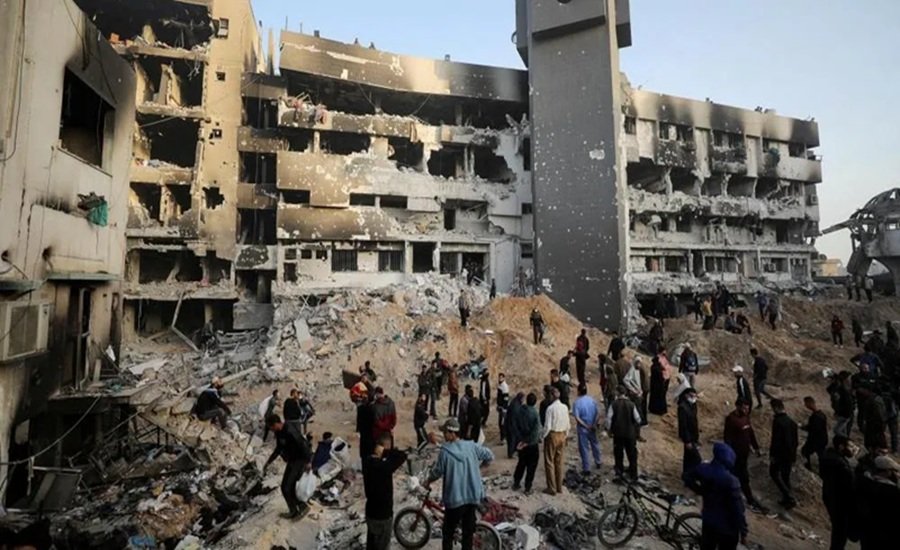
Al-Shifa Hospital, Gaza’s largest medical facility, was completely destroyed by the Israelis in early 2024.
The report puts the total number of Palestinians worldwide at 15.49 million. “Of these, 5.56 million reside in the State of Palestine, while 1.86 million live in the 1948 territories. The Palestinian diaspora now reached approximately 8.82 million, including 6.82 million living in Arab countries, with the rest spread across various regions worldwide. This continued dispersal underscores the long-term political and historical drivers of forced displacement.”
Destruction of the health system
The report cites figures from the World Health Organisation, revealing the catastrophic state of the healthcare system in Gaza: “94% of hospitals and healthcare facilities have been damaged or destroyed.”
While nearly half the hospitals in the besieged enclave have been put out of service as a result of Israeli attacks, those still functioning are operating at a drastically reduced capacity. “Only 19 out of 36 hospitals remain partially operational, functioning with severely limited capacity amid acute shortages of medicines, medical supplies, healthcare workers, and fuel,” the report added. “Currently, Gaza Strip has approximately 2,000 hospital beds for a population exceeding two million.”
The so-called “ceasefire” has brought no relief to the medical sector and is posing a grave risk to the besieged enclave’s women and children. “Humanitarian conditions for women and children have reached critical levels,” the report revealed. “Approximately 60,000 pregnant women face grave health risks due to limited or absent healthcare services, while 155,000 pregnant and breastfeeding women struggle to access prenatal and postnatal care.”
The wanton destruction of infrastructure in the Strip has resulted in greatly curtailed access to clean water for residents, further imperilling their health. “More than 70% of Gaza’s population relies on contaminated or unsafe drinking water,” the report stated. “By July 2025, 95% of households were completely unable to access safe water.”
Destruction of educational institutions
The Israelis have laid waste to nearly every school and university in the Gaza Strip. Long after their bombardments rendered schools inoperable and they had become shelters for displaced people, the Israelis continued bombing them, reducing many to rubble.
“As of early December 2025, more than 179 government schools were completely destroyed, while 218 schools were bombed or damaged, including 118 government schools and 100 UNRWA schools,” the report added. “At the higher education level, 63 university buildings in Gaza Strip were completely destroyed, while eight universities in the West Bank were subjected to repeated raids and vandalism.”
Beyond the physical structures, the human toll of Israel’s wanton bombings has been staggering: “18,979 school students were martyred, including 18,863 in Gaza Strip. Additionally, 1,399 university students were killed, along with 797 school teachers and administrators and 241 higher education employees, reflecting direct targeting of the education sector.”
What it means
The findings of the PCBS report paint a devastating picture of the mass killing of Palestinians that the world has witnessed live for over two years in all its gory detail: open skulls and protruding intestines of children, wailing mothers, fathers futilely digging through thousands of tonnes of rubble to reach their buried infants, and sleep-deprived, resource-starved doctors caring for an unending stream of injured patients barely clinging to life.
The report also reveals the systematic destruction of the foundations of life itself — an endeavour the Israelis made clear from the outset that they intended to pursue. The sharp population decline, the collapse of medical infrastructure, the annihilation of education, and the forced displacement of Palestinians expose a deliberate campaign to erase Gaza demographically, socially, and intellectually, exactly as Israeli leaders declared while launching their genocidal assault on October 7.
What the Israelis have been doing in Gaza — with total impunity and unflinching Western support — has laid bare the total vacuousness of international institutions. The Israelis have implemented to the letter what their leadership has unabashedly been stating for years. This genocide has not only incinerated those caught in its raging inferno. It has also fundamentally altered the way we perceive destruction.


