

Suchitra Vijayan
ON November 22, 2021, Indian authorities arrested Khurram Parvez, a noted human rights defender in the world’s most militarized zone—Kashmir. A lifelong activist, Khurram was drawn to non-violent resistance at a young age of 13 after he witnessed his grandfather being shot during a demonstration in Kashmir.
The National Investigation Agency charged him under India’s stringent anti-terror law with allegations of terror funding, criminal conspiracy, raising funds for terrorist attacks, and waging war against the mighty Indian state. Authorities raided his home and the office of the Jammu Kashmir Coalition of Civil Society (JKCCS) and seized electronic devices and documents.
Khurram and JKCCS are not new to raids or arrests. They have lived with these threats for as long as I have known them. Over the last decade, the pressure has been constant, and it intensified after August 2019, when India abrogated Kashmir’s special status and autonomy. In October of the following year, the National Investigation Agency (NIA) conducted simultaneous raids on JKCCS offices and the homes of key activists, including Khurram’s own home and office. Devices and documents were also seized. Serious terrorism charges were filed under the controversial anti-terror law, Unlawful Activities (Prevention) Act (UAPA). These were not isolated incidents. They formed part of a broader campaign that targeted JKCCS, human rights activists, journalists, and similar groups, sending a message that those who document occupation would be treated as enemies of the state. There have been multiple raids, at least three were reported, and persistent threats. The pattern was clear for everyone to see: sustained repression of an organisation and its members who tried to keep a record of state violence against their communities.
That last round of raids and arrests, the one that put Khurram behind bars in 2021, was finally able to hit the civil liberties institution he headed. It emptied the once bustling JKCCS office. Six months after Khurram’s arrest, I called a friend in Srinagar and asked about Parvez Imroz Saab, the man who built and held the JKCCS together. My friend said that every day, Imroz saab still went to the empty office and sat there, his trademark smoke in hand, but no one came. The office, located in Amira Kadal in Srinagar, which used to be a hive of activity, always open even in the worst of times, had fallen silent. The state had not only caged a human rights defender, it had hollowed out one of the last remaining spaces of dissent.
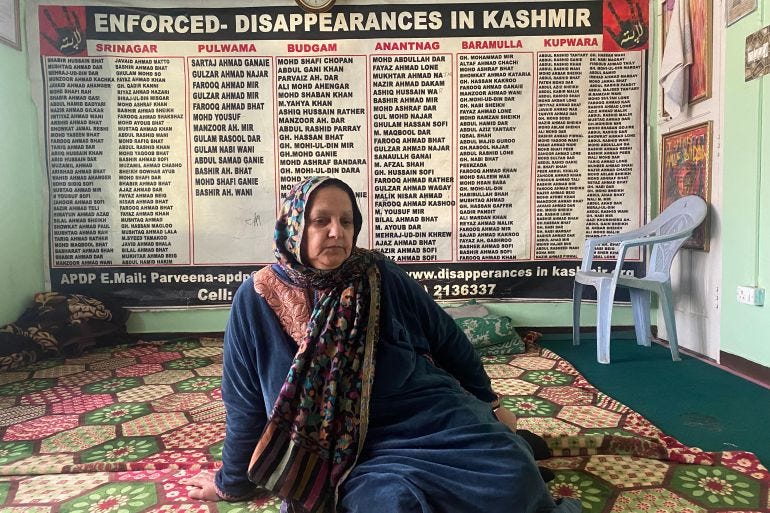
Khurram’s arrest is widely understood as a reprisal. Since that day, every year, human rights organisations, United Nations experts, activists, writers, and journalists across the world mark the anniversary of his arrest by insisting that his name not be forgotten.
Let’s remember this. Khurram Parvez was disappeared into the Indian carceral system, held behind the walls of Rohini Jail in New Delhi for the crime of documenting grave human rights violations in Kashmir. His detention has been extended repeatedly. In March 2023, he was arrested in a separate case on fresh allegations of terrorism financing. Earlier that year, he received the Martin Ennals Award, a prestigious human rights prize.
As I write this on the eve of his fourth year of incarceration, I find myself without the correct language. Time feels distorted. Has it really been four years already? Has it been so long since Khurram walked freely through his city, through the JKCCS office that became a waystation for so many of us who came to Kashmir to learn how to listen, write, and document the occupation?
I first met Khuram almost a decade ago, in the fall of 2014, the day after the Indian Independence Day, August 14. I had gone to the JKCCS office in Srinagar, where I met Khurram, Parvez Imroz Saab, and a host of other lawyers and researchers. That space was many things at once. It was a place for anyone who reported or researched on Kashmir, human rights, and the sustained occupation of the region. JKCCS was also a living archive — you could ask the lawyers and researchers about almost any case, any killing, any protest, and they would locate it instantly inside a larger structure and history of the occupation of Kashmir.
I remember the unease of walking into that room as an Indian citizen in 2014, sitting in the heart of an occupied land my passport claimed as its own. Khurram met that discomfort with a quiet generosity. There he was, with his smile and his patience, answering questions I did not yet know how to ask correctly. The Kashmir chapter of my book, Midnight’s Borders, would not exist without him.
Khurram was more than a world-renowned activist. He became my friend. A decent man. Kind, open, and stubbornly willing only to see the best in others, even when everyone around him was exhausted by the cruelty of the present.
There are days like today, when I count forward from that first meeting. And then I try to remember when I last saw him. For a long time now, the years have blurred together, and I couldn’t remember. Then, I wonder if it was 2016, when we were on a panel together at the UN office in New York. Was that the last time I saw him? Did I not see him again? That cannot be true. The surveillance, the tightening noose around Kashmir, and the slow work of repression have all conspired to blur the timelines and conversations.
After four years, I do not know what new words are left to describe Khurram’s incarceration. I only know that his absence has now stretched into years that can no longer be described as temporary or exceptional.
Some details of the case remain almost unbearable. Khurram has been imprisoned for documenting what happened to his people. Among the evidence placed against him are two human rights reports, the Structures of Violence Report and the Torture Report produced by JKCCS on violations in Kashmir and the impunity with which Indian forces operate there: the reports painstakingly record enforced disappearances, torture, extrajudicial killings, and the architecture of occupation.
In the case of late scholar and activist G. N. Saibaba, I once wrote that a bookshelf had become evidence of sedition. Following an excruciating decade in prison, the 90% disabled and ailing Saibaba passed away months after his acquittal. In Khurram’s case, the human rights reports of the organization he worked for became the evidence of sedition. The state alleges that by documenting these crimes, he tarnished India’s image. A human rights report has been recast as a secessionist document. The record of violence is treated as the real crime, and the man who kept that record sits behind the walls of Rohini Jail.
Since his arrest, statements and urgent appeals have repeated the same basic facts every year. Khurram is a human rights defender. He is protected under international law. His detention violates India’s obligations. The charges are baseless and punitive. All of this is true, and all of it feels inadequate beside the theft of his years spent in pre-trial detention under a law designed to keep people locked up without conviction.
What remains with me are smaller, stubborn images, like Khurram in that crowded office in Srinagar. Khurram listened more than he spoke, making room for others even as he carried their stories. Khurram insisted that documentation is never abstract, that every line in a report is a life, a family, a case with perpetrators and an act of impunity that will one day be adjudicated.
The Indian state has tried to turn that work into proof of terror. It has tried to make an example of him, a warning to others who might dare to watch the state too closely. Yet the record he and JKCCS helped build continues to travel. The reports are cited in courtrooms, in UN documents, in classrooms, and in the quiet work of young researchers who were children when the first cases he documented occurred. The state holds him captive, but it cannot do the same to the record of repression or the list of alleged perpetrators that Khurram and his colleagues published.
Khurram Parvez’s continued imprisonment lays bare a simple fact. In today’s India, the act of bearing witness itself is suspected, punished, and the person who names the crime is turned into a criminal. The archive — human rights reports, case files, stories, photos, testimonies — has become contraband in a nation that now thrives on criminalizing dissent.
C. The Polis Project

