

Concerns over the act posing an unprecedented threat to India’s hard-won right to information and freedom of the press
NEW DELHI — In an extraordinary show of unity, senior judges, eminent lawyers, leading journalists, rights groups and grassroots movements sounded a sharp alarm on Wednesday, warning that the newly notified Digital Personal Data Protection (DPDP) Act, 2023 poses an unprecedented threat to India’s hard-won right to information and freedom of the press.
Meeting at the Constitution Club of India for a national consultation convened by the Roll Back RTI Amendments Campaign—a collective of the National Campaign for Peoples’ Right to Information (NCPRI) and over 30 civil society organisations—alongside the Campaign for Judicial Accountability and Reforms (CJAR) and the Foundation for Media Professionals (FMP), speakers cautioned that key provisions of the Act could “cripple transparency” and “chill democratic scrutiny”, striking at the very heart of public accountability.
The sense of urgency followed the government’s November 14 notification of the DPDP Rules and an order activating major portions of the Act in a staggered manner. Among the earliest sections to come into force was Section 44(3)—a controversial clause that amends the RTI Act to block access to all personal information, regardless of whether disclosure is necessary to expose corruption or wrongdoing.
Legal experts at the consultation described the move as a “drastic rollback” of the landmark 2005 RTI Act, which has been instrumental in revealing scams, detecting administrative negligence, securing welfare entitlements and protecting constitutional rights.
‘Vital Information to Be Off-Limits’
Former Supreme Court judge Justice Madan Lokur illustrated the stakes by referring to a recent tragedy in Goa, where a restaurant fire killed 25 people.
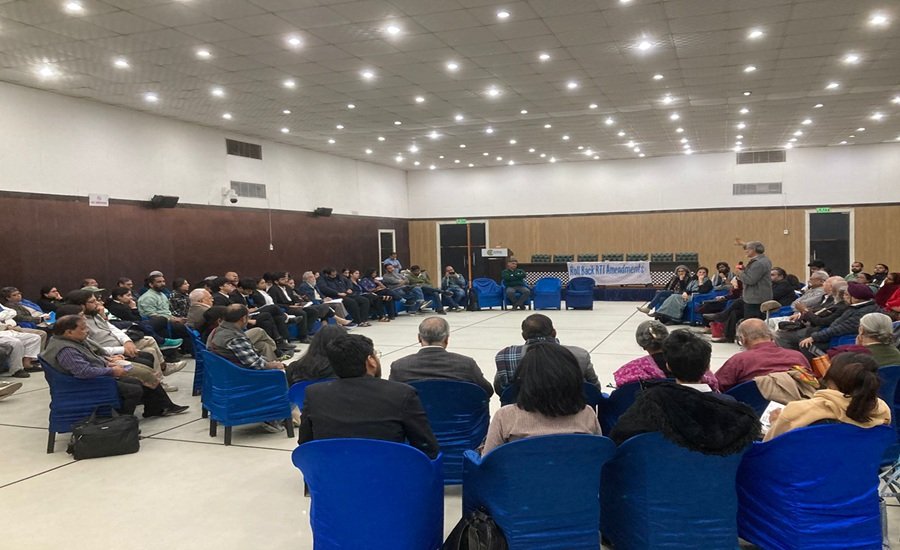
Consultation meeting on DPDP act implications at the Constitution Club of India
“Who approved the fireworks? Who inspected the building? Which officer ignored earlier complaints?” he asked. “Under the DPDP, all of this could be treated as personal information and withheld. This is devastating for public accountability. The right to know is being dismantled piece by piece. The DPDP is a death blow to the RTI Act.”
Justice Rekha Sharma echoed the concerns, emphasising the need for nationwide public education.
“People across the country must understand how deeply the DPDP Act affects their ability to seek answers from the government,” she added.
Red Flags Raised
The consultation saw participation from social movements, civil society organisations, retired judges, senior advocates, journalists, researchers and grassroots campaigns.
Among those present were senior lawyers Huzefa Ahmadi, Nitya Ramakrishnan, Gautam Bhatia, Cheryl D’Souza, Suroor Mander, Soutik Banerjee, Shomona Khanna, and Indira Unninayar.
Journalists—including senior editors, investigative reporters and the President of the Press Club of India—warned that the DPDP Act could severely curtail journalism, particularly investigative reporting that relies on government documents, inspection reports, vigilance findings, and service records of public officials
Representatives from a wide range of movements—including the Right to Food Campaign, National Alliance of Peoples’ Movements, National Federation of Indian Women, Internet Freedom Foundation, Jan Swasthya Abhiyan, People’s Union for Civil Liberties, Right to Education Campaign, National Campaign for Dalit Human Rights, Common Cause, Constitutional Conduct Group, AIDWA and several others—spoke of how the law could undercut grassroots monitoring of welfare schemes, suppress evidence of discrimination, and impede transparency in public spending.
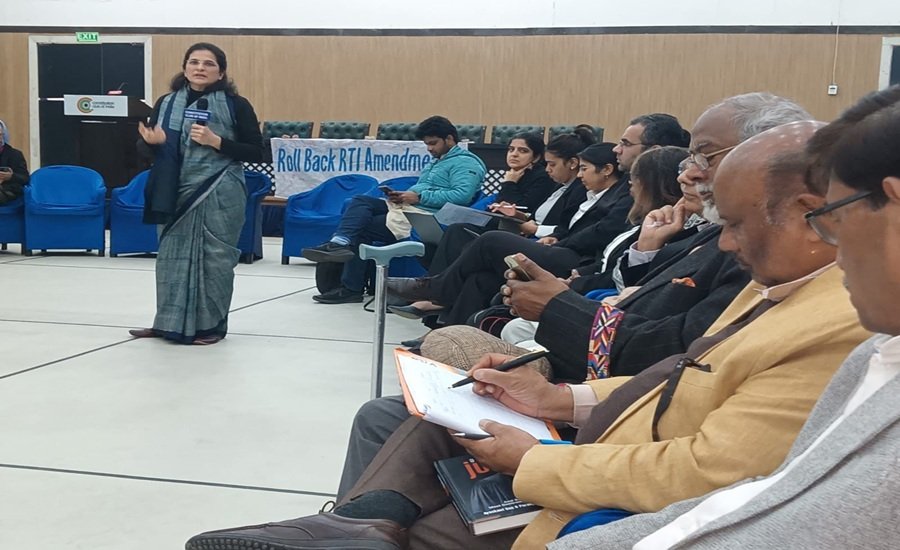
RTI activists Anjali Bhardwaj, Nikhil Dey, Dr Ghulam Shaikh and Amrita Johri presented detailed analysis showing how the DPDP Act significantly dilutes the RTI law. They highlighted an alarming possibility:
Under the new legal framework, activists, journalists, lawyers, political parties, researchers and NGOs collecting or analysing information could be designated as ‘data fiduciaries’— a categorisation that exposes them to heavy compliance burdens and crippling penalties.
Authoritarian Overreach
Participants expressed strong concern over the excessive centralisation of authority in the DPDP Act.
The law empowers the Central Government to constitute a Data Protection Board whose members are appointed and controlled by the government. With powers to impose penalties of up to ₹250 crore (and double that amount for certain violations), the Board could be weaponised against those seeking accountability, many participants warned.
Speakers stressed that the language of “privacy” and “data protection” was being used as a smokescreen to hollow out public rights. Several participants argued that privacy and transparency are not contradictory principles—and that the Act’s approach is “misguided and dangerous”.
Participants noted that India’s democratic ecosystem relies heavily on independent researchers, community organisations, whistleblowers and journalists who collect and disseminate information. The DPDP Act could expose them to harassment, litigation and financial risk.
“The chilling effect would be enormous,” one senior journalist said. Another added: “This will impact every single story that requires documentary evidence.”
Activists from movements working on food security, women’s rights, public health, labour rights and environmental justice explained that monitoring government implementation often depends on accessing information about officers responsible for inspections, approvals, allocations and expenditures—records that may now be denied.
Call for Public Action and Legal Challenge
There was strong consensus that the DPDP Act, in its current form, is “extremely problematic and incompatible with the constitutional vision of transparency and accountability.”
The coalition resolved to intensify its public awareness efforts and to challenge the DPDP Act’s provisions in court.


