

Over a thousand representatives from social organisations, educational trusts, welfare networks and community development institutions are in attendance at the two-day event in Lucknow
LUCKNOW – The National NGOs Conference 2025 opened at the Islamic Centre of India here on Saturday drawing more than a thousand representatives from social organisations, educational trusts, welfare networks and community development institutions across the country.
The two-day event, organised by the Association of Muslim Professionals (AMP) in collaboration with the Islamic Centre of India, aims to strengthen the NGO ecosystem and promote coordinated action in education, healthcare, livelihood support and skill development.
The inaugural session, anchored by AMP Uttar Pradesh head Shaheen Islam, began with a recitation of the Qur’an by Qari Qamruddin. Welcoming participants, AMP NGO Connect head Mobin Beg stressed the need for stronger linkages between organisations. In his introductory remarks, Farooq Siddiqui, head of AMP’s National Coordination Committee, underlined the importance of district-level networks, shared resources and structured collaboration. Welfare work, he said, “cannot remain fragmented” and requires institutional leadership and long-term planning for real impact.
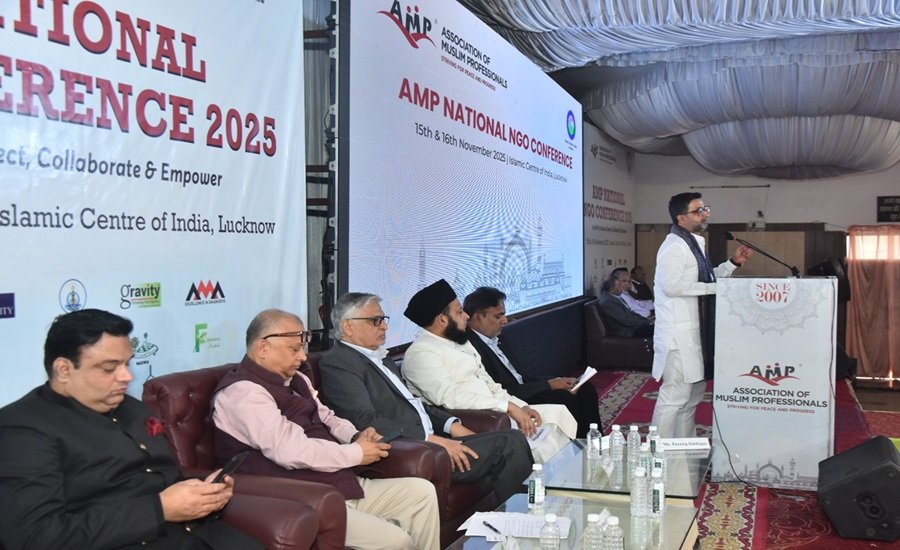
Uttar Pradesh Minister of State for Minority Affairs and Waqf, Danish Azad Ansari, called for greater cooperation between NGOs and government agencies. Highlighting the need for empowerment through skills, entrepreneurship and improved access to welfare schemes, he said community development must align with government initiatives. Responding to his remarks, AMP President Aamir Edresy reiterated the organisation’s commitment to community-led and self-sustained development models.
A major highlight of the day was an analytical presentation by Prof Amitabh Kundu of the Institute for Human Development, New Delhi. Using data to map the socio-economic and educational status of Indian Muslims, he stressed the removal of systemic barriers related to gender, caste and religion. Education and healthcare, he said, must remain central to any long-term national development vision, including the goal of a Viksit Bharat.
Dr Syed Zafar Mahmood, Chairman Zakat Foundation of India, stressed the need of increasing participation of Muslim in the governance from grassroots to the highest levels. A good Muslim presence in the governance system, he said, would be of immense benefit to the community.
The conference also spotlighted innovations in education and welfare delivery. Education Foundation General Secretary Suhail Azani shared examples of coordinated community-giving, including AMP’s Sadqa Box initiative that supported over 5,000 families last year.
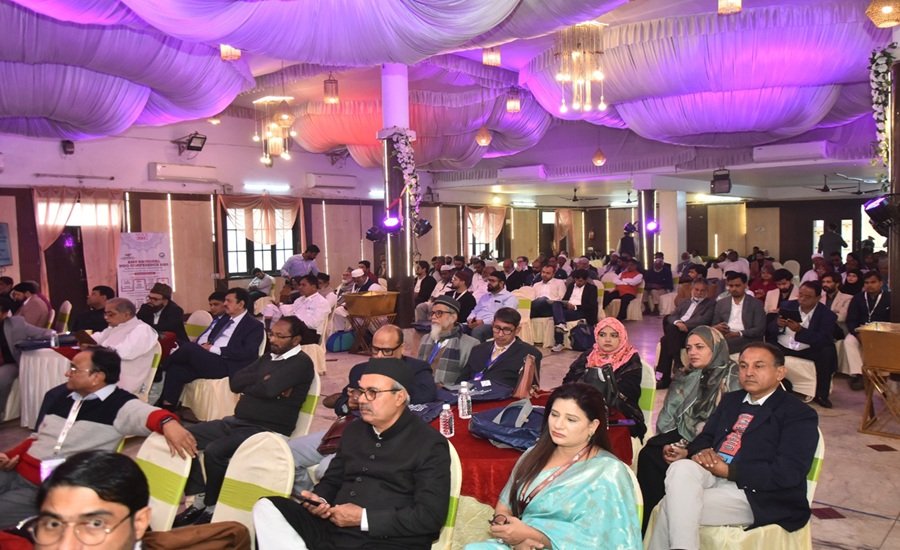
Abdul Ahad, Organising Secretary of the conference and AMP National Core Team member, highlighted the extremely low representation of Muslims in IITs, IIMs, AIIMS and NITs—currently less than one percent—and emphasised the need for robust academic preparation and leadership development.
Javed Mirza, Founder and President of the New Equitable and Innovative Education Association (NEIEA), presented a low-cost digital learning model offering more than 60 online courses with strong participation from female learners, madrasa students and out-of-school children. Rural educator Sajid Husain and Jamia Millia Islamia’s Prof Abdul Qaiyum Ansari added insights on improving teaching standards and proposed a South–North collaboration framework involving shared faculty resources, mentoring and student support networks.
Najmul Hasan Rizvi Najmi, prominent educationst, stressed the need to enhance educational quality while ensuring holistic development, including career counselling, self-employment pathways and preparation for government job opportunities. He urged NGOs and educators to adopt career-oriented guidance models matching youth aspirations with emerging economic trends.
Throughout the day, participants engaged actively in discussions on collaboration, transparency, teacher training, resource sharing and structured community financing. The proceedings concluded with an award and memento distribution ceremony honouring speakers, contributors and partner organisations.
Delegates expressed a shared commitment to strengthening NGO networks and preparing for the presentation of AMP’s 25-Year Roadmap for Educational and Economic Empowerment (2025–2050), which will guide further deliberations during the conference.


