

ONCE again, the Hindu nationalist, volunteer paramilitary organisation Rashtriya Swayamsevak Sangh (RSS), has tried to establish a foothold in the New Delhi-based premier educational institution Jamia Millia Islamia. And the students there rightly registered a strong protest against it.
The issue hogged the limelight in national media. The “Godi Media,” a pejorative term coined by famed journalist Ravish Kumar to describe the mainstream media outlets perceived as acting as a “lapdog” or PR arm for the ruling BJP government, tried to portray that Jamia was in the grip of fundamentalists who do not allow other ideas to flourish on the campus and beyond. However, anyone with the slightest interest in history knows that Jamia Millia Islamia holds the position of a bright and inspiring chapter in the history of India’s freedom struggle, secular democracy, and religious harmony.
The university, established in 1920 during the peak of the Non-Cooperation Movement, was a national revolt against the slave education system of British imperialism. Its founders created an educational institution that not only equipped Muslim youth with modern education but also made them a part of India’s shared nationality, secular values, and interfaith harmony. In contrast, the RSS, established in 1925, is an ideological and organisational structure that presents the idea of a Hindu rashtra based on Hindutva. This idea isolates minorities, especially Muslims, from the national mainstream and treats them as second-class citizens.
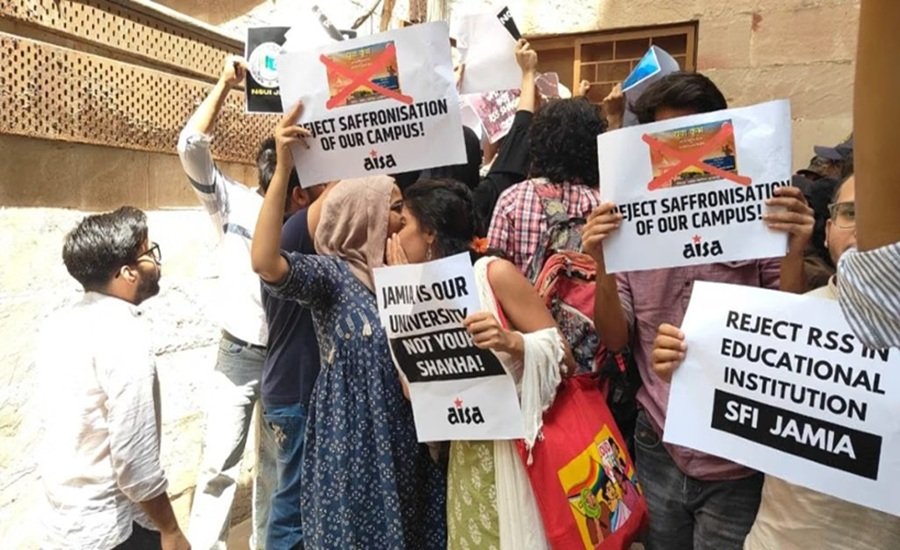
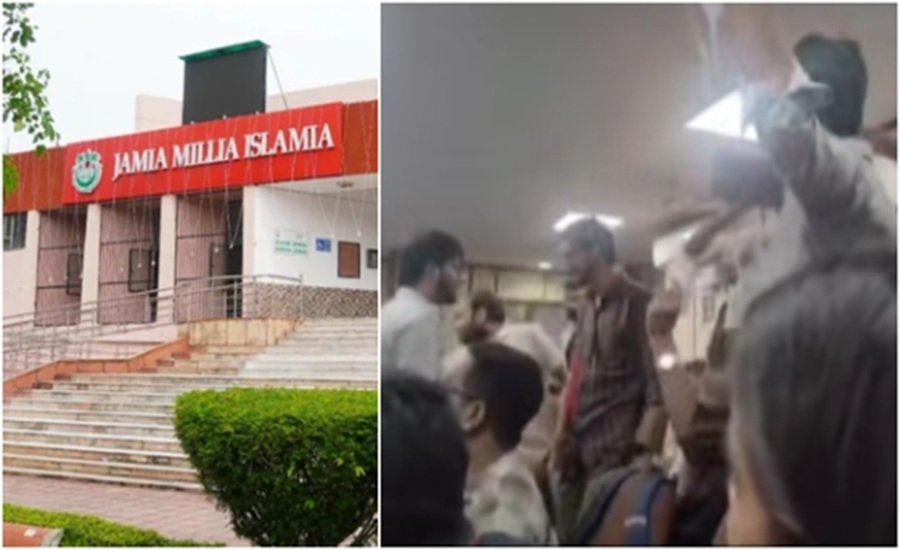
The powerful protest organised on Tuesday (28 April) by student organisations such as NSUI, AISA, and other progressive groups against the Yuva Kumbh programme held under RSS auspices in Jamia Millia Islamia was not merely a trivial, temporary incident. It reflects a deep clash between two opposing ideological worlds. The students correctly pointed out that instead of participating in the freedom struggle, the RSS chose the path of cooperation with the British, and today, by playing the false card of nationalism, it is trying to strengthen its communal power.
The foundation of RSS was laid in 1925 in Nagpur by Dr K B Hedgewar. At that time, major national campaigns such as the Non-Cooperation Movement, the Khilafat Movement, and the Civil Disobedience Movement were in full swing in India. Hedgewar was initially associated with the Congress, but after the formation of the RSS, the organisation did not participate in any major freedom movement. Historical documents and credible academic studies clearly show that from 1925 to 1947, the RSS remained inactive as an organisation in the freedom struggle. Instead of focusing on Hindu-Muslim unity, it concentrated only on the organisation and discipline of Hindu society.
The French researcher Christophe Jaffrelot, in his book The Hindu Nationalist Movement in India, describes the RSS as the central organisation of Hindu nationalism, which is based on majoritarian nationalism and is inclined to give subordinate status to minorities. In his latest book Modi’s India: Hindu Nationalism and the Rise of Ethnic Democracy, it is also made clear that this organisation represents a thought that leads towards ethnic nationalism.
Hedgewar’s successor, M S Golwalkar, in his book We; or, Our Nationhood Defined, presented a clear concept of Hindu rashtra and wrote: “In the Hindu nation, the foreign races must necessarily adopt Hindu culture and language, must necessarily learn to respect and obey Hindu religion. No other thought should come to their mind except the glory of the Hindu nation. Or else they must remain as obedient followers of the Hindu nation, making no demands. They should not even talk about any special treatment; they should have no rights or privileges whatsoever. There should be no other path for them except this. We are an ancient nation; let us deal with the foreign nations in the same way as ancient nations dealt with foreign nations.”
Otherwise, according to Golwalkar: “Our racial pride is the gift of our religion and our entire civilisation is the product of our religion… Germany shocked the world by purging the Semitic races — the Jews. This action is a manifestation of racial pride. Germany has also proven that the assimilation of different races and cultures and becoming one nation is impossible. This is a lesson for us to remember and benefit from.”
Historians like Jaffrelot consider this ideology to be close to European fascist thought, especially at a time when the ideas of racial superiority of Hitler and Mussolini were at their peak.
The historical allegation of cooperation with British rule against the RSS is also serious. After independence, in 1948, a ban was imposed on it in the context of Mahatma Gandhi’s assassination, which was later lifted. Its involvement or the role of its affiliated elements has also remained under discussion in events like the 1975 Emergency and the dastardly demolition of the Babri Masjid in Ayodhya in 1992.
Academic researchers like Jaffrelot describe the RSS as a representative of ethnic nationalism or majoritarian politics, which gives subordinate status to minorities. Its branches impart military exercises, discipline, and a specific ideological training, which are of a semi-military nature. Although the RSS calls itself a cultural organisation, its political arm, the Bharatiya Janata Party (BJP), and other organisations of the Sangh Parivar make it directly active in politics. It tries to bring Hindutva into the mainstream by gaining influence in education, media, and social organisations. However, its basic thinking is based on communal division, which continuously polarises society.
There is a world of difference between Jamia Millia Islamia and the RSS. The latter promotes the politics of communal division and violence. The role of elements affiliated with the Sangh Parivar has repeatedly come to the fore in the Babri Masjid demolition, the 2002 anti-Muslim pogrom in Gujarat, and many incidents of mob violence. Human rights organisations and researchers describe it as a politics that gives minorities the status of internal enemies to maintain majoritarian supremacy.
Such a philosophy can be given no other name except an attack on the secular spirit of the Indian Constitution. The Constitution includes secularism in its basic values, while the RSS weakens it by calling secularism Muslim appeasement. Golwalkar had described the secular state as a threat to national integrity. There is evidence of its early leadership being influenced by European fascism and Nazism. During the time of Hedgewar and Golwalkar, efforts were made to introduce the concepts of discipline and racial superiority of Mussolini and Hitler among Hindu youth. Although some researchers do not accept this comparison as complete, the semi-military structure of the RSS, its intolerance, and the element of majoritarian supremacy bring it close to fascist or totalitarian tendencies.
The RSS particularly influences education and youth. Through programmes like Yuva Kumbh, it enters universities claiming to be engaged in nation-building, but in reality, it promotes a narrow and specific Hindutva ideology. It tries to confine the youth to a uniform cultural mould instead of pluralism and diversity. This continuously harms social harmony. Through campaigns like Ghar Wapsi, Love Jihad, and Halal boycott, Muslims are isolated, an exercise that overall becomes an obstacle to social integration and national progress. Studies like the Sachar Committee Report, headed by Justice Rajindar Sachar, also show that such communal politics push minorities to the margins economically and socially, thereby affecting the progress of the entire country. According to the report, the literacy rate of Muslims is below the national average, the poverty rate is higher, access to bank credit is limited, and their share in government jobs is significantly lower than that of other communities. This is the result of long-term communal politics. Therefore, logically, the RSS is a cancer on society because it keeps the politics of division alive, distorts historical facts, weakens the secular foundations of the Constitution, and sows the seeds of hatred instead of diversity in the young generation, causing long-term damage to society.
In contrast, the foundation and tradition of Jamia Millia Islamia is an example of a bright and inclusive nationalism. Its foundation was laid on 29 October 1920 in Aligarh and it was later shifted to Delhi. It was a direct result of the Non-Cooperation Movement, when students and teachers of Aligarh Muslim University revolted against British slave education and established a national institution. Its founders were true warriors and nationalists of the freedom struggle. Maulana Mohammad Ali Jauhar, a great leader of the Khilafat Movement and also President of the Congress, played a pivotal role in making Jamia a centre of national education. Hakim Ajmal Khan, the famous physician and nationalist leader, was its first Chancellor. He connected Muslims with modern education and the national movement. Sheikh-ul-Hind Maulana Mahmud Hasan, a great scholar of Deoband, who endured the hardships of Malta Jail, laid the foundation. Dr Mukhtar Ahmad Ansari, Abdul Majeed Khwaja, and later Dr Zakir Hussain strengthened it further. Dr Zakir Hussain, who later became the President of India, was the soul of Jamia. Mahatma Gandhi and Maulana Abul Kalam Azad also fully supported it.
The vision of Jamia’s founders was very clear. They wanted to bring Muslim youth into the national mainstream without sacrificing their religious identity. Mohammad Ali Jauhar had said that the purpose of Jamia is that Muslims should not blindly follow the old paths, but should participate in the freedom struggle and build a democratic, secular India.
In Jamia’s education, along with nationalism, Islamic history and humanism were also given space. Its admission policy was open to men, women, Hindus, and Muslims alike. It was a Millia, meaning a national university, which belonged to all Indians.
Jamia played an important role in fine arts, journalism, social sciences, and progressive education. Its tradition has been one of pluralism, interfaith harmony, and the protection of freedom. The students’ history of protest, whether against the Citizenship Amendment Act (CAA) and the National Register of Citizens (NRC) or on other democratic issues, is a continuation of this same tradition. Jamia promoted Hindu-Muslim unity and made education a means of freedom, humanism, and national integration. Its founders proved that there is no contradiction between religious identity and national loyalty if it is based on secular values.
Maulana Mohammad Ali Jauhar, in his world-famous speech at the Round Table Conference on 19 November 1930, made this comprehensive statement regarding Indian Muslims’ relationship with their country and the Muslim World:
“My affiliation is with two circles of equal size which are not concentric. One circle is Hindustan and the other is the Muslim World. When I came to England in 1920 as the leader of the Khilafat delegation, my friends said to me: ‘You should get some symbol printed on your stationery.’ I chose two circles for this. In one circle was written ‘Hindustan’ and in the other the word ‘Khilafat’ for Islam. As Indian Muslims, we belong to both these circles. We are connected to both these circles […] We cannot leave either of them. We are not nationalists; we are very much nationalists. And as a Muslim, I say: ‘God made man and the devil made him into a nation.’ Nationalism divides people and our religion unites them. No religious or crusading war has seen such a holocaust as happened in your last war, and that war was a war of your nationalism, not of my jihad.”
The contradiction between the thought of Jamia Millia Islamia and the Rashtriya Swayamsevak Sangh is fundamental and irreconcilable. The biggest contradiction is in the concept of nationalism. Jamia believes in inclusive nationalism, where people of all religions participate in nation-building with equal rights. The RSS presents the idea of a Hindu rashtra, where non-Hindus are external or foreign elements who must either assimilate into Hindu culture or accept subordinate status. The definitions of Savarkar and Golwalkar are directly opposed to the secular nationalism of Jamia’s founders.
There is also a clear contradiction in their role in the freedom struggle. Jamia is a product of that struggle, whereas the RSS as an organisation did not take any active part in it and instead considered Hindu-Muslim unity to be weak. The contradiction between secularism and Hindutva is also prominent. Jamia teaches pluralism and harmony, while the RSS promotes majoritarian supremacy by calling secularism appeasement. There is also a difference in the purpose of education. Jamia makes education a tool for freedom and humanism, while the RSS turns it into a means of ideological training. The contradiction in the status of minorities is also clear. Jamia brings Muslims into the national mainstream, while the RSS labels them as a threat or second-class citizens.
The Yuva Kumbh programme this week is a living example of this very contradiction. The students’ criticism of the Jamia administration is justified that when progressive programmes are blocked, how is space being given to the RSS? The students’ protest is the protection of Jamia’s foundation and the safeguarding of its secular heritage.
There is no doubt that the communal politics of the RSS is a serious threat to India’s social harmony and democratic values. It continuously divides society and becomes an obstacle in the path of progress. The founders of Jamia Millia Islamia have left behind a great legacy in the form of this magnificent institution, which is a symbol of unity in diversity, secularism, and national humanism. As a former student, I take pride in Jamia’s great tradition. Opposition to programmes like Yuva Kumbh is not extremism but the protection of national, secular, and democratic values. To take India forward, it is necessary to reject the divisive RSS politics and allow institutions like Jamia to remain true to their foundation. Only in this way can the building of a truly inclusive and developed India become possible.
__________________
Mohammad Alamullah is a UK-based academic, author, and journalist, holding two Master’s degrees from Swansea University, UK, and Jamia Millia Islamia. He has authored three books: A Brief History of Muslim Majlis Mushawarat, Few Days in Iran, and Media: Paper to Screen — Scenarios, Problems and Possibilities. The views expressed are solely his own.


