

Judicial time cannot be wasted on unfounded allegations targeting religious communities, the court tells Save India Foundation
NEW DELHI – In a stern ruling, the Delhi High Court on Wednesday reprimanded an NGO, Save India Foundation, for repeatedly filing public interest litigations (PILs) against mosques and dargahs without any credible legal basis. The bench emphasised that PILs cannot be used as a tool to paralyse the judicial system or target religious sites.
The court noted that several petitions submitted by the NGO lacked strong legal grounding and concrete evidence. “Such applications are a waste of judicial time and resources and undermine the true purpose of PILs,” the bench observed during the hearing.
Highlighting the proper scope of PILs, the court said, “The ambit of public interest litigation should be limited to serious and genuine matters affecting the public, not used for general or unproven allegations against religious institutions. Our courts cannot be a forum to target any particular community or religious organisation.”
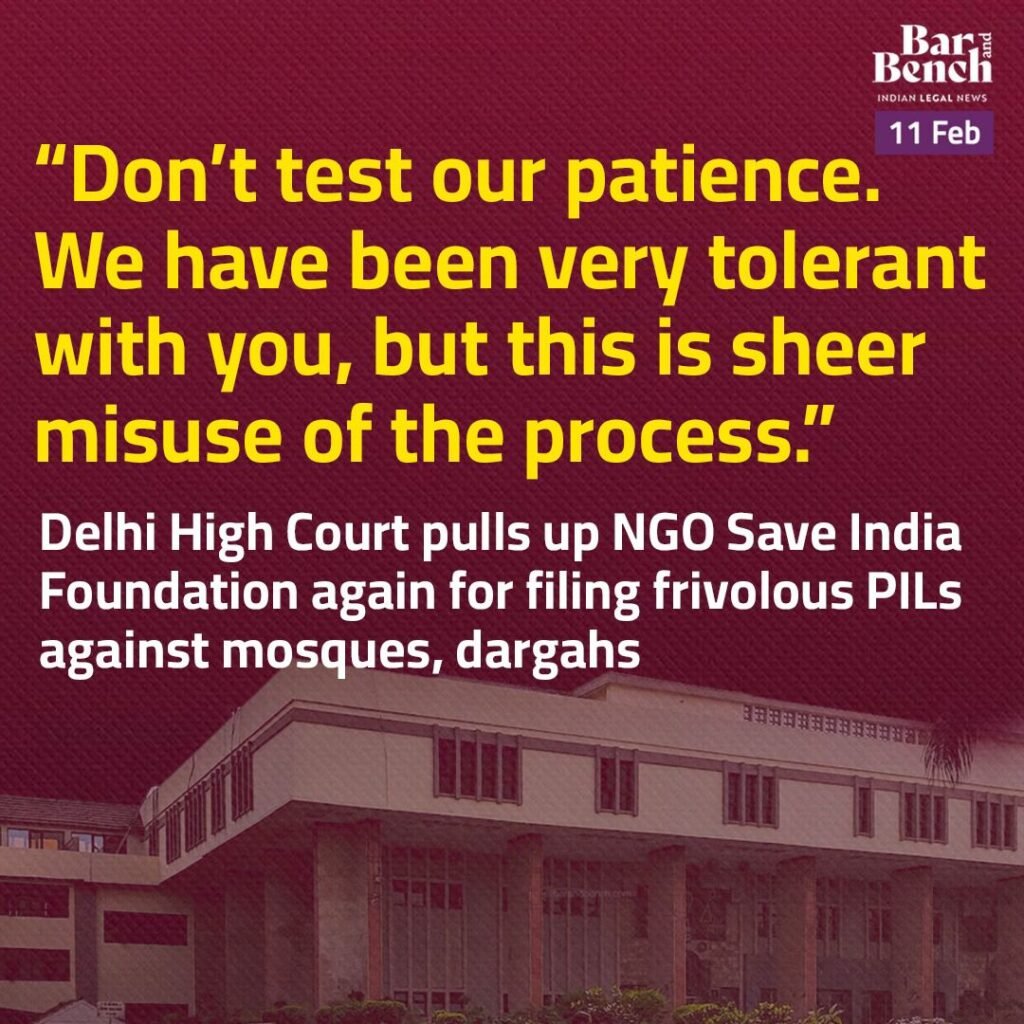
The judges further warned that if such baseless petitions continue to be filed in the future, the court may take strict action, including imposing fines. The NGO was instructed to seriously understand the legal responsibilities and limitations of filing PILs.
Legal experts noted that this ruling aligns with a broader judicial trend in India, where courts are cracking down on “frivolous and baseless” PILs to prevent misuse of the legal system and protect minority religious institutions from unwarranted harassment. They emphasised, “PILs cannot be employed for political, ideological, or sectarian purposes under the guise of public interest.”
The Delhi High Court had previously cautioned the same NGO against filing PILs without reasonable legal grounds. In the latest hearing, the bench reiterated that PILs are an extraordinary legal remedy and should not be used for personal or non-serious objectives.
The matter has drawn attention from various sections of society, particularly minority communities, as it underscores the importance of protecting places of worship from frivolous legal harassment. The court’s directions serve as a reminder that respect for religious institutions and communities remains a priority within the judicial process.
Further developments, including the next hearing and potential judicial instructions, are awaited.


