

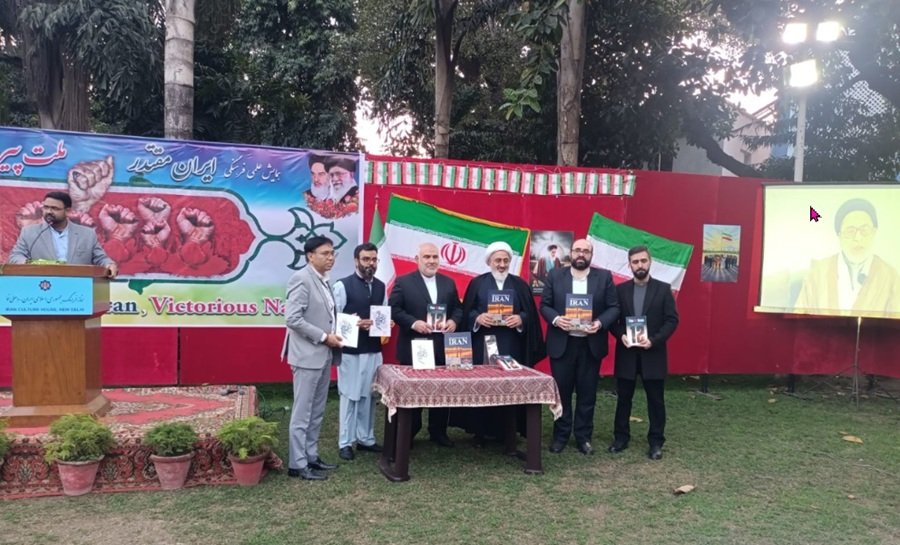
NEW DELHI — Demonstrating resilience and strength, the Iran Cultural House marked the 47th anniversary of the Islamic Revolution with a grand celebration here on Thursday evening, during which Iranian envoy to India Mohammad Fathali asserted that Iran remains steadfast despite numerous challenges.
The Islamic Republic of Iran Culture House also mounted a photo and poster exhibition highlighting the country’s progress in science, education, healthcare and social development since the 1979 revolution. The event was attended by diplomats, political leaders, scholars, academics and members of civil society.
Delivering the keynote address, Iran’s Ambassador to India Mohammad Fathali described the Islamic Revolution as a decisive turning point rooted in independence, freedom and the collective will of the people. He said the revolution carried a universal message of self-determination and resistance against domination. Referring to decades of sanctions and external pressure, the Ambassador noted that Iran’s emphasis on self-reliance and internal capacity had driven sustained development across key sectors.
He outlined Iran’s achievements in advanced fields such as nanotechnology, information technology, artificial intelligence and space research. Highlighting self-sufficiency in healthcare, he said Iran now produces advanced cancer medicines and vaccines domestically. He also pointed to successful satellite launches achieved through indigenous expertise as milestones in the country’s scientific progress.
On education, Ambassador Fathali said the post-revolution period witnessed a dramatic expansion in student enrolment and academic institutions. He emphasised the growing role of women as doctors, engineers, scientists and university faculty, describing it as a significant social advancement.
Dr Faridoddin Faridasr, Counsellor at the Iran Culture House, said the conference and exhibition were designed to present Iran’s revolutionary principles and post-revolution achievements through academic engagement and visual documentation. He added that women’s empowerment and national development formed the central themes of the exhibition. Referring to external threats, he said Iran would respond firmly to any aggression and that the Iranian people would defeat what he described as conspiracies by hostile forces.
On the occasion, National Conference MP from Srinagar Aga Syed Ruhullah Mehdi congratulated Iran on the anniversary and said the two countries share common values related to sovereignty, justice and resistance to external domination. Drawing parallels between Iran’s post-revolution experience and India’s journey after Independence, he expressed optimism about stronger bilateral relations and emphasised leadership grounded in faith, resilience, reform and dignity.
Ladakh MP Mohammad Haneefa Jan described the Islamic Revolution as a catalyst for awareness and hope, noting progress in public participation, education, scientific research and social consciousness. Stressing the importance of youth, ethical values and knowledge, he recalled the deep-rooted cultural and economic ties between India and Iran and called for unity and tolerance.
Former Ladakh MLA Asghar Karbalai said that despite threats and pressure from the United States and Israel, Iranian leadership had stood firm — a stance he said other nations could learn from. He added that successive US administrations, beginning with President Jimmy Carter, had opposed the Islamic Revolution as it marked a decline in American influence in the region.
Dr Tasleem Ahmad Rahmani and other prominent religious leaders also addressed the gathering, hailing Iran’s all-round progress and development. They underlined the positive impact of the Islamic Revolution on Sunni-Shia relations.
The programme concluded with the release of publications and discussions on shared values, future cooperation and the continuing relevance of the Islamic Revolution in the contemporary world.


