

Scholars from India, Iran, Indonesia, Kuwait, Sweden, and several European countries are participating in the international conference on ‘Qur’an and Science’
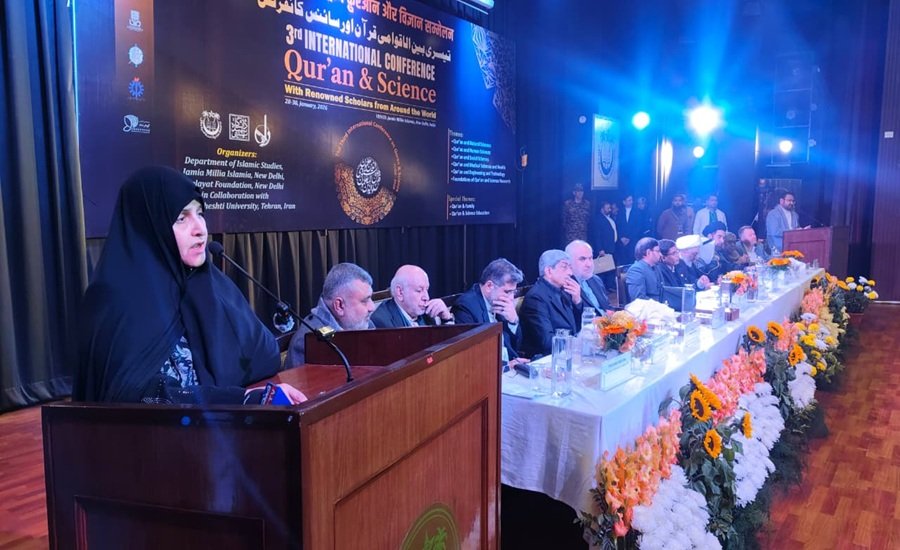
NEW DELHI – At a moment of deep global contestation over faith, ethics, and knowledge, Prof Jamileh Almolhoda, distinguished Iranian scholar and wife of former Iranian President Ebrahim Raisi (Shaheed), on Wednesday said ignorance—not knowledge—lies at the root of misconceptions about the Holy Qur’an. She called for a robust scholarly response and a decisive scholarly push to counter misconceptions surrounding the Holy Qur’an.
Addressing the inaugural session of a three-day international conference on “Qur’an and Science” at Jamia Millia Islamia (JMI), Prof Almolhoda said acts such as the desecration of the Qur’an in different parts of the world stem not from freedom of expression but from ignorance and lack of understanding.
Prof Almolhoda expressed deep concern over the steady erosion of family values, the marginalisation of ethical education, and the neglect of younger generations in many societies. Warning against the uncritical dominance of Western ideological frameworks, she argued that Qur’anic knowledge offers moral clarity and intellectual tools to confront contemporary civilisational crisis. “The Qur’an does not merely address individual spirituality; it provides a comprehensive worldview that nurtures families, societies, and ethical public life,” she said, stressing that young people must strengthen their relationship with the Qur’an to ensure intellectual security and meaningful success in life.
In his address, Dr Mohammad Fath Ali, Ambassador of Iran to India, said the relationship between the Qur’an and science has been a subject of scholarly debate for centuries. He noted that the Qur’an repeatedly encourages reflection, contemplation, dialogue, and ethical reasoning—principles that remain essential in today’s world. “The Qur’an promotes knowledge, debate, and moral responsibility, reminding humanity that scientific progress without ethics can lead to imbalance and injustice,” he said.
Echoing the centrality of Qur’anic guidance in human life, Vice-Chancellor of Jamia Millia Islamia Prof Mazhar Asif said the real measure of human success lies not in material advancement or technological progress, but in understanding, reflecting upon, and living by divine guidance. “The tragedy of our times,” Prof Asif observed, “is that a scripture which once transformed nations, shaped moral character, and safeguarded societies from wrongdoing has today been reduced to a ritual—recited mainly for the dead.”
Calling for the restoration of the Qur’an to the centre of individual and collective existence, Prof Asif urged believers to read it with understanding, internalise its message, and translate its teachings into personal conduct and social responsibility. “We read the Qur’an, but often do not understand it; and even when we understand it, we fail to follow it,” he remarked. Emphasising that the essence of religion lies in ethical behaviour, he said faith must ensure that one’s words, actions, and decisions do not cause harm to others. Values such as mercy, compassion, justice, and responsibility, he added, must find expression in everyday life.
Chief guest Prof Mohammad Mehtab Alam Rizvi, Registrar of Jamia Millia Islamia, highlighted the Qur’an’s engagement with scientific realities, pointing to verses referring to the creation of water, the expansion of the universe, the origin of human beings from clay, the orderly system governing the heavens, and the barrier between the two oceans that prevents their waters from mixing. “These signs testify that the Qur’an is not only a book of spiritual guidance but also draws attention to the scientific principles governing the universe,” he said, adding that such references invite humanity to observe nature with humility and curiosity.
Delivering the keynote address, Dr Aslam Parvez, former Vice-Chancellor of Maulana Azad National Urdu University (MANUU), Hyderabad, challenged the widespread perception that religion is limited to rituals and symbolism. Quoting Qur’anic injunctions on the use of reason and intellect, he said love and faith are demonstrated through action rather than verbal claims. “The Qur’an strongly urges the use of intellect and senses. It clearly states that those who abandon reason are no better than animals,” he said. He also stressed the Qur’anic instruction to spend surplus wealth in the path of goodness so that social balance and human dignity are preserved.
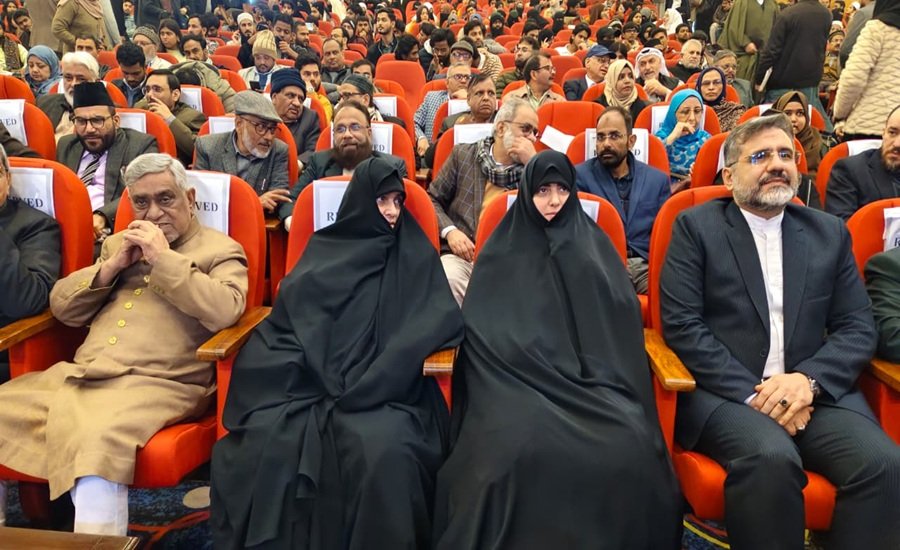
Conference Director Prof Iqtidar Mohammad Khan, Head of the Department of Islamic Studies at Jamia, said the Qur’an calls upon human beings to observe the signs scattered across the universe with insight and sound intellect. In an era dominated by rapid technological advancement, he emphasised the need for meaningful engagement between revelation and rational inquiry. “Such engagement is essential for improving both intellectual understanding and practical life,” he noted.
Prof Akhtar-ul-Wasey, attending as guest of honour, said the Qur’an and science ultimately guide humanity towards the same source of truth—Almighty God. “There is no contradiction between the Qur’an and modern science,” he said, adding that while the Qur’an provides ethical and philosophical principles, science helps in understanding and explaining the natural world. He congratulated Jamia Millia Islamia for hosting the conference at a critical geopolitical moment marked by conflict, polarisation, and moral uncertainty.
Addressing a key contemporary question, Syed Kalbe Jawad Naqvi asked why a book revealed more than 1,400 years ago should continue to be read today. He argued that several Qur’anic insights align with scientific discoveries that were established centuries later. Cautioning against treating science as infallible, he pointed out that scientific theories evolve and are often revised. “Science should not be made subservient to the Qur’an, but science itself should be understood in the light of Qur’anic guidance,” he said.
Adding an international perspective, Engineer Mustafa Abbas of Kuwait posed thought-provoking questions to the audience: “Do we need the Qur’an in this age of technology? Do we obey Qur’anic principles with the same seriousness as we obey traffic rules?” He stressed that the Qur’an urges continuous reflection so that the mysteries of the universe can be understood on sound intellectual and ethical foundations.
Other speakers, including Prof Abdul Majid Hakim Elahi, Representative of the Supreme Leader of Iran, and Jamila Sadat Alam-ul-Huda, highlighted that the complex scientific and social challenges of the modern world underline the Qur’an’s purpose of awakening human consciousness and bringing humanity closer to the wisdom embedded in creation. They emphasised that young people, in particular, must reconnect with the Qur’an to navigate modern life with confidence and moral clarity.
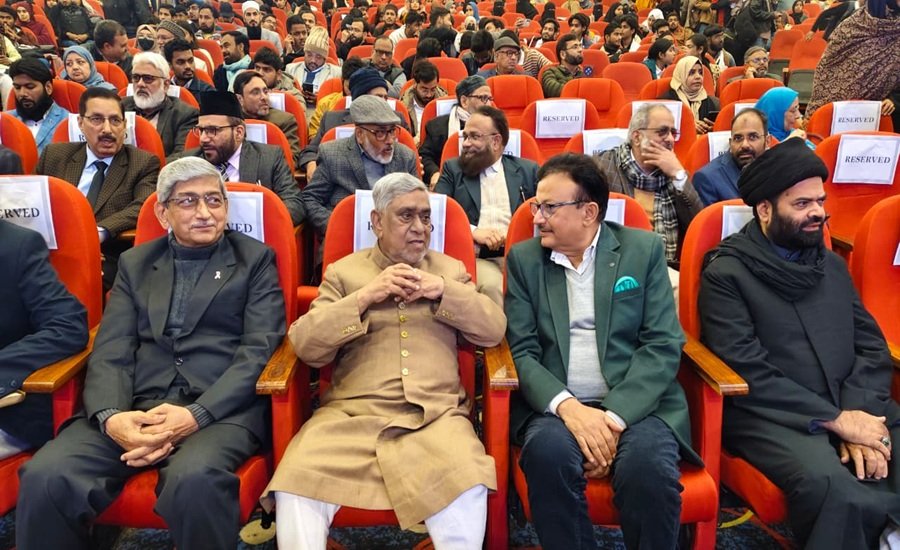
The programme began with the recitation of the Holy Qur’an by Dr Mohammad Munawwar Kamal. The proceedings were conducted by Junaid Haris, Associate Professor, and Dr Mehdi Baqar, while Dr Mohammad Mushtaq, Associate Professor, proposed the vote of thanks. Distinguished guests were felicitated with shawls, mementoes, and bouquets, and a scholarly book was released as part of the inaugural ceremony.
The international conference is jointly organised by the Department of Islamic Studies, Jamia Millia Islamia, Welayat (Wilayat) Foundation, New Delhi, and Shahid Beheshti University, Tehran (Iran). Scholars from India, Iran, Indonesia, Kuwait, Sweden, and several European countries are participating, reflecting the global scope of contemporary academic engagement with Qur’anic thought and its relationship with modern science.
The conference will continue with technical sessions and panel discussions on Thursday and Friday at the Faculty of Humanities and Languages, Jamia Millia Islamia, where scholars will present research papers and engage in discussions across multiple thematic areas.


