

Under India’s controversial anti-terror law, UAPA, a suspect can spend years in jail without trial if the accusations against them seem true. Meanwhile Indian courts are also expanding the definition of terrorism.
NEW DELHI — Thousands of prisoners in India are trapped in a legal limbo under the Unlawful Activities Prevention Act, commonly known as UAPA, with recent Supreme Court decisions fueling the debate on India’s definition of terrorism and its use of security laws.
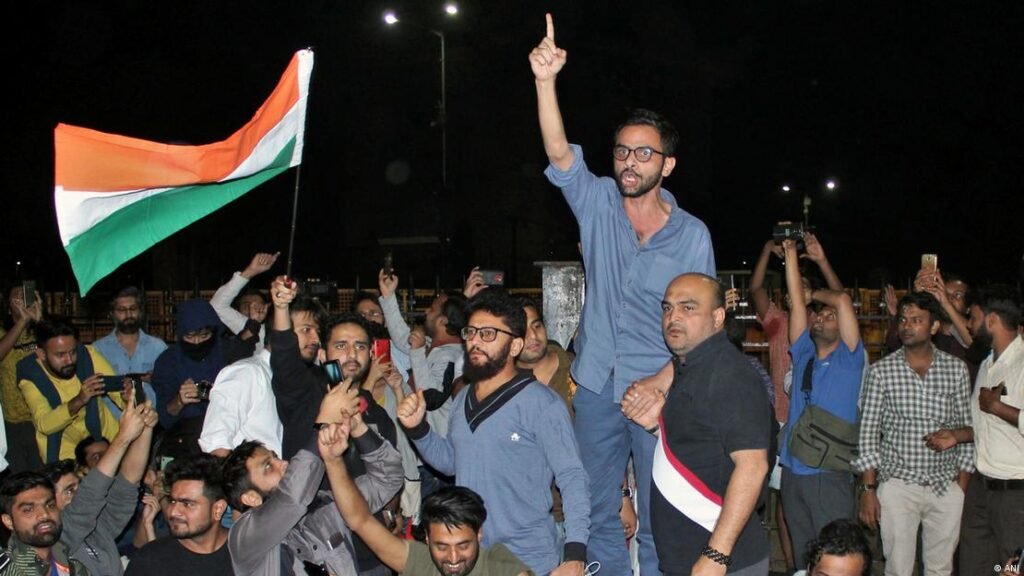
This month, the Supreme Court denied bail to Umar Khalid and Sharjeel Imam, two activists accused in the 2020 Delhi riots case, while granting bail to five others charged in the same conspiracy.
The two face accusations of inciting clashes in New Delhi that killed 53 people, most of them Muslims. They have now spent more than five years in prison without trial.
“Of the 18 accused in the 2020 riots cases, 16 are Muslims; while ruling Bharatiya Janata Party leaders whose hate speeches preceded the violence, faced no charges. Neither Khalid nor Imam were even present in Delhi during the violence,” Brinda Karat, senior Communist Party of India leader, told DW.
Karat pointed out that Imam was already in custody and Khalid was elsewhere, but their absence was “perversely interpreted” as evidence of orchestration.
“The court has dangerously expanded terrorism’s definition — allowing peaceful road blockades to be classified as terrorist acts, thereby enabling the government to target strikers, indigenous protesters and slum dwellers,” said Karat.
UAPA reverses presumption of innocence
Official data shows 10,440 people were arrested under UAPA between 2019 and 2023, but only 335 were convicted — a 3.2% conviction rate. Most remain in jail, with the long, drawn-out legal process becoming an additional punishment.
India has cycled through successive anti-terror laws before UAPA, including the Prevention of Terrorism Act (POTA) from 2002-2004. When POTA was repealed due to widespread misuse, authorities transformed UAPA into the primary anti-terror statute and subsequently strengthened it with amendments in 2008 and 2019.
What makes UAPA particularly harsh is a provision that essentially reverses the fundamental legal principle of “innocent until proven guilty.” Under the law, bail can be denied if a court finds that accusations appear true at first glance.
“Effectively, an accused must dispel the case set up by the prosecution at the stage of getting bail,” Madan Lokur, a retired Supreme Court judge who has consistently criticized UAPA for stifling dissent, told DW.
Lokur warned the process of getting justice under some Indian laws is torturous, pointing also to the Prevention of Money Laundering Act (PMLA), which is often used in combination with UAPA.
“Under UAPA and PMLA the burden of proof is reversed for getting bail,” Lokur told DW. “The principle now being followed in UAPA and PMLA cases is prima facie [Latin for “at first glance”] guilty until proven innocent,” he added.
No coming back from UAPA terror label?
Aakar Patel, activist and former head of Amnesty International in India, told DW that UN human rights bodies have consistently raised concerns about UAPA’s vague provisions and its use to criminalize legitimate human rights work in India.
“This selective prosecution erodes public trust in the justice system, entrenches impunity for state actors, and criminalizes free expression,” added Patel.
Once the state labels you a terrorist, it becomes impossible to reclaim your life and rights, says lawyer Rebecca John, who has taken part in several UAPA cases.
“That label remains with you and no institutional protection is offered to a citizen contesting that claim,” John told DW.
She warns that the law is weaponized against vulnerable people while the powerful can violate its provisions with little consequence.
“Courts, who today act more as ‘executive courts’ rather than constitutional courts, never test the allegations put forward by the state — they are accepted as gospel truth, thereby further empowering the police to fabricate and brazenly lie without any checks or scrutiny,” she added.
Laws wielded as weapons against critics
UAPA is just one of the weapons in the state’s expanding arsenal that critics say is used to silence dissent.
The National Security Act (NSA) allows detention for up to 12 months without charges or trial. In Kashmir, the Public Safety Act (PSA) permits detention for up to two years without trial on grounds as vague as being a “hardcore activist.”
The law was used against three former chief ministers in 2019, and journalist Sajad Gul spent 20 months detained under it. Following the April 2025 Pahalgam terror attack, nearly 100 people were charged under the PSA.
Climate activist Sonam Wangchuk also remains detained under the NSA after his arrest in September last year during protests in Ladakh, in the east of the larger Kashmiri region. The protest focused on demands for constitutional safeguards and statehood.
“Wangchuk had challenged his detention under the draconian law. He still finds himself in the same position as on the date of the challenge. What is the point of the challenge if quick and effective relief is not given by courts?” asked John.
Money laundering laws used against media, activists
Critics also warn that the Prevention of Money Laundering Act (PMLA) is being increasingly deployed against opposition politicians, journalists and activists.
Harsh Mander, a prominent human rights activist, faced PMLA-related raids in 2021 and probes linked to foreign funding of his NGO work, while NewsClick journalists saw their offices raided under the same law in 2023.
Journalist Siddique Kappan was arrested in October 2020 while traveling to report on an incident and was then charged under both UAPA and PMLA, spending 28 months in jail before receiving bail.
‘The balance between security and liberty has been lost’
An activist might face UAPA charges for alleged terrorism, NSA detention for threatening public order, and PMLA investigations for money laundering — all stemming from the same peaceful protest or critical report.
A BJP functionary, when asked about concerns over the application of these security laws, declined to comment, saying the matter was before the courts and “the law of the land would take its course.”
“That’s how our judicial system works,” he said.
But Kapil Sibal, a senior advocate who represented Muslim activist Umar Khalid and journalist Siddique Kappan, has a different view.
“The question is not whether India needs security laws. It is whether laws designed to protect the nation should be allowed to hollow out the very freedoms they purport to defend,” he told DW.
“The balance between security and liberty has been lost,” said Sibal


