

At the ADR Webinar, constitutional experts warned that the bill could undermine parliamentary democracy while failing to address the root causes of criminalisation in politics
NEW DELHI — With nearly half of India’s sitting Members of Parliament facing criminal cases, a proposed constitutional amendment Bill aimed at curbing the criminalisation of politics has sparked intense debate over constitutional limits, federalism, and potential misuse of state power.
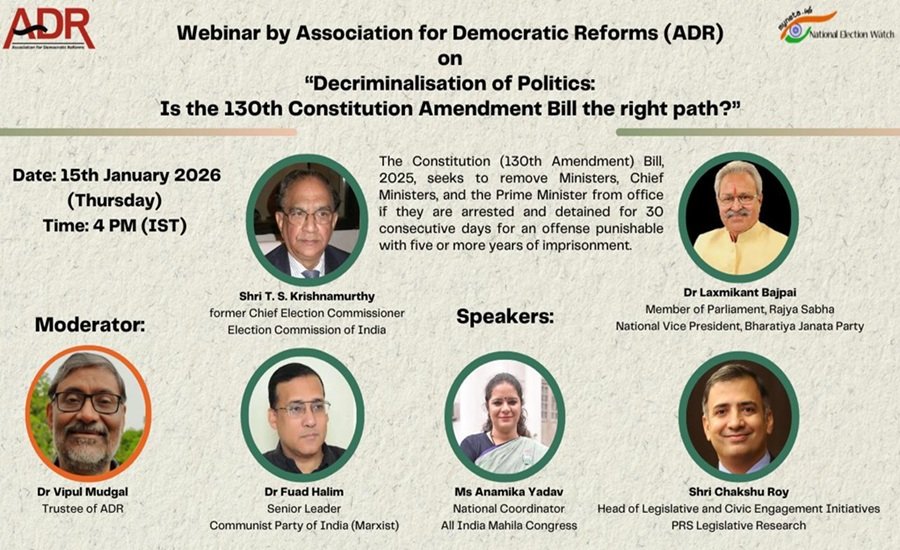
The Association for Democratic Reforms (ADR) organised a webinar titled “Is the 130th Constitutional Amendment the Right Path?”, where political leaders and constitutional experts warned that the bill could undermine parliamentary democracy while failing to address the root causes of criminalisation in politics.
Moderated by ADR Trustee Dr Vipul Mudgal, the discussion drew on stark data from ADR’s analysis of affidavits filed during the 2024 general elections. According to the findings, 46 per cent of MPs face criminal cases, while 31 per cent are accused of serious offences such as murder, rape, kidnapping, and armed robbery—marking a 55 per cent increase since 2009. Dr Mudgal cautioned that if the trend continues, every MP could have a criminal case by 2038. “This is a serious disease,” he said, adding that any remedy must not destroy democratic institutions in the process.
The proposed bill—reportedly allowing the removal or disqualification of ministers upon arrest or extended detention—raises fundamental constitutional questions. Participants questioned whether investigative agencies can act independently against sitting chief ministers or a prime minister, whether ministers are being held to different standards than MPs and MLAs, and whether such disqualifications fall within the judiciary’s domain or Parliament’s exclusive authority.
Chakshu Roy of PRS Legislative Research flagged four major concerns: erosion of the legislature’s power to remove a prime minister or chief minister through a no-confidence motion; threats to federalism if central or state agencies arrest elected executives; dilution of the presumption of innocence; and restrictions on the freedom of prime ministers and chief ministers to choose their councils of ministers.
Defending the intent of the bill, BJP Rajya Sabha MP Dr Laxmikant Bajpai argued that criminalisation corrodes democracy and erodes public trust. “When lawbreakers become lawmakers, justice itself is compromised,” he said, conceding that while the bill may be imperfect, inaction is no longer an option.
Opposition speakers, however, strongly disagreed. Anamika Yadav of the All India Mahila Congress accused the government of using the bill to weaken political opponents rather than cleanse electoral politics. She cited instances of candidates with serious criminal allegations being given party tickets and alleged systematic misuse of agencies such as the Enforcement Directorate and the CBI against opposition leaders.
CPI(M) senior leader Dr Fuad Halim warned that granting sweeping powers to the executive over elected representatives would further dilute democracy and violate the principle of separation of powers. He argued that the bill risks bypassing due process and could be deployed selectively, pointing to what he described as the disproportionate targeting of opposition figures in recent years.
Former Chief Election Commissioner T.S. Krishnamurthy struck a more nuanced note, describing the goal of keeping criminal elements out of governance as “laudable” but criticising the bill as a piecemeal solution. He called for comprehensive electoral reforms and suggested a stronger role for Parliament’s Ethics Committee in evaluating whether public representatives facing criminal charges should continue in office.
The webinar concluded with broad agreement that criminalisation of politics poses a grave threat to democracy, but also deep unease over whether the proposed amendment addresses the problem without eroding constitutional safeguards. Dr Mudgal warned against a drift towards “rule by law instead of rule of law,” citing concerns over extended detention provisions under the Bharatiya Nyaya Sanhita and the bill’s selective application to ministers but not legislators. With the bill now referred to a Joint Parliamentary Committee, the central question remains unresolved: how to clean up politics without weakening the foundations of India’s parliamentary democracy.


